


Association of Growth Substrates and Bacterial Genera with Benzo[ a]pyrene Mineralization in Contaminated Soil
- PMID: 25469077
- PMCID: PMC4245834
- DOI: 10.1089/ees.2014.0275
Association of Growth Substrates and Bacterial Genera with Benzo[ a]pyrene Mineralization in Contaminated Soil
Abstract
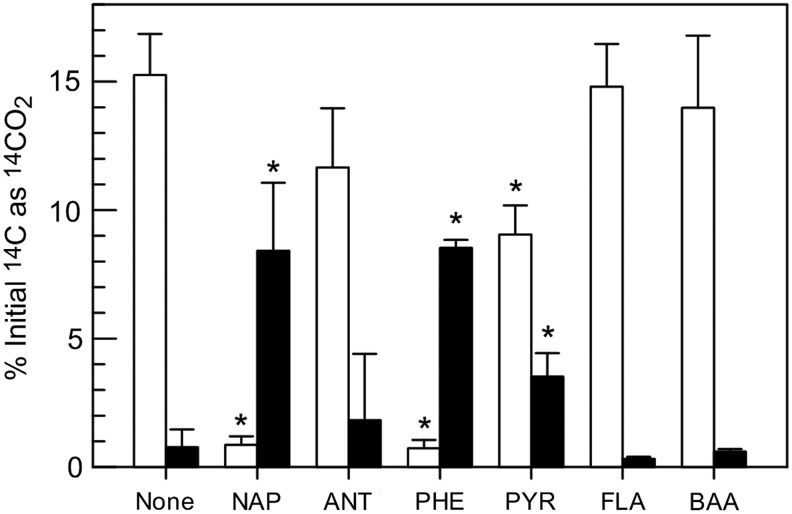
Benzo[a]pyrene (BaP) is a carcinogenic polycyclic aromatic hydrocarbon (PAH) that is not known to be a bacterial growth substrate. Organisms capable of cometabolizing BaP in complex field-contaminated systems have not previously been identified. We evaluated BaP mineralization by a bacterial community from a bioreactor treating PAH-contaminated soil during coincubation with or after pre-enrichment on various PAHs as growth substrates. Pyrosequence libraries of 16S rRNA genes were used to identify bacteria that were enriched on the added growth substrate as a means of associating specific organisms with BaP mineralization. Coincubating the bioreactor-treated soil with naphthalene, phenanthrene, or pyrene inhibited BaP mineralization, whereas pre-enriching the soil on the same three PAHs enhanced BaP mineralization. Combined, these results suggest that bacteria in the bioreactor community that are capable of growing on naphthalene, phenanthrene, and/or pyrene can metabolize BaP, with coincubation competitively inhibiting BaP metabolism. Anthracene, fluoranthene, and benz[a]anthracene had little effect on BaP mineralization compared to incubations without an added growth substrate under either coincubation or pre-enrichment conditions. Substantial increases in relative abundance after pre-enrichment with phenanthrene, naphthalene, or pyrene, but not the other PAHs, suggest that members of the genera Cupriavidus and Luteimonas may have been associated with BaP mineralization.
Keywords: PAHs; benzo[a]pyrene; bioremediation; cometabolism; pyrosequencing; soil.
Figures


References
-
- Aitken M.D., Stringfellow W.T., Nagel R.D., Kazunga C., and Chen S.H. (1998). Characteristics of phenanthrene-degrading bacteria isolated from soils contaminated with polycyclic aromatic hydrocarbons. Can. J. Microbiol. 44, 743. - PubMed
-
- Chen S.H., and Aitken M.D. (1999). Salicylate stimulates the degradation of high-molecular weight polycyclic aromatic hydrocarbons by Pseudomonas saccharophila P15. Environ. Sci. Technol. 33, 435
Grants and funding
LinkOut - more resources
Full Text Sources
Other Literature Sources