


NIH working group report: Innovative research to improve maintenance of weight loss
- PMID: 25469998
- PMCID: PMC5841916
- DOI: 10.1002/oby.20967
NIH working group report: Innovative research to improve maintenance of weight loss
Abstract
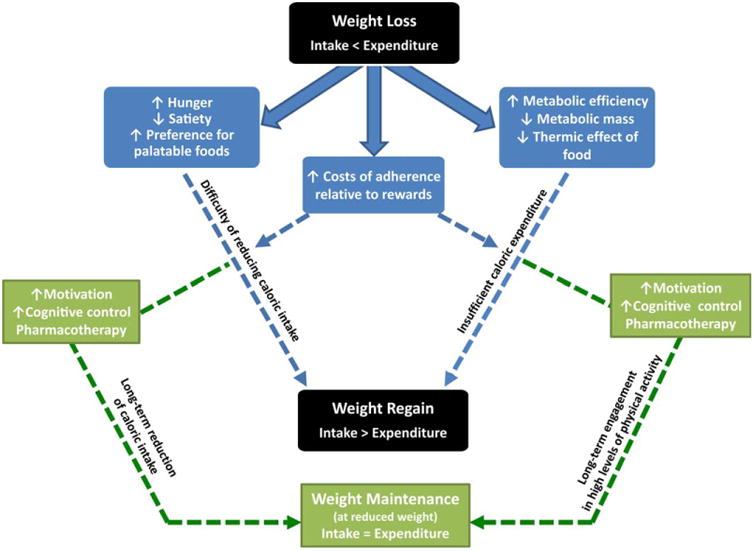
Objectives: The National Institutes of Health, led by the National Heart, Lung, and Blood Institute, organized a working group of experts to discuss the problem of weight regain after weight loss. A number of experts in integrative physiology and behavioral psychology were convened with the goal of merging their perspectives regarding the barriers to scientific progress and the development of novel ways to improve long-term outcomes in obesity therapeutics. The specific objectives of this working group were to: (1) identify the challenges that make maintaining a reduced weight so difficult; (2) review strategies that have been used to improve success in previous studies; and (3) recommend novel solutions that could be examined in future studies of long-term weight control.
Results: Specific barriers to successful weight loss maintenance include poor adherence to behavioral regimens and physiological adaptations that promote weight regain. A better understanding of how these behavioral and physiological barriers are related, how they vary between individuals, and how they can be overcome will lead to the development of novel strategies with improved outcomes.
Conclusions: Greater collaboration and cross-talk between physiological and behavioral researchers is needed to advance the science and develop better strategies for weight loss maintenance.
© 2014 The Obesity Society.
Conflict of interest statement
Figures
Comment in
-
Improving long-term weight loss maintenance: can we do it?Obesity (Silver Spring). 2015 Jan;23(1):2-3. doi: 10.1002/oby.20964. Epub 2014 Dec 11. Obesity (Silver Spring). 2015. PMID: 25504330 No abstract available.
References
-
- Ogden CL, Carroll MD, Curtin LR, McDowell MA, Tabak CJ, Flegal KM. Prevalence of overweight and obesity in the United States, 1999-2004. JAMA. 2006;295:1549–1555. - PubMed
-
- Cawley J, Meyerhoefer C. The medical care costs of obesity: an instrumental variables approach. J Health Econ. 2012;31:219–230. - PubMed
-
- Finkelstein EA, Trogdon JG, Cohen JW, Dietz W. Annual medical spending attributable to obesity: payer-and service-specific estimates. Health Aff (Millwood) 2009;28:w822–w831. - PubMed
-
- Leibel R, Rosenbaum M. Metabolic response to weight perturbation. In: Clément K, editor. Novel Insights into Adipose Cell Functions, Research and Perspectives in Endocrine Interactions. Heidelberg: Springer-Verlag; 2010. pp. 121–133.
-
- Thomas J, Bond D, Phelan S, Hill J, Wing R. Weight-loss maintenance for 10 years in the national weight control registry. Am J Prev Med. 2014;46:17–23. - PubMed
Publication types
MeSH terms
Grants and funding
LinkOut - more resources
Full Text Sources
Other Literature Sources
Medical
