


Controlled, cross-sectional MRI evaluation of joint status in severe haemophilia A patients treated with prophylaxis vs. on demand
- PMID: 25470205
- PMCID: PMC4359687
- DOI: 10.1111/hae.12539
Controlled, cross-sectional MRI evaluation of joint status in severe haemophilia A patients treated with prophylaxis vs. on demand
Abstract
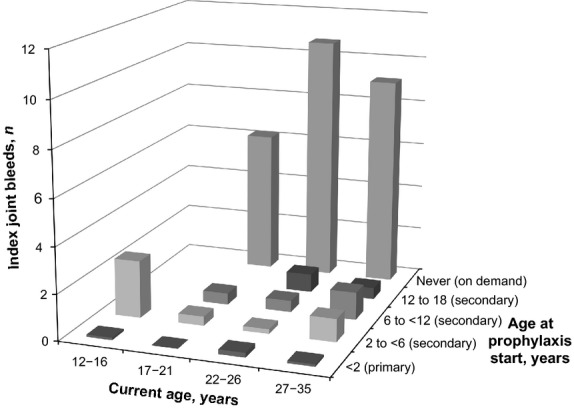
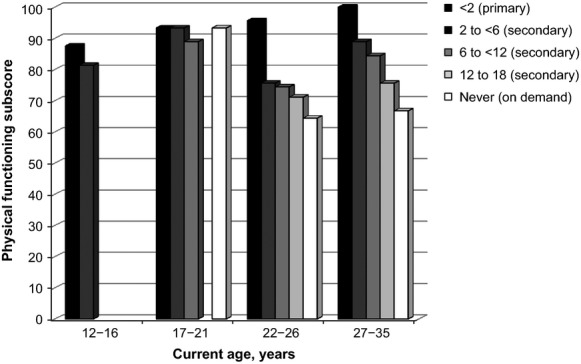
In patients with haemophilia A, factor VIII (FVIII) prophylaxis reduces bleeding frequency and joint damage compared with on-demand therapy. To assess the effect of prophylaxis initiation age, magnetic resonance imaging (MRI) was used to evaluate bone and cartilage damage in patients with severe haemophilia A. In this cross-sectional, multinational investigation, patients aged 12-35 years were assigned to 1 of 5 groups: primary prophylaxis started at age <2 years (group 1); secondary prophylaxis started at age 2 to <6 years (group 2), 6 to <12 years (group 3), or 12-18 years (group 4); or on-demand treatment (group 5). Joint status at ankles and knees was assessed using Compatible Additive MRI scoring (maximum and mean ankle; maximum and mean of all 4 joints) and Gilbert scores in the per-protocol population (n = 118). All prophylaxis groups had better MRI joint scores than the on-demand group. MRI scores generally increased with current patient age and later start of prophylaxis. Ankles were the most affected joints. In group 1 patients currently aged 27-35 years, the median of maximum ankle scores was 0.0; corresponding values in groups 4 and 5 were 17.0 and 18.0, respectively [medians of mean index joint scores: 0.0 (group 1), 8.1 (group 2) and 13.8 (group 4)]. Gilbert scores revealed outcomes less pronounced than MRI scores. MRI scores identified pathologic joint status with high sensitivity. Prophylaxis groups had lower annualized joint bleeds and MRI scores vs. the on-demand group. Primary prophylaxis demonstrated protective effects against joint deterioration compared with secondary prophylaxis.
Keywords: cross-sectional study; haemophilia; joint status; magnetic resonance imaging; on-demand treatment; prophylaxis.
© 2014 The Authors. Haemophilia Published by John Wiley & Sons Ltd.
Figures
References
-
- National Hemophilia Foundation. Medical and Scientific Advisory Council (MASAC) recommendation regarding the need for collaboration. Document #102. Available at: http://www.hemophilia.org/NHFWeb/MainPgs/MainNHF.aspx?menuid=57%26conten.... Accessed January 14, 2014.
-
- Manco-Johnson MJ, Abshire TC, Shapiro AD, et al. Prophylaxis versus episodic treatment to prevent joint disease in boys with severe hemophilia. N Engl J Med. 2007;357:535–44. - PubMed
-
- Nilsson IM, Berntorp E, Lofqvist T, Pettersson H. Twenty-five years’ experience of prophylactic treatment in severe haemophilia A and B. J Intern Med. 1992;232:25–32. - PubMed
-
- Liesner RJ, Khair K, Hann IM. The impact of prophylactic treatment on children with severe haemophilia. Br J Haematol. 1996;92:973–8. - PubMed
-
- Lofqvist T, Nilsson IM, Berntorp E, Pettersson H. Haemophilia prophylaxis in young patients–a long-term follow-up. J Intern Med. 1997;241:395–400. - PubMed
Publication types
MeSH terms
Substances
LinkOut - more resources
Full Text Sources
Other Literature Sources
Medical
