


Chemical composition, antibacterial and antioxidant activities of six essentials oils from the Alliaceae family
- PMID: 25470273
- PMCID: PMC6271055
- DOI: 10.3390/molecules191220034
Chemical composition, antibacterial and antioxidant activities of six essentials oils from the Alliaceae family
Abstract
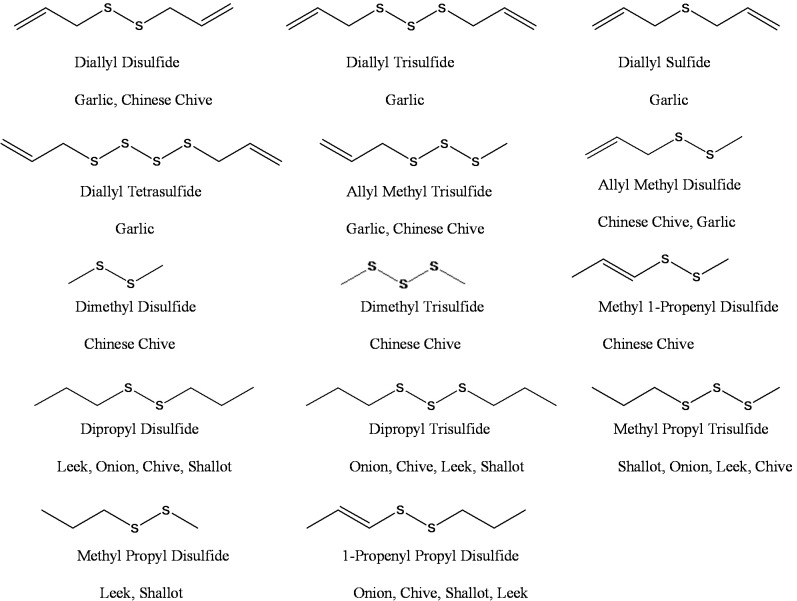
Six essential oils (EOs) from the Alliaceae family, namely garlic (Allium sativum), onion (Allium cepa), leek (Allium porrum), Chinese chive (Allium tuberosum), shallot (Allium ascalonicum) and chive (Allium schoenoprasum) were characterized by GC and GC-MS and evaluated for their functional food properties. Antibacterial properties were tested on five food-borne pathogens: Two Gram-positive Staphylococcus aureus (ATCC 25923), Listeria monocytogenes (ATCC 19115) and three Gram-negative Salmonella Typhimurium (ATCC 14028), Escherichia coli (ATCC 8739) and Campylobacter jejuni (ATCC 33291) bacteria. Antioxidant and radical-scavenging properties were tested by means of Folin-Ciocalteu and 2,2-diphenyl-1-picrylhydrazyl (DPPH) assays. Garlic, Chinese chive and onion EOs had the highest antibacterial activity whereas shallot and leek EOs were the strongest antioxidants. Heating caused a decrease in the antioxidant activity of these Eos, as shown in the Total Polar Materials (TPM) test. Suggestions on relationships between chemical composition and biological activities are presented. Results show that the EOs could be of value in the food industry as alternatives to synthetic antioxidants.
Conflict of interest statement
The authors declare no conflict of interest.
Figures
References
-
- Tepe B., Sokmen M., Akpulat H., Sokmen A. In vitro antioxidant activities of the methanol extracts of five species from Turkey. Food Chem. 2005;92:89–92. doi: 10.1016/j.foodchem.2004.07.016. - DOI
-
- Benkeblia N., Lanzotti V. Allium thiosulfinates: Chemistry, biological properties and their potential utilization in food preservation. Food. 2007;1:193–201.
-
- Corzomartinez M., Corzo N., Villamiel M. Biological properties of onions and garlic. Trends Food Sci. Technol. 2007;18:609–625. doi: 10.1016/j.tifs.2007.07.011. - DOI
MeSH terms
Substances
LinkOut - more resources
Full Text Sources
Other Literature Sources
Medical
Molecular Biology Databases
Miscellaneous
