. 2015 Jan;74(1):75-84.
doi: 10.1097/NEN.0000000000000151.

Reassessment of risk genotypes (GRN, TMEM106B, and ABCC9 variants) associated with hippocampal sclerosis of aging pathology

Affiliations

Reassessment of risk genotypes (GRN, TMEM106B, and ABCC9 variants) associated with hippocampal sclerosis of aging pathology

Peter T Nelson et al. J Neuropathol Exp Neurol. 2015 Jan.

Abstract

Hippocampal sclerosis of aging (HS-Aging) is a common high-morbidity neurodegenerative condition in elderly persons. To understand the risk factors for HS-Aging, we analyzed data from the Alzheimer's Disease Genetics Consortium and correlated the data with clinical and pathologic information from the National Alzheimer's Coordinating Center database. Overall, 268 research volunteers with HS-Aging and 2,957 controls were included; detailed neuropathologic data were available for all. The study focused on single-nucleotide polymorphisms previously associated with HS-Aging risk: rs5848 (GRN), rs1990622 (TMEM106B), and rs704180 (ABCC9). Analyses of a subsample that was not previously evaluated (51 HS-Aging cases and 561 controls) replicated the associations of previously identified HS-Aging risk alleles. To test for evidence of gene-gene interactions and genotype-phenotype relationships, pooled data were analyzed. The risk for HS-Aging diagnosis associated with these genetic polymorphisms was not secondary to an association with either Alzheimer disease or dementia with Lewy body neuropathologic changes. The presence of multiple risk genotypes was associated with a trend for additive risk for HS-Aging pathology. We conclude that multiple genes play important roles in HS-Aging, which is a distinctive neurodegenerative disease of aging.


Figures
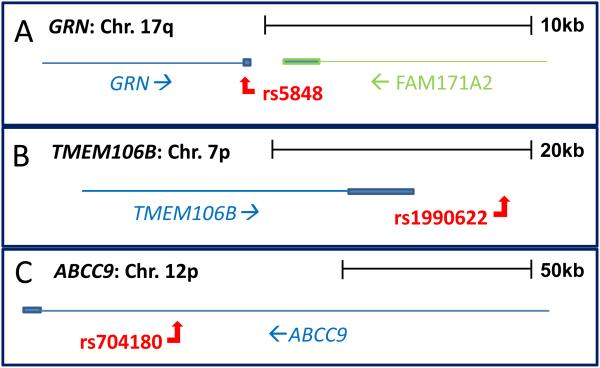
Figure 1
Figure 1
Genomic context for the 3 single nucleotide polymorphisms (SNPs) shown in the chronological order that they were discovered to be relevant to hippocampal sclerosis in aged populations (17, 18, 21, 43, 59). (A) rs5848 (annotated as a T/C SNP) resides in the proximal 3' untranslated region of the GRN gene on chromosome 17q. (B) rs1990662 (an A/G SNP) resides approximately 7 kb downstream from the annotated 3' untranslated region of the TMEM106B gene on chromosome 7p. (C) SNP rs704180 (an A/G SNP) resides within an intron in the ABCC9 gene on chromosome 12p. Figures are derived from UCSC Genome Browser, genome.ucsc.edu, using human genome assembly GRCh37. SNP, single nucleotide polymorphism.
Figure 2
Figure 2
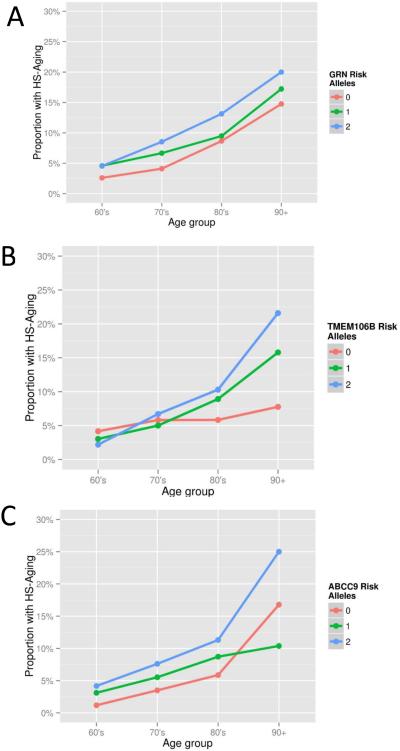
Proportion of cases with Hippocampal sclerosis of aging (HS-Aging) pathology by age group at death and genotype. (A-C) Genotypes are shown for rs1990622 (TMEM106B; panel A); rs704180 (ABCC9; panel B); and rs5848 (GRN; panel C). These analyses factor in the results of all the cases (n = 3498 total), with case/control operationalizations as described in Methods. Note that HS-Aging pathology is most common in the “oldest-old”, and that the previously described risk genotypes (rs1990622 A_A; rs704180 A_A; and rs5848 T_T) have the highest risk for HS-Aging pathology across multiple age groups. For statistical analyses of relevant odds ratios, see Table 2.
Figure 3
Figure 3
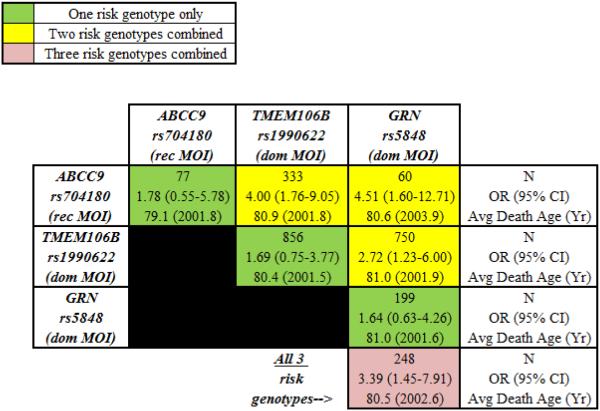
Genotype combinations and the risk of being diagnosed with HS-Aging pathology. Each case (total n = 2709) included here had genotype information for each risk allele (rs5848, rs1990622, and rs704180). For these data, odds ratio (OR) was assessed in comparison to the individuals that lacked all three risk alleles: rs5848 (T_T), rs1990622 (A_A), and rs704180 (A_A). In terms of potential confounders that might affect HS-Aging pathologic diagnosis (age and year of death), the control group had average age at death 80.1 years and average 2001.7 year of death. The number of persons in each group (N), average age at death, OR, and 95% confidence intervals (CI) are shown for each combinatorial subgroup. For a similar analysis that assumes a dominant mode of inheritance for TMEM106B and GRN, see Supplemental Materials. MOI, mode of inheritance; dom, dominant; rec, recessive.
Figure 4
Figure 4
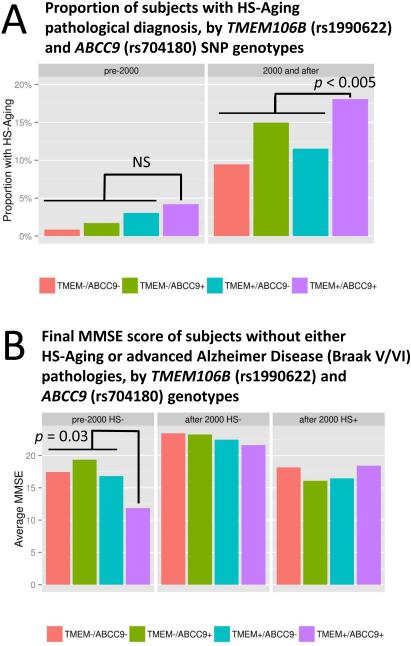
Additional evidence of additive effects for ABCC9 and TMEM106B SNPs in hippocampal sclerosis of aging (HS-Aging) pathology. In both panels, “ABCC9+” means rs704180 A_A and “ABCC9-” means rs704180 A_G or G_G; “TMEM+” means rs1990622 A_A and “TMEM-“ means rs1990622 A_G or G_G. (A) The proportion of individuals with HS-Aging by pathological diagnoses is shown, stratifying by ABCC9 and TMEM106B genotypes. Note that as previously shown, the neuropathologic diagnosis of HS-Aging pathology was relatively unusual prior to 2000. In these pre-2000 cases, among a subset of patients without either diagnosis of HS-Aging or AD (Braak Stage <=IV), neuropathologic changes, cases with both TMEM106B and ABCC9 risk genotypes shows lower global cognitive status as indicated by final MMSE scores (p = 0.03), compatible with the hypothesis that a substantial proportion of these individuals had undiagnosed HS-Aging pathology. Statistical tests are Chi-square except for the pre-2000 HS-Aging pathologic evaluations for which there was a low cell count and the Fisher exact test was used. NS, not significant; MMSE, Mini-Mental State Examination; SNP, single nucleotide polymorphism.

References

    1. Montine TJ, Phelps CH, Beach TG, et al. National Institute on Aging-Alzheimer's Association guidelines for the neuropathologic assessment of Alzheimer's disease: a practical approach. Acta Neuropathol. 2012;123:1–11. - PMC - PubMed
    1. Nelson PT, Smith CD, Abner EL, et al. Hippocampal sclerosis of aging, a prevalent and high-morbidity brain disease. Acta Neuropathol. 2013;126:161–77. - PMC - PubMed
    1. Amador-Ortiz C, Ahmed Z, Zehr C, et al. Hippocampal sclerosis dementia differs from hippocampal sclerosis in frontal lobe degeneration. Acta Neuropathol (Berl) 2007;113:245–52. - PMC - PubMed
    1. Amador-Ortiz C, Lin WL, Ahmed Z, et al. TDP-43 immunoreactivity in hippocampal sclerosis and Alzheimer's disease. Ann Neurol. 2007;61:435–45. - PMC - PubMed
    1. Neumann M, Sampathu DM, Kwong LK, et al. Ubiquitinated TDP-43 in frontotemporal lobar degeneration and amyotrophic lateral sclerosis. Science. 2006;314:130–3. - PubMed

Publication types

MeSH terms