


A randomized placebo-controlled double-blind study evaluating the time course of response to methylphenidate hydrochloride extended-release capsules in children with attention-deficit/hyperactivity disorder
- PMID: 25470572
- PMCID: PMC4268556
- DOI: 10.1089/cap.2014.0100
A randomized placebo-controlled double-blind study evaluating the time course of response to methylphenidate hydrochloride extended-release capsules in children with attention-deficit/hyperactivity disorder
Abstract
Objective: The purpose of this study was to assess the time of onset and time course of efficacy over 12.0 hours of extended-release multilayer bead formulation of methylphenidate (MPH-MLR) compared with placebo in children 6-12 years of age with attention-deficit/hyperactivity disorder (ADHD) in a laboratory school setting.
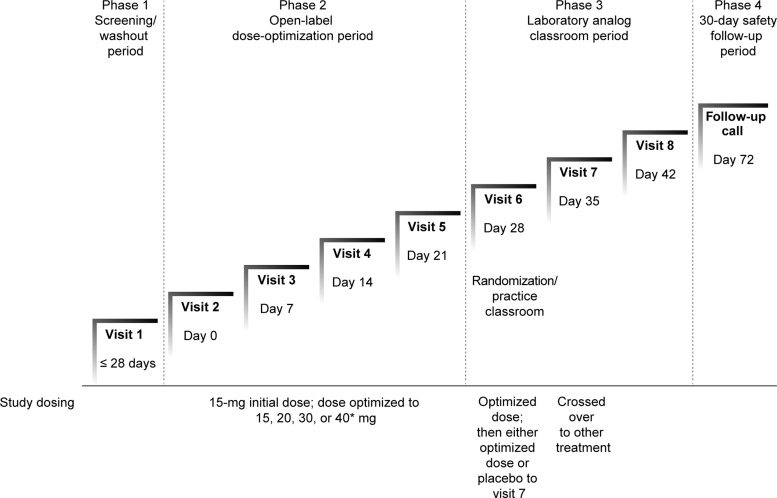
Methods: This randomized double-blind placebo-controlled study included children 6-12 years of age with ADHD. Enrolled children went through four study phases: 1) Screening period (≤4 weeks) and a 2 day medication washout period; 2) open-label period with dose initiation of MPH-MLR 15 mg daily and individual dose optimization treatment period (2-4 weeks); 3) double-blind crossover period in which participants were randomized to sequences (1 week each) of placebo and the optimized MPH-MLR dose given daily; and 4) follow-up safety call. Analog classroom time course evaluations were performed at the end of each double-blind week. The primary efficacy end-point was the mean of the on-treatment/postdose Swanson, Kotkin, Agler, M-Flynn, and Pelham (SKAMP)-Total scores over time points collected 1.0-12.0 hours after dosing. End-points were evaluated using a mixed-effects analysis of covariance.
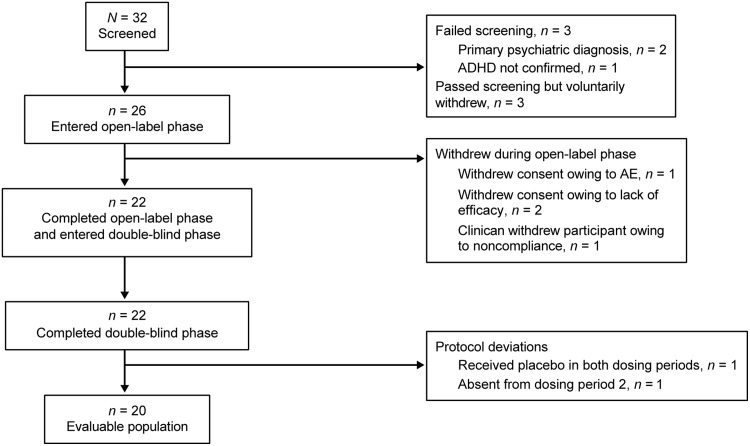
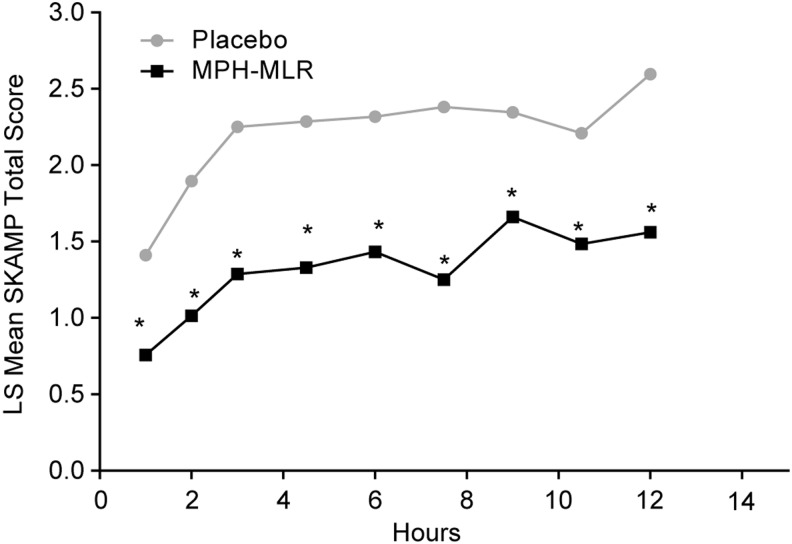
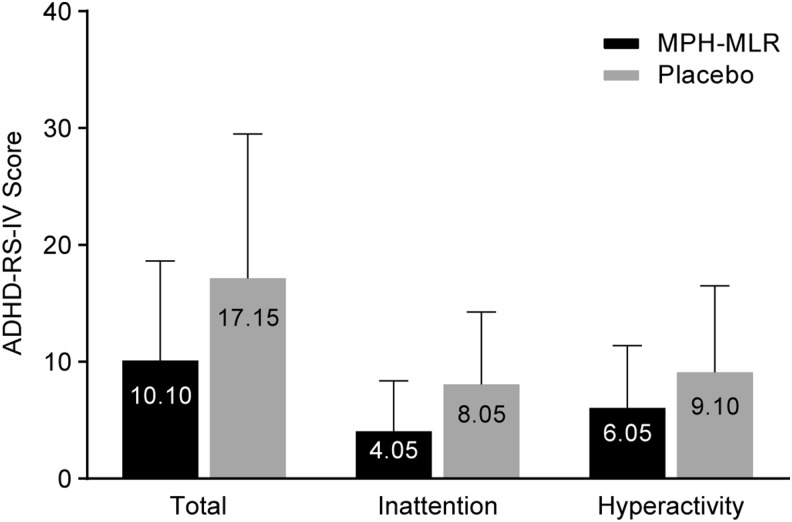
Results: The evaluable population included 20 participants. The least-squares mean postdose SKAMP-Total score was higher for placebo than for MPH-MLR (2.18 vs. 1.32, respectively; p=0.0001), indicating fewer symptoms with MPH-MLR therapy than with placebo. No difference in SKAMP-Total score between participants who received sequence 1 or sequence 2 was noted. From each of hours 1.0-12.0, least-squares mean SKAMP-Total score was significantly lower for those receiving MPH-MLR than for those receiving placebo (p≤0.0261). Neither serious adverse events nor new or unexpected safety findings were noted during the study.
Conclusions: MPH-MLR showed a significant decrease in SKAMP scores compared with placebo in children with ADHD 6-12 years of age, indicating a decrease in ADHD symptoms. The estimated onset was observed within 1.0 hour, and duration was measured to 12.0 hours postdose.
Trial registration: ClinicalTrials.gov Identifier: NCT01269463.
Figures
References
-
- Adjei A, Kupper RJ, Teuscher NS, Wigal S, Sallee FR, Childress A, Kollins S, Greenhill L: Steady-state bioavailability of methyphenidate extended-release (MPH-MLR) capsule versus methylphenidate immediate-release tablets (Ritalin®) in healthy adult volunteers. Clin Drug Invest in press, 2014a - PubMed
-
- Adjei A, Teuscher NS, Kupper RJ, Chang W-W, Greenhill L, Newcorn J, Connor DF, Wigal S: Single-dose pharmacokinetics of methylphenidate extended-release administered as intact capsule or sprinkles versus methylphenidate immediate-release tablets (Ritalin®) in healthy adult volunteers. J Child Adolesc Psychopharmacol, 2014b - PMC - PubMed
-
- American Psychiatric Association: Diagnostic and Statistical Manual of Mental Disorders, 4th ed., Text Revision. Washington, DC: American Psychiatric Association; 2000
-
- DuPaul GJ, Power TJ, Anastopoulos AD, Reid R: ADHD Rating Scale–IV: Checklist, Norms, and Clinical Interpretation. New York: Guilford Press; 1998
Publication types
MeSH terms
Substances
Associated data
Grants and funding
LinkOut - more resources
Full Text Sources
Other Literature Sources
Medical
Miscellaneous
