Comment
. 2014 Dec;6(12):1521-4.
doi: 10.15252/emmm.201404749.

Heart over mind: metabolic control of white adipose tissue and liver

Affiliations
Comment

Heart over mind: metabolic control of white adipose tissue and liver

Michinari Nakamura et al. EMBO Mol Med. 2014 Dec.

Abstract

Increasing evidence suggests that the heart controls the metabolism of peripheral organs. Olson and colleagues previously demonstrated that miR‐208a controls systemic energy homeostasis through the regulation of MED13 in cardiomyocytes (Grueter et al, 2012). In their follow‐up study in this issue of EMBO Molecular Medicine, white adipose tissue (WAT) and liver are identified as the physiological targets of cardiac MED13 signaling, most likely through cardiac‐derived circulating factors, which boost energy consumption by upregulating metabolic gene expression and increasing mitochondrial numbers (Baskin et al, 2014). In turn, increased energy expenditure in WAT and the liver confers leanness. These findings strengthen the evidence of metabolic crosstalk between the heart and peripheral tissues through cardiokines and also set the stage for the development of novel treatments for metabolic syndrome.


Figures
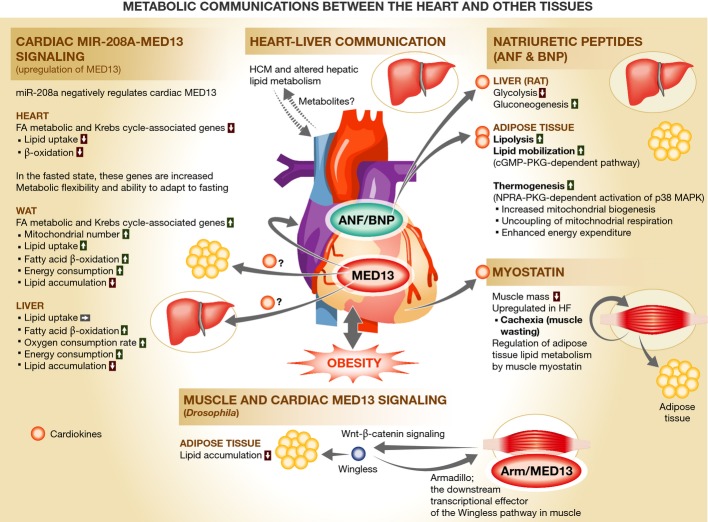
Figure 1
Figure 1. Metabolic communications between the heart and other tissues
More than 16 proteins secreted from the heart have thus far been identified as cardiokines. Some of these act on other tissues to regulate metabolism in an endocrine manner. (A) Upregulation of MED13 in the heart enhances lipid utilization in white adipose tissue (WAT) and liver via unidentified circulating factors but decreases lipid utilization in the heart, thereby increasing systemic energy expenditure and leading to leanness (Baskin et al, 2014). (B) Metabolic derangement in a primary genetic heart disease, such as familial hypertrophic cardiomyopathy (HCM), adversely impacts liver metabolism (Magida & Leinwand, 2014). (C) Natriuretic peptides enhance lipolysis, lipid mobilization, and thermogenesis in adipocytes, in addition to natriuresis, diuresis, and vasodilation (Rashed et al, ; Sengenes et al, ; Bordicchia et al, 2012). (D) Secretion of myostatin (and probably other cardiokines, such as activin A) from the heart is increased in heart failure (HF) and accounts for muscle wasting (Shimano et al, 2012). Myostatin secreted from the skeletal muscle regulates lipid metabolism in adipose tissue (Lee, 2004). (E) Upregulation of MED13 in the heart and muscle increases the secretion of Wingless (Wnt), which enhances lipid metabolism in adipocytes in Drosophila (Lee et al, 2014). miR-208a, microRNA-208a; MED13, Mediator complex subunit 13; ANF, atrial natriuretic factor; BNP, B-type natriuretic peptide; NPRA, natriuretic peptide receptor A; PKG, cGMP-dependent protein kinase.

Comment on

References

    1. Anker SD, Ponikowski P, Varney S, Chua TP, Clark AL, Webb-Peploe KM, Harrington D, Kox WJ, Poole-Wilson PA, Coats AJ. Wasting as independent risk factor for mortality in chronic heart failure. Lancet. 1997;349:1050–1053. - PubMed
    1. Baskin KK, Grueter CE, Kusminski CM, Holland WL, Bookout AI, Satapati S, Kong M, Burgess SC, Malloy CR, Scherer PE, et al. MED13 dependent signaling from the heart confers leanness by enhancing metabolism in adipose tissue and liver. EMBO Mol Med. 2014;6:1610–1621. - PMC - PubMed
    1. de Bold AJ. Thirty years of research on atrial natriuretic factor: historical background and emerging concepts. Can J Physiol Pharmacol. 2011;89:527–531. - PubMed
    1. Bordicchia M, Liu D, Amri EZ, Ailhaud G, Dessi-Fulgheri P, Zhang C, Takahashi N, Sarzani R, Collins S. Cardiac natriuretic peptides act via p38 MAPK to induce the brown fat thermogenic program in mouse and human adipocytes. J Clin Invest. 2012;122:1022–1036. - PMC - PubMed
    1. Callis TE, Pandya K, Seok HY, Tang RH, Tatsuguchi M, Huang ZP, Chen JF, Deng Z, Gunn B, Shumate J, et al. MicroRNA-208a is a regulator of cardiac hypertrophy and conduction in mice. J Clin Invest. 2009;119:2772–2786. - PMC - PubMed

Publication types

Substances