


Association of mitochondrial DNA levels with frailty and all-cause mortality
- PMID: 25471480
- PMCID: PMC4319988
- DOI: 10.1007/s00109-014-1233-3
Association of mitochondrial DNA levels with frailty and all-cause mortality
Abstract
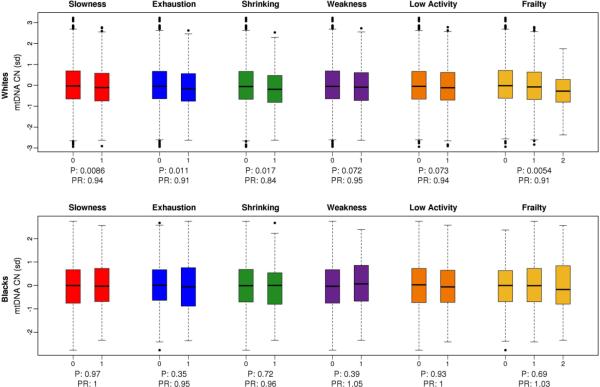
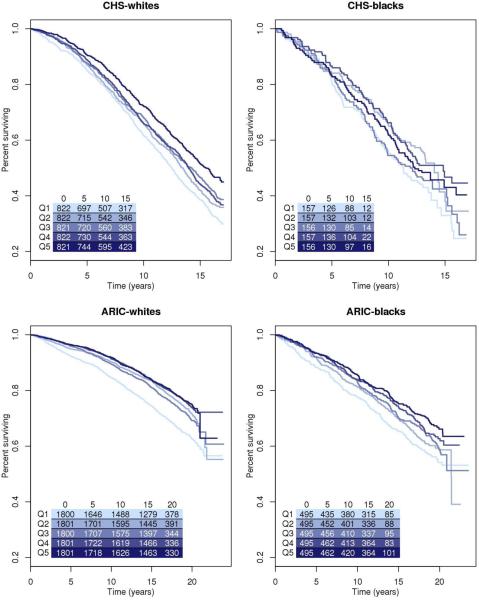
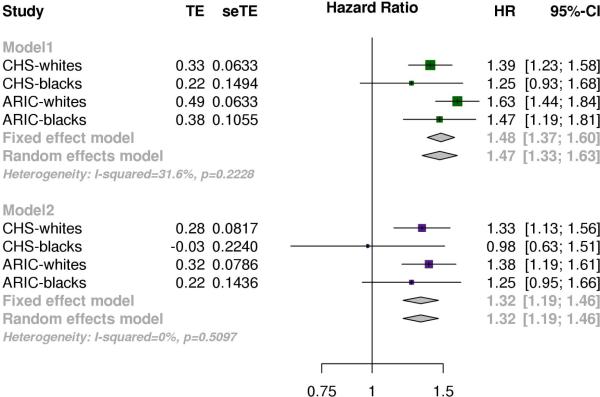
Mitochondrial function is altered with age and variants in mitochondrial DNA (mtDNA) modulate risk for several age-related disease states. However, the association of mtDNA copy number, a readily available marker which reflects mitochondrial depletion, energy reserves, and oxidative stress, on aging and mortality in the general population has not been addressed. To assess the association between mtDNA copy number and two primary outcomes--prevalent frailty and all-cause mortality--we utilize data from participants who were from two multicenter, multiethnic, community-based, prospective studies--the Cardiovascular Health Study (CHS) (1989-2006) and the Atherosclerosis Risk in Communities (ARIC) study (1987-2013). A total of 4892 participants (43.3% men) from CHS and 11,509 participants (44.9% men) from ARIC self-identifying as white or black were included in the analysis. mtDNA copy number, the trait of interest, was measured using a qPCR-based method in CHS and an array-based method in ARIC from DNA isolated from whole blood in participants from both cohorts. In race-stratified meta-analyses, we observe a significant inverse association of mtDNA copy number with age and higher mtDNA copy number in women relative to men. Lower mtDNA copy number was also significantly associated with prevalent frailty in white participants from CHS (OR 0.91, 95% CI 0.85-0.97). Additionally, mtDNA copy number was a strong independent predictor of all-cause mortality in an age- and sex-adjusted, race-stratified analysis of 16,401 participants from both cohorts with a pooled hazard ratio of 1.47 (95% CI 1.33-1.62) for the lowest quintile of mtDNA copy number relative to the highest quintile. Key messages: Mitochondrial DNA (mtDNA) copy number is associated with age and sex. Lower mtDNA copy number is also associated with prevalent frailty. mtDNA copy number is a significant predictor of all-cause mortality in a multiethnic population.
Figures
References
-
- ERNSTER L, LOW H, NORDENBRAND K, ERNSTER B. A component promoting oxidative phosphorylation, released from mitochondria during aging. Exp Cell Res. 1955;9:348–349. - PubMed
-
- Honjo I, Ozawa K, Kitamura O, et al. Rapid change of phospholipid in pancreas mitochondria during aging. J Biochem (Tokyo) 1968;64:311–320. - PubMed
-
- Harman D. The biologic clock: the mitochondria? J Am Geriatr Soc. 1972;20:145–147. - PubMed
Publication types
MeSH terms
Substances
Grants and funding
- UL1RR025005/RR/NCRR NIH HHS/United States
- N01 HC085080/HL/NHLBI NIH HHS/United States
- U01 HL096812/HL/NHLBI NIH HHS/United States
- R01HL59367/HL/NHLBI NIH HHS/United States
- R01 HL059367/HL/NHLBI NIH HHS/United States
- R01 HL086694/HL/NHLBI NIH HHS/United States
- P30 AG021334/AG/NIA NIH HHS/United States
- U01HG004402/HG/NHGRI NIH HHS/United States
- R01HL087641/HL/NHLBI NIH HHS/United States
- N01 HC055222/HL/NHLBI NIH HHS/United States
- N01 HC085079/HL/NHLBI NIH HHS/United States
- R01 HL080295/HL/NHLBI NIH HHS/United States
- HL080295/HL/NHLBI NIH HHS/United States
- N01 HC085081/HL/NHLBI NIH HHS/United States
- P30-AG021334/AG/NIA NIH HHS/United States
- UL1 RR025005/RR/NCRR NIH HHS/United States
- U01 HL080295/HL/NHLBI NIH HHS/United States
- UL1 TR001079/TR/NCATS NIH HHS/United States
- N01 HC085082/HL/NHLBI NIH HHS/United States
- N01 HC085086/HL/NHLBI NIH HHS/United States
- N01 HC085083/HL/NHLBI NIH HHS/United States
- HHSN268200625226C/PHS HHS/United States
- U01 HG004402/HG/NHGRI NIH HHS/United States
- R01 AG023629/AG/NIA NIH HHS/United States
- R01 HL087641/HL/NHLBI NIH HHS/United States
- AG023629/AG/NIA NIH HHS/United States
- R56 AG023629/AG/NIA NIH HHS/United States
- R01HL086694/HL/NHLBI NIH HHS/United States
- N01 HC55222/HC/NHLBI NIH HHS/United States
LinkOut - more resources
Full Text Sources
Other Literature Sources
Medical
