


A review of factors influencing participation in social and community activities for wheelchair users
- PMID: 25472004
- PMCID: PMC4581875
- DOI: 10.3109/17483107.2014.989420
A review of factors influencing participation in social and community activities for wheelchair users
Abstract
Objective: To systematically identify factors associated with participation in social and community activities for adult wheelchair users (WCUs).
Data sources: PubMed/MEDLINE, CINAHL, PsycINFO and EMBASE.
Study selection: Quantitative and qualitative peer-reviewed publications were included, which were written in English, reported original research and investigated factors associated with social and community participation in adult WCUs.
Data extraction: The Preferred Reporting Items for Systematic Reviews and Meta-Analyses guidelines were used. Factors were organized using the International Classification of Functioning, Disability and Health (ICF).
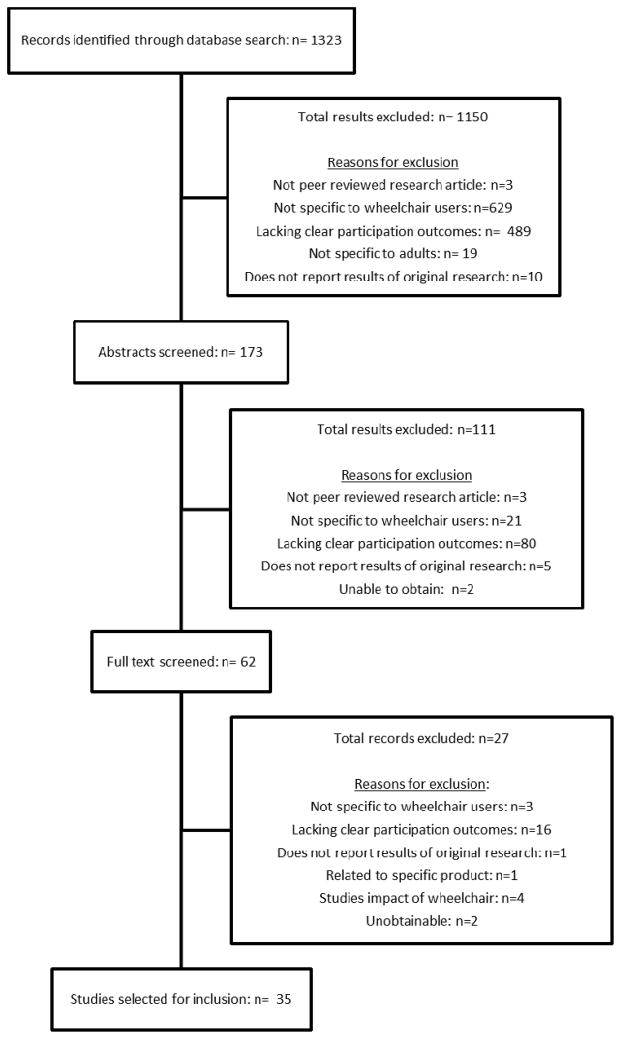
Data synthesis: Thirty-five studies were selected: two of power WCUs, 10 of manual WCUs and 23 of both. Six qualitative studies, ranging in quality from 8/10 to 9/10 and 29 quantitative studies were included, ranging in quality from 4/15 to 11/15. Fifteen body function, 4 activity, 5 participation, 15 environmental and 14 personal factors were found to be associated with social and community participation.
Conclusions: Social and community participation of WCUs is associated with factors from all ICF domains. Wheelchair factors, accessibility, skills with wheelchair use, pain, finances and education are modifiable factors frequently reported to be associated with participation. Experimental research focusing on modifiable factors is needed to further our understanding of factors influencing participation among WCUs. Implications for Rehabilitation Wheelchair factors, including comfort and durability, are associated with participation and may be targeted in clinical intervention. Wheelchair skills are clinically modifiable and have been shown to improve participation in manual wheelchair users. Body functions (e.g. confidence, depression and fatigue) and personal factors (e.g. finances and level of education) may be considered for clinical intervention.
Keywords: Community integration; experimental research; leisure activities; social participation; systematic review; wheelchairs.
Conflict of interest statement
Declaration of Interests
The authors report no declaration of interest.
References
-
- World Health Organization. Active ageing: A policy framework. Geneva: World Health Organization; 2002. - PubMed
-
- World Health Organization. International classification of functioning, disability and health. Geneva: World Health Organization; 2001.
-
- Levasseur M, Desrosiers J, Tribble DC. Subjective quality-of-life predictors for older adults with physical disabilities. Am J Phys Med Rehabil. 2008;87:10–830. - PubMed
-
- Chang FH, Wang YH, Jang Y, Wang CW. Factors associated with quality of life among people with spinal cord injury: Application of the international classification of functioning, disability and health model. Arch Phys Med Rehabil. 2012 Dec;93(12):2264–70. - PubMed
-
- Baum CM. Fulfilling the promise: Supporting participation in daily life. Arch Phys Med Rehabil. 2011 Feb;92(2):169–75. - PubMed
Publication types
MeSH terms
Grants and funding
LinkOut - more resources
Full Text Sources
Other Literature Sources
Medical
