Review
. 2014 Nov 28;12 Suppl 2(Suppl 2):S3.
doi: 10.1186/1479-5876-12-S2-S3. Epub 2014 Nov 28.

Chronic Obstructive Pulmonary Disease heterogeneity: challenges for health risk assessment, stratification and management

Review

Chronic Obstructive Pulmonary Disease heterogeneity: challenges for health risk assessment, stratification and management

Josep Roca et al. J Transl Med. .

Abstract

Background and hypothesis: Heterogeneity in clinical manifestations and disease progression in Chronic Obstructive Pulmonary Disease (COPD) lead to consequences for patient health risk assessment, stratification and management. Implicit with the classical "spill over" hypothesis is that COPD heterogeneity is driven by the pulmonary events of the disease. Alternatively, we hypothesized that COPD heterogeneities result from the interplay of mechanisms governing three conceptually different phenomena: 1) pulmonary disease, 2) systemic effects of COPD and 3) co-morbidity clustering, each of them with their own dynamics.

Objective and method: To explore the potential of a systems analysis of COPD heterogeneity focused on skeletal muscle dysfunction and on co-morbidity clustering aiming at generating predictive modeling with impact on patient management. To this end, strategies combining deterministic modeling and network medicine analyses of the Biobridge dataset were used to investigate the mechanisms of skeletal muscle dysfunction. An independent data driven analysis of co-morbidity clustering examining associated genes and pathways was performed using a large dataset (ICD9-CM data from Medicare, 13 million people). Finally, a targeted network analysis using the outcomes of the two approaches (skeletal muscle dysfunction and co-morbidity clustering) explored shared pathways between these phenomena.

Results: (1) Evidence of abnormal regulation of skeletal muscle bioenergetics and skeletal muscle remodeling showing a significant association with nitroso-redox disequilibrium was observed in COPD; (2) COPD patients presented higher risk for co-morbidity clustering than non-COPD patients increasing with ageing; and, (3) the on-going targeted network analyses suggests shared pathways between skeletal muscle dysfunction and co-morbidity clustering.

Conclusions: The results indicate the high potential of a systems approach to address COPD heterogeneity. Significant knowledge gaps were identified that are relevant to shape strategies aiming at fostering 4P Medicine for patients with COPD.


Figures
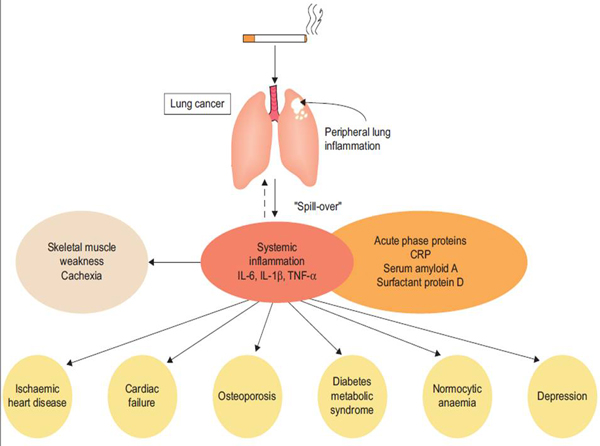
Figure 1
Figure 1
Lung injury caused by inhaled irritants like tobacco smoking generates peripheral lung inflammation that may cause "spill over" of different types of cytokines into the systemic circulation. According to this hypothesis, systemic inflammation causes skeletal muscle dysfunction and muscle wasting, but it may also cause and worsen co-morbidities (reproduced from [30]with permission)
Figure 2
Figure 2
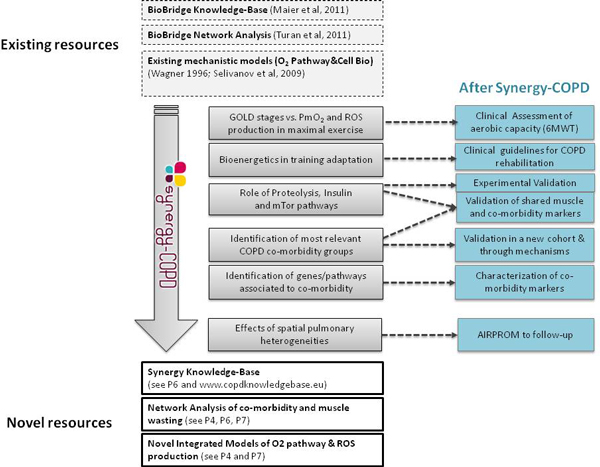
Diagram indicating input data (top rectangles with discontinuous line), biomedical achievements (central grey rectangles), resources generated by the project (bottom rectangles with continuous line) and further developments to be considered after the Synergy-COPD project. (blue rectangles).
Figure 3
Figure 3
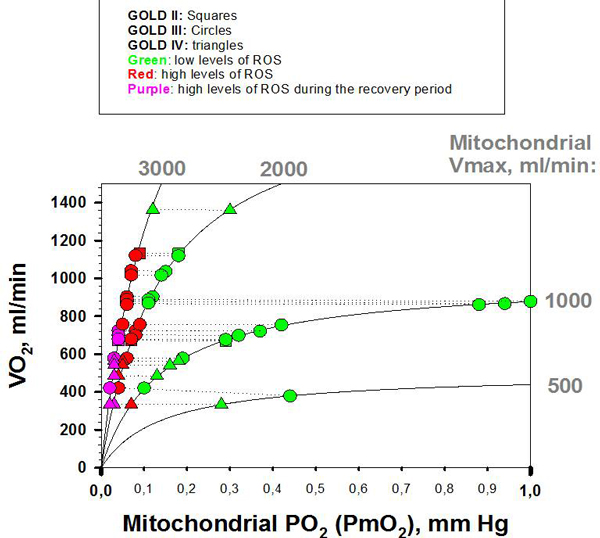
Relationships between measured maximum O2 transport (VO2), y-axis; and, estimated cellular oxygenation (PmO2), x-axis, in COPD patients. The different symbols correspond to classical GOLD stages: squares, GOLD II; circles GOLD III; and, triangles, GOLD IV (measured VO2 obtained from [32]). The symbols connected with discontinuous lines correspond to the same patient (same VO2) with estimated PmO2 values corresponding to different mitochondrial oxidative capacities (Vmax values and VO2/Vmax ratios). For a given patient, the lower the VO2/Vmax ratio, the lower was the estimated PmO2. The colors correspond to the mitochondrial ROS generation: green, mitochondrial ROS levels similar to those seen in healthy subjects; red, abnormally high mitochondrial ROS levels; and, violet, high ROS levels that persist after exercise withdrawal. The lower the PmO2, the higher were mitochondrial ROS levels.
Figure 4
Figure 4
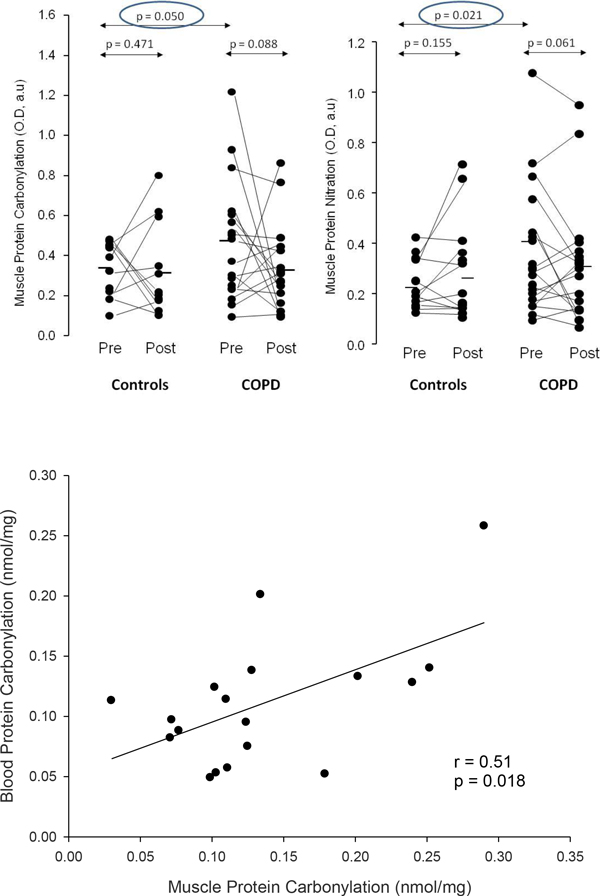
Oxidative stress in COPD. Upper panel: Muscle oxidative stress. Individual and mean group effects of an 8-week endurance training program on protein carbonylation (left) and protein nitration (right) in the vastus lateralis of healthy subjects (controls) and patients with COPD. At baseline (rest, pre-training measurements), COPD patients showed higher nitroso-redox disequilibrium than healthy subjects. A trend toward a decrease in oxidative stress was observed after training in COPD patients [28]. Bottom panel: Association between muscle and blood. COPD patients at baseline (rest, pre-training) showed an association of protein carbonylation levels between skeletal muscle and blood [28] (reproduced from[28]with permission).
Figure 5
Figure 5
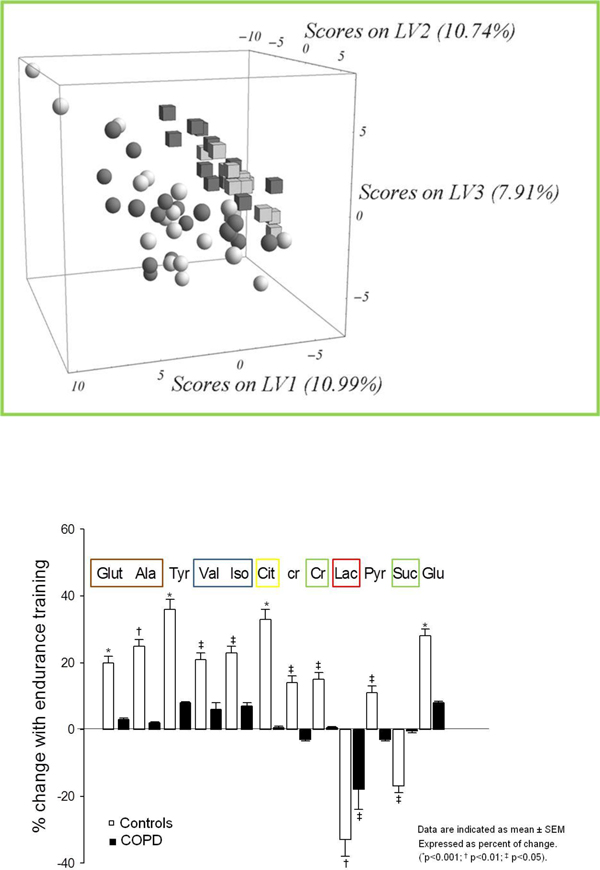
Metabolic analysis. Upper panel: Resting individual metabolic profiles in COPD patients (spheres) and in healthy sedentary subjects (cubes), including pre (black symbols) - and post -training data (grey symbols). The results are expressed by the three Latent Variables (LV1, 2 and 3) of the partial-least square discriminant analysis (PLS-DA). The percentages indicate the magnitude of the differences between the two groups of subjects for each dimension (p<0.05). Bottom panel: Endurance training responses of individual metabolites. Mean training-induced responses of individual metabolites. Data expressed as percent of change are indicated as mean ± SEM. (*p<0.001; p<0.01; p<0.05) (reproduced from [27]with permission)
Figure 6
Figure 6
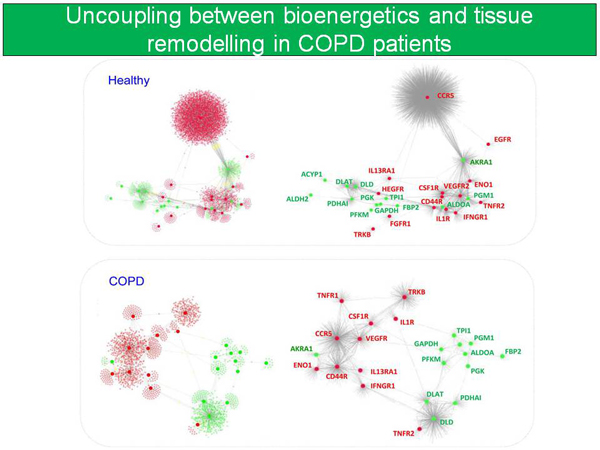
Interaction networks using skeletal muscle expression profiling, plasma cytokines and physiological measurements. Uncoupling between bioenergetics, inflammation and skeletal muscle remodeling was observed in COPD patients as compared to healthy subjects [33]

References

    1. Vestbo J, Hurd SS, Agusti AG, Jones PW, Vogelmeier C, Anzueto A, Barnes PJ, Fabbri LM, Martinez FJ, Nishimura M, Stockley RA, Sin DD, Rodriguez-Roisin R. Global strategy for the diagnosis, management, and prevention of chronic obstructive pulmonary disease: GOLD executive summary. American journal of respiratory and critical care medicine. 2013;187:347–365. doi: 10.1164/rccm.201204-0596PP. - DOI - PubMed
    1. Murray CJL, Lopez AD. Measuring the Global Burden of Disease. New England Journal of Medicine. 2013;369:448–457. doi: 10.1056/NEJMra1201534. - DOI - PubMed
    1. WHO. 2008-2013 Action Plan for the Global Strategy for the Prevention and Control of Noncommunicable Diseases. 2008. http://www.who.int/nmh/publications/9789241597418/en/ Accessed: 2013-08-20. (Archived by WebCite® at http://www.webcitation.org/6J0XGnHcJ.
    1. Agusti A, Calverley P, Celli B, Coxson H, Edwards L, Lomas D, MacNee W, Miller B, Rennard S, Silverman E. Characterisation of COPD heterogeneity in the ECLIPSE cohort. Respiratory Research. 2010;11:122. - PMC - PubMed
    1. Casanova C, de Torres JP, Aguirre-Jaime A, Pinto-Plata V, Marin JM, Cordoba E, Baz R, Cote C, Celli BR. The progression of chronic obstructive pulmonary disease is heterogeneous: the experience of the BODE cohort. American journal of respiratory and critical care medicine. 2011;184:1015–1021. doi: 10.1164/rccm.201105-0831OC. - DOI - PubMed

Publication types