


Impact of type 2 diabetes mellitus on the prognosis of early stage triple-negative breast cancer in People's Republic of China
- PMID: 25473296
- PMCID: PMC4251575
- DOI: 10.2147/OTT.S71095
Impact of type 2 diabetes mellitus on the prognosis of early stage triple-negative breast cancer in People's Republic of China
Abstract
Background: Type 2 diabetes mellitus (T2DM) is one of the most common chronic metabolic diseases. Increased cause-specific mortality and decreased disease-free survival (DFS) have been reported among cancer patients with T2DM compared with patients without T2DM, even after adjustments of other comorbidities. However, less is known about the impact of T2DM and other comorbidities on DFS in Chinese patients with early stage triple-negative breast cancer (TNBC).
Patients and methods: We assessed patients who were newly diagnosed with early stage primary TNBC at the Department of Breast Surgery, Fudan University, from 2003 to 2011. Of the 1,100 TNBC patients, 865 female patients had invasive and early stage TNBC. The association of the variables in the T2DM and non-T2DM groups was compared using the Pearson's chi-square and independent t-tests. DFS was estimated using the Kaplan-Meier method. The effects of T2DM and other possible risk factors on DFS were assessed by Cox proportional hazards regression using univariate or multivariate analysis.
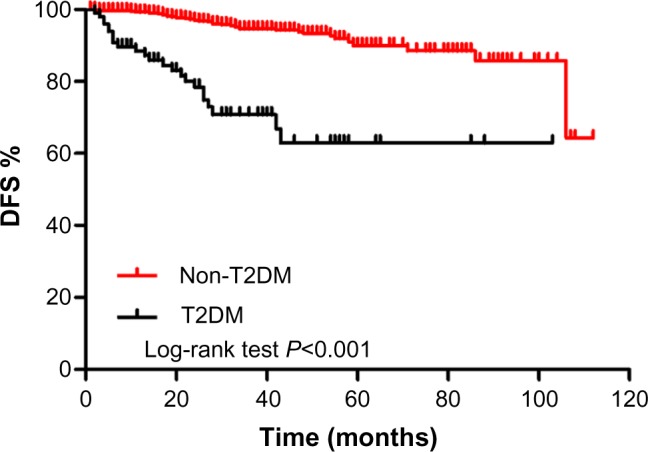
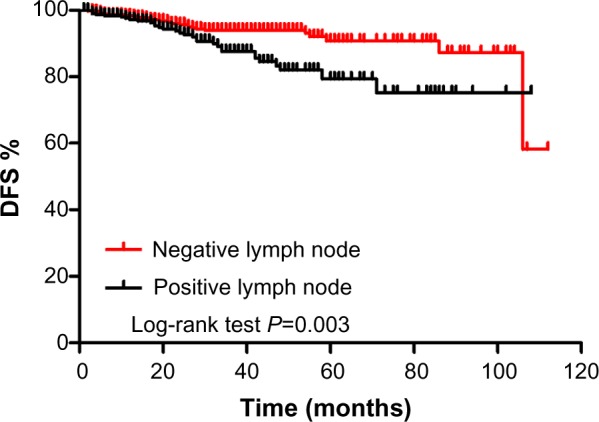
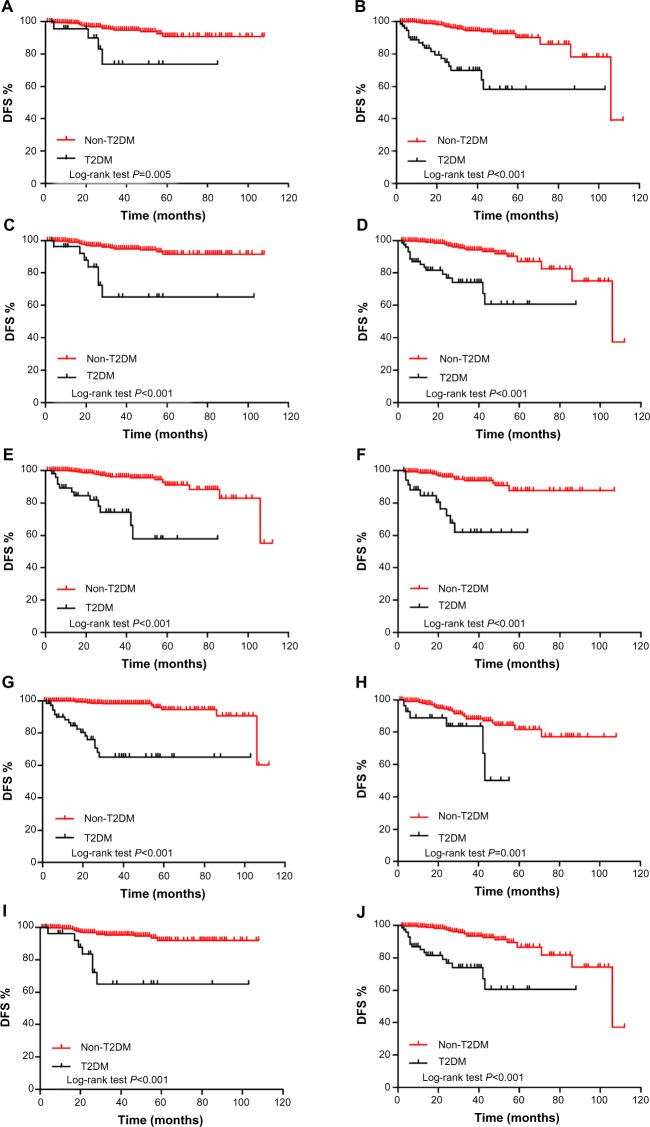
Results: A total of 865 early stage primary TNBC cases were studied, including 104 (12.02%) subjects with T2DM. Metastatic or recurrent disease was detected in 24 (23.08%) patients in the T2DM group and 35 (4.60%) patients in the non-T2DM group. Patients with T2DM exhibited a significantly lower DFS than patients without T2DM (log-rank P<0.001). Similar results were observed when patients with positive lymph nodes were compared with patients with negative lymph nodes (log-rank P=0.003). T2DM was independently associated with a lower DFS after adjustments of other variables (adjusted hazard ratio, 7.719; 95% confidence interval, 4.304-13.843; P<0.001) and adjustments of lymph node positivity (adjusted hazard ratio, 2.407; 95% confidence interval, 1.391-4.166; P=0.002). The DFS rates at 2 years for the T2DM group and the non-T2DM group were 78% and 97%, respectively. The prognostic influence of T2DM was consistent across the subgroups, including subgroups by age (>50 or ≤50), menopausal status (post- or premenopausal), tumor size (>5 cm or ≤5 cm), lymph node involvement (positive or negative), and adjuvant chemotherapy (received or not) using the Kaplan-Meier method (log-rank P<0.05).
Conclusion: In the People's Republic of China, T2DM is an independent prognostic risk factor that indicates an increased likelihood of recurrence and metastasis in patients with early stage TNBC. The presence of T2DM should be taken into account when evaluating the risk for an early stage TNBC patient. More effective therapeutic regimens are needed for early stage TNBC patients with T2DM.
Keywords: disease-free survival; highly aggressive breast cancer; hyperglycemia.
Figures
References
-
- Hou G, Zhang S, Zhang X, Wang P, Hao X, Zhang J. Clinical pathological characteristics and prognostic analysis of 1,013 breast cancer patients with diabetes. Breast Cancer Res Treat. 2013;137(3):807–816. - PubMed
-
- Kinne DW, Butler JA, Kimmel M, Flehinger BJ, Menendez-Botet C, Schwartz M. Estrogen receptor protein of breast cancer in patients with positive nodes. High recurrence rates in the postmenopausal estrogen receptor-negative group. Arch Surg. 1987;122(11):1303–1306. - PubMed
-
- Parl FF, Schmidt BP, Dupont WD, Wagner RK. Prognostic significance of estrogen receptor status in breast cancer in relation to tumor stage, axillary node metastasis, and histopathologic grading. Cancer. 1984;54(10):2237–2242. - PubMed
LinkOut - more resources
Full Text Sources
Other Literature Sources
