


Genetic variability of Cotton leaf curl betasatellite in Northern India
- PMID: 25473373
- PMCID: PMC4250495
- DOI: 10.1016/j.sjbs.2014.11.006
Genetic variability of Cotton leaf curl betasatellite in Northern India
Abstract
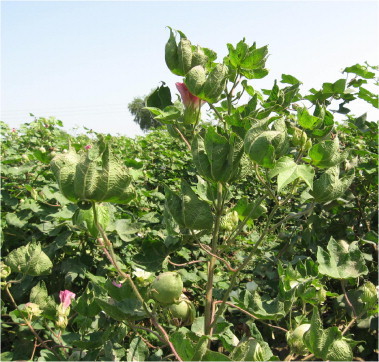
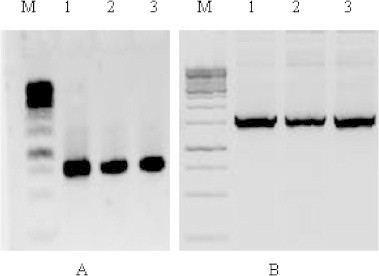
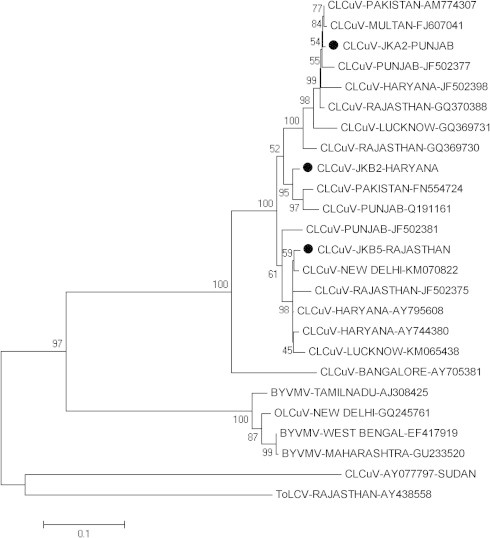
Cotton is an important crop and its production is affected by various disease pathogens. Monopartite begomovirus associated betasatellites cause Cotton leaf curl disease (CLCuD) in Northern India. In order to access the occurrence and genetic variability of Cotton leaf curl betasatellites, an extensive field survey was conducted in states of Rajasthan, Punjab and Haryana. We selected the betasatellite sequence for analysis as they are reported as important for disease severity and sequence variability. Based on the field observations, the disease incidence ranged from 30% to 80% during the survey. Full genome and DNA β were amplified from various samples while no amplicon was obtained in some samples. The nucleotide sequence homology ranged from 90.0% to 98.7% with Cotton leaf curl virus (CLCuV), 55.2-55.5% with Bhendi yellow vein mosaic virus, 55.8% with Okra leaf curl virus and 51.70% with Tomato leaf curl virus isolates. The lowest similarity (47.8%) was found in CLCuV-Sudan isolate. Phylogenetic analysis showed that analyzed isolates formed a close cluster with various CLCuV isolates reported earlier. The analysis results show sequence variation in Cotton leaf curl betasatellite which could be the result of recombination. The results obtained by genome amplification and sequence variability indicate that some new variants are circulating and causing leaf curl disease in Rajasthan, Punjab and Haryana.
Keywords: Betasatellites; CLCuD, Cotton leaf curl disease; CLCuV, Cotton leaf curl virus; Cotton leaf curl virus; Genetic variability; Northern India; PCR, polymerase chain reaction; SCR, satellite conserved region.
Figures
References
-
- Amin I., Hussain K., Akbergenov R., Yadav J.S., Qazi J., Mansoor S., Hohn T., Fauquet C.M., Briddon R.W. Suppressors of RNA silencing encoded by the components of the Cotton leaf curl begomovirus–betasatellite complex. Mol. Plant Microbe Interact. 2011;24:973–983. - PubMed
-
- Amrao L., Amin I., Shahid M.S., Briddon R.W., Mansoor S. Cotton leaf curl disease in resistant cotton is associated with a single begomovirus that lacks an intact transcriptional activator protein. Virus Res. 2010;152:153–163. - PubMed
-
- Asad S., Haris W.A., Bashir A., Zafar Y., Malik K.A., Malik N.N., Lichtenstein C.P. Transgenic tobacco expressing geminiviral RNAs are resistant to the serious viral pathogen causing Cotton leaf curl disease. Arch. Virol. 2003;148:2341–2352. - PubMed
-
- Azhar M.T., Akhtar S., Mansoor S. Cotton leaf curl Multan betasatellites strains cloned from Gossypium barbadense further supports selection due to host resistance. Virus Genes. 2012;45:402–405. - PubMed
-
- Briddon R.W., Mansoor S., Bedford I.D., Pinner M.S., Saunders K., Stanley J., Zafar Y., Malik K.A., Markham P.G. Identification of DNA components required for induction of Cotton leaf curl disease. Virology. 2001;285:234–243. - PubMed
LinkOut - more resources
Full Text Sources
Other Literature Sources
