


The Newborn Individualized Developmental Care and Assessment Program (NIDCAP) with Kangaroo Mother Care (KMC): Comprehensive Care for Preterm Infants
- PMID: 25473384
- PMCID: PMC4248304
- DOI: 10.2174/157340411796355216
The Newborn Individualized Developmental Care and Assessment Program (NIDCAP) with Kangaroo Mother Care (KMC): Comprehensive Care for Preterm Infants
Abstract
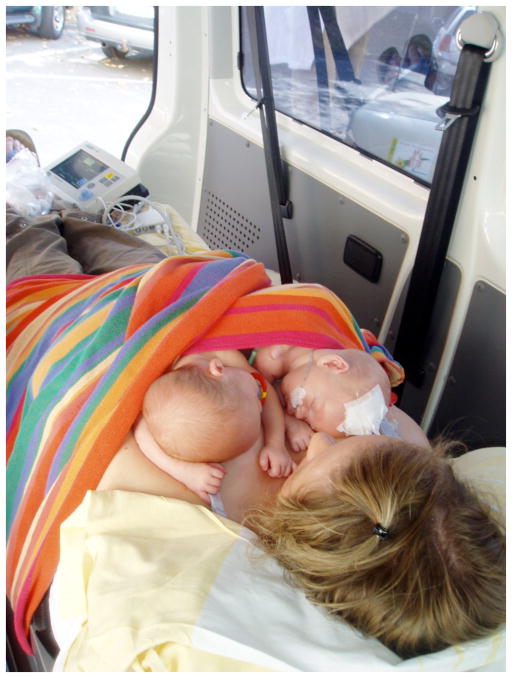
State-of-the-art Newborn Intensive Care Units (NICUs), instrumental in the survival of high-risk and ever-earlier-born preterm infants, often have costly human repercussions. The developmental sequelae of newborn intensive care are largely misunderstood. Developed countries eager to export their technologies must also transfer the knowledge-base that encompasses all high-risk and preterm infants' personhood as well as the neuro-essential importance of their parents. Without such understanding, the best medical care, while assuring survival jeopardizes infants' long-term potential and deprives parents of their critical role. Exchanging the womb for the NICU environment at a time of rapid brain growth compromises preterm infants' early development, which results in long-term physical and mental health problems and developmental disabilities. The Newborn Individualized Developmental Care and Assessment Program (NIDCAP) aims to prevent the iatrogenic sequelae of intensive care and to maintain the intimate connection between parent and infant, one expression of which is Kangaroo Mother Care. NIDCAP embeds the infant in the natural parent niche, avoids over-stimulation, stress, pain, and isolation while it supports self-regulation, competence, and goal orientation. Research demonstrates that NIDCAP improves brain development, functional competence, health, and life quality. It is cost effective, humane, and ethical, and promises to become the standard for all NICU care.
Keywords: Kangaroo Mother Care; NICU; NIDCAP; developmental care; premature infant; prematurity.
Figures



References
-
- Villar J, Merialdi M, Gulmezoglu AM, et al. Characteristics of randomized controlled trials included in systematic reviews of nutritional interventions reporting maternal morbidity, mortality, preterm delivery, intrauterine growth restriction and small for gestational age and birth weight outcomes. J Nutr. 2003;133(5 2):1632–9. - PubMed
-
- Creasy RK. Preventing preterm birth. NEJM. 1991;325:727–8. - PubMed
-
- Lockwood CJ, Kuczynski E. Risk stratification and pathological mechanisms in preterm delivery. Pediatr Perinatal Epidemiol. 2001;15(2):78–89. - PubMed
-
- Heron M, Sutton P, Xu J, Ventura S, Strobino D, Guyer B. Annual summary of vital statistics: 2007. Pediatrics. 2010;125:4–15. - PubMed
Grants and funding
LinkOut - more resources
Full Text Sources
Medical