


Developing patient-friendly genetic and genomic test reports: formats to promote patient engagement and understanding
- PMID: 25473429
- PMCID: PMC4254435
- DOI: 10.1186/s13073-014-0058-6
Developing patient-friendly genetic and genomic test reports: formats to promote patient engagement and understanding
Abstract
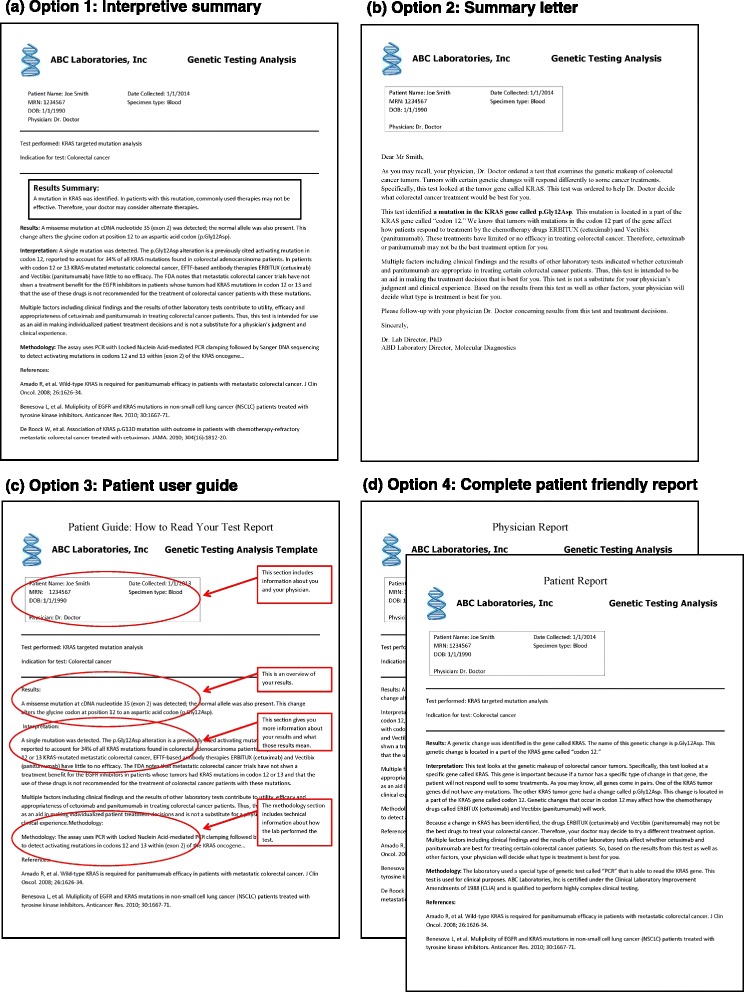
With the emergence of electronic medical records and patient portals, patients are increasingly able to access their health records, including laboratory reports. However, laboratory reports are usually written for clinicians rather than patients, who may not understand much of the information in the report. While several professional guidelines define the content of test reports, there are no guidelines to inform the development of a patient-friendly laboratory report. In this Opinion, we consider patient barriers to comprehension of lab results and suggest several options to reformat the lab report to promote understanding of test results and their significance to patient care, and to reduce patient anxiety and confusion. In particular, patients' health literacy, genetic literacy, e-health literacy and risk perception may influence their overall understanding of lab results and affect patient care. We propose four options to reformat lab reports: 1) inclusion of an interpretive summary section, 2) a summary letter to accompany the lab report, 3) development of a patient user guide to be provided with the report, and 4) a completely revised patient-friendly report. The complexity of genetic and genomic test reports poses a major challenge to patient understanding that warrants the development of a report more appropriate for patients.
Figures
References
-
- The Lewin Group: Laboratory Medicine: A National Status Report. ᅟ ᅟ 2008.
-
- Practice BTP. The Economic and Functional Impacts of Genetic and Genomic Clinical Laboratory Testing in the United States. 2012.
-
- UnitedHealth . Personalized Medicine: Trends and Prospects for the New Science of Genetic Testing and Molecular Diagnostics. St Paul: Center for Health Reform and Modernization; 2012.
-
- Miller DT, Adam MP, Aradhya S, Biesecker LG, Brothman AR, Carter NP, Church DM, Crolla JA, Eichler EE, Epstein CJ, Faucett WA, Feuk L, Friedman JM, Hamosh A, Jackson L, Kaminsky EB, Kok K, Krantz ID, Kuhn RM, Lee C, Ostell JM, Rosenberg C, Scherer SW, Spinner NB, Stavropoulos DJ, Tepperberg JH, Thorland EC, Vermeesch JR, Waggoner DJ, Watson MS, et al. Consensus statement: chromosomal microarray is a first-tier clinical diagnostic test for individuals with developmental disabilities or congenital anomalies. Am J Hum Genet. 2010;86:749–764. doi: 10.1016/j.ajhg.2010.04.006. - DOI - PMC - PubMed
LinkOut - more resources
Full Text Sources
Other Literature Sources
Miscellaneous
