. 2014 Dec 4;10(12):e1004537.
doi: 10.1371/journal.ppat.1004537. eCollection 2014 Dec.

Differential PfEMP1 expression is associated with cerebral malaria pathology

Affiliations

Differential PfEMP1 expression is associated with cerebral malaria pathology

Dumizulu L Tembo et al. PLoS Pathog. .

Abstract

Plasmodium falciparum is unique among human malarias in its ability to sequester in post-capillary venules of host organs. The main variant antigens implicated are the P. falciparum erythrocyte membrane protein 1 (PfEMP1), which can be divided into three major groups (A-C). Our study was a unique examination of sequestered populations of parasites for genetic background and expression of PfEMP1 groups. We collected post-mortem tissue from twenty paediatric hosts with pathologically different forms of cerebral malaria (CM1 and CM2) and parasitaemic controls (PC) to directly examine sequestered populations of parasites in the brain, heart and gut. Use of two different techniques to investigate this question produced divergent results. By quantitative PCR, group A var genes were upregulated in all three organs of CM2 and PC cases. In contrast, in CM1 infections displaying high levels of sequestration but negligible vascular pathology, there was high expression of group B var. Cloning and sequencing of var transcript tags from the same samples indicated a uniformly low expression of group A-like var. Generally, within an organ sample, 1-2 sequences were expressed at dominant levels. 23% of var tags were detected in multiple patients despite the P. falciparum infections being genetically distinct, and two tags were observed in up to seven hosts each with high expression in the brains of 3-4 patients. This study is a novel examination of the sequestered parasites responsible for fatal cerebral malaria and describes expression patterns of the major cytoadherence ligand in three organ-derived populations and three pathological states.


Conflict of interest statement

The authors have declared that no competing interests exist.

Figures
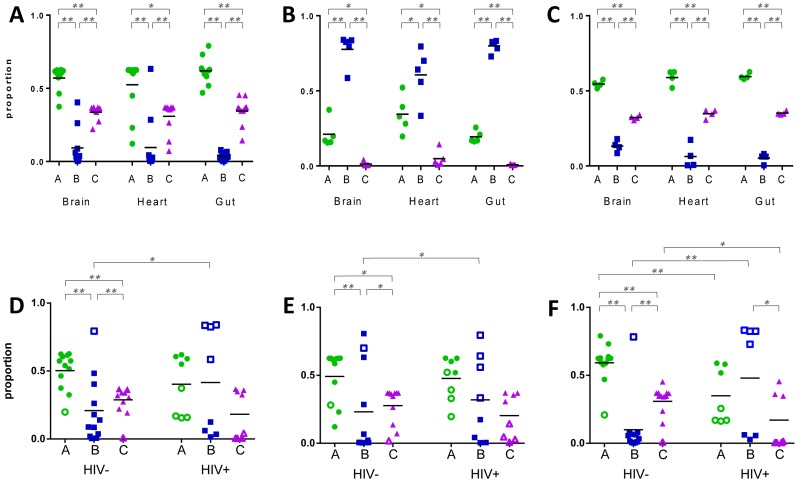
Figure 1
Figure 1. Expression of var gene groups in the organs of paediatric hosts.
Primers specific for var groups A, B and C were used to measure their relative expression in tissue biopsies from fatal paediatric malaria patients. Panels A–C display hosts within diagnostic groups CM2 (A), CM1 (B) and parasitaemic controls (C). Panels D–F represent P. falciparum populations in the brain (D), heart (E) and gut (F) of HIV-infected (HIV+) and uninfected (HIV-) hosts. Each dot point represents analysis from a single organ biopsy from one patient and the horizontal lines depict the mean level of expression for each group. In panels D–F, CM2/PC hosts are denoted by filled shapes and CM1 patients with open shapes. * p<0.05, ** p<0.005.
Figure 2
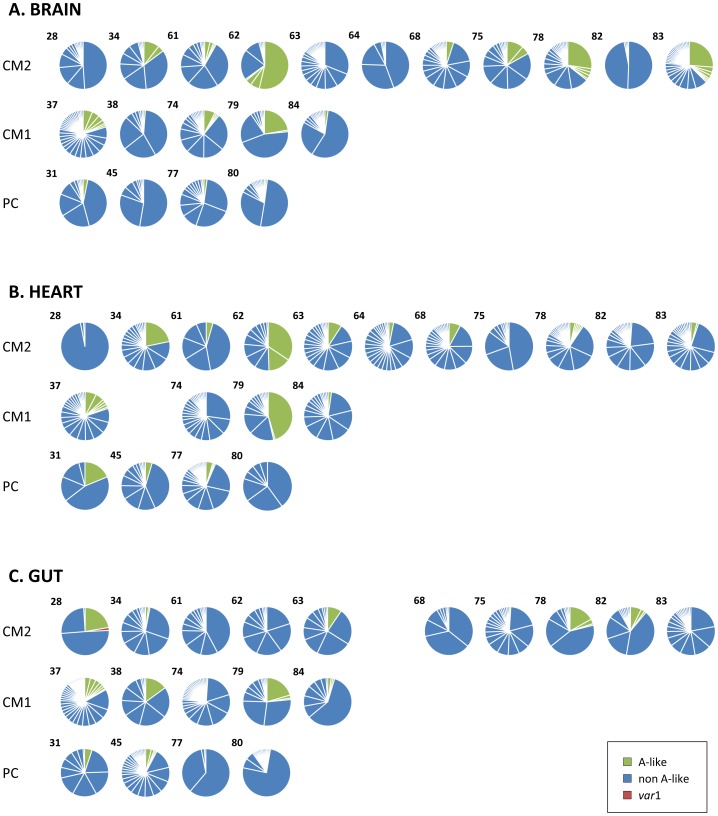
Figure 2. Distribution of individual var/PfEMP1-DBL1α types in fatal paediatric malaria hosts.
100 DBL1α tags were amplified and sequenced from each tissue biopsy and different sequence variants identified. Each pie graph represents all DBL1α types from a single organ of an individual host shown in the brain (A), heart (B) and gut (C). Case numbers are shown in the upper left corner of each graph and they are arranged by diagnostic group (CM, cerebral malaria; PC, parasitaemic controls). Tags are coloured by whether they are classified as group A-like var types (green) or non-group A (blue).
Figure 3
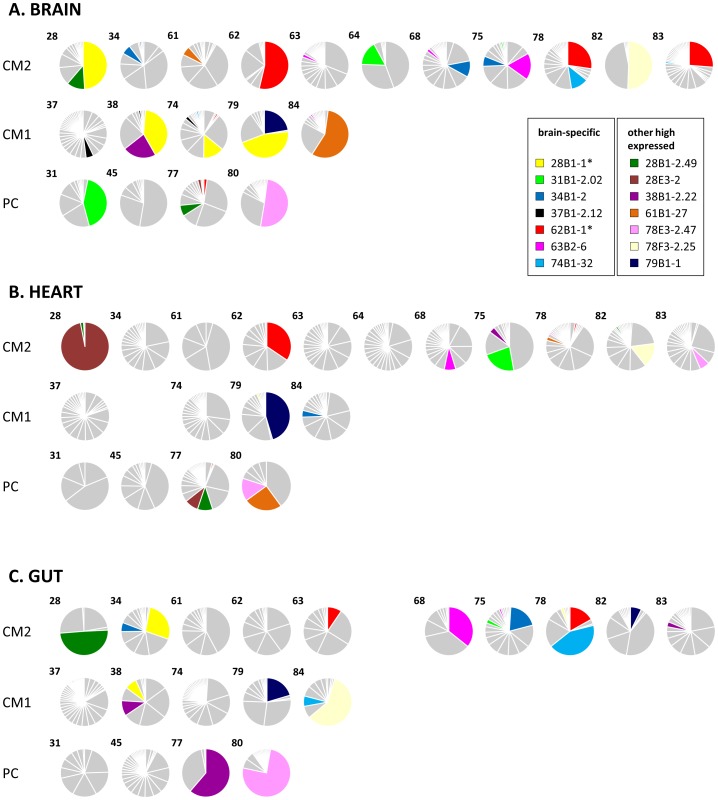
Figure 3. Distribution of individual var/PfEMP1-DBL1α types in the organs of fatal paediatric malaria hosts.
Each pie graph represents all DBL1α variants from a single organ of an individual host shown in the brain (A), heart (B) and gut (C). Case numbers are shown in the upper left corner of each graph and they are arranged by diagnostic group (CM, cerebral malaria; PC, parasitaemic controls). These charts are identical to those in Fig. 2 except that sections are shaded to highlight the DBL1α types that were detected in the highest number of different hosts. Further information on these can be found in S1 Table. The two DBL1α types detailed in results are marked with an asterisk.

References

    1. Enderes C, Kombila D, Dal-Bianco M, Dzikowski R, Kremsner P, et al. (2011) Var Gene promoter activation in clonal Plasmodium falciparum isolates follows a hierarchy and suggests a conserved switching program that is independent of genetic background. J Infect Dis 204: 1620–1631. - PubMed
    1. Recker M, Buckee CO, Serazin A, Kyes S, Pinches R, et al. (2011) Antigenic variation in Plasmodium falciparum malaria involves a highly structured switching pattern. PLoS Pathog 7: e1001306. - PMC - PubMed
    1. Warimwe GM, Recker M, Kiragu EW, Buckee CO, Wambua J, et al. (2013) Plasmodium falciparum var Gene Expression Homogeneity as a Marker of the Host-Parasite Relationship under Different Levels of Naturally Acquired Immunity to Malaria. PLoS One 8: e70467. - PMC - PubMed
    1. Dharia NV, Plouffe D, Bopp SE, Gonzalez-Paez GE, Lucas C, et al. (2010) Genome scanning of Amazonian Plasmodium falciparum shows subtelomeric instability and clindamycin-resistant parasites. Genome Res 20: 1534–1544. - PMC - PubMed
    1. Gardner MJ, Hall N, Fung E, White O, Berriman M, et al. (2002) Genome sequence of the human malaria parasite Plasmodium falciparum. Nature 419: 498–511. - PMC - PubMed

Publication types

Substances