


Objectively measured physical activity in obese women with and without migraine
- PMID: 25475207
- PMCID: PMC4821591
- DOI: 10.1177/0333102414562970
Objectively measured physical activity in obese women with and without migraine
Abstract
Aim: The aim of this article is to cross-sectionally compare objectively measured physical activity (PA) levels and their association with migraine characteristics in obese women with and without migraine.
Methods: Obese women seeking weight loss treatment were divided into migraine (n = 25) and control (n = 25) groups matched by age and body mass index (BMI). Participants wore the SenseWear Armband monitor for seven days to objectively evaluate daily light-(LPA) and moderate-to-vigorous intensity PA (MVPA). Migraine diagnosis was confirmed by a neurologist using ICHD-3-beta criteria. Migraine characteristics were tracked daily using a smartphone-based diary over a four-week period immediately preceding the objective PA assessment.
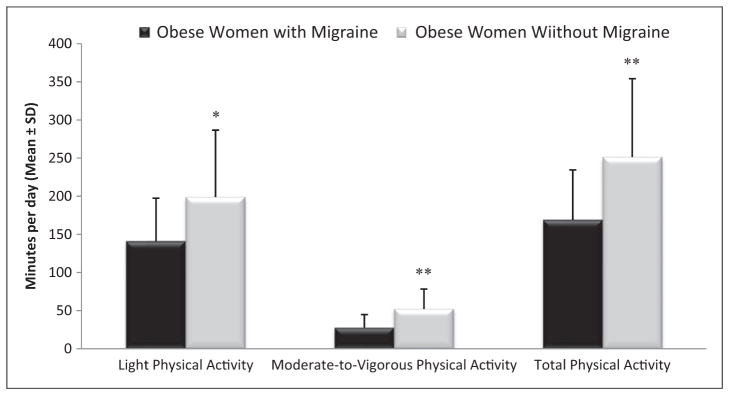
Results: Migraine participants spent 57.9 fewer minutes/day in LPA (141.1 ± 56.4 vs. 199.1 ± 87.7, p = 0.019) and 24.5 fewer minutes/day in MVPA (27.8 ± 17.0 vs. 52.3 ± 26.0, p < 0.001), compared to controls. Migraine participants reported 4.8 ± 3.1 migraine days/month (mean duration = 17.1 ± 8.9 hours; mean maximum pain severity = 6.4 ± 1.7 on a 0-10 scale). Higher BMI (p < 0.05), but not migraine characteristics, were related to lower total PA. Additionally, total objectively measured PA was not associated with how often PA was reported to exacerbate migraine attacks during the four-week diary assessment.
Conclusions: Obese women with migraine spent nearly 1.5 hours/day less in PA compared to controls; however, lower PA was not related to migraine characteristics. Further research is needed to identify PA barriers and effective interventions in obese women with migraine.
Trial registration: ClinicalTrials.gov NCT01197196 NCT01724632.
Keywords: Obesity; headache; migraine; physical activity; smartphone.
© International Headache Society 2014.
Conflict of interest statement
None declared.
Figures
References
-
- Bigal ME, Liberman JN, Lipton RB. Obesity and migraine: A population study. Neurology. 2006;66:545–550. - PubMed
-
- Bigal ME, Lipton RB. Obesity is a risk factor for transformed migraine but not chronic tension-type headache. Neurology. 2006;67:252–257. - PubMed
-
- Bigal ME, Tsang A, Loder E, et al. Body mass index and episodic headaches: A population-based study. Arch Intern Med. 2007;167:1964–1970. - PubMed
-
- Fava A, Pirritano D, Consoli D, et al. Chronic migraine in women is associated with insulin resistance: A cross-sectional study. Eur J Neurol. 2014;21:267–272. - PubMed
Publication types
MeSH terms
Associated data
Grants and funding
LinkOut - more resources
Full Text Sources
Other Literature Sources
Medical
Miscellaneous
