. 2015 Jun;29(3):346-351.
doi: 10.1007/s00540-014-1954-z. Epub 2014 Dec 5.

Effects of mechanical ventilation with different tidal volume on oxidative stress and antioxidant in lung

Affiliations

Effects of mechanical ventilation with different tidal volume on oxidative stress and antioxidant in lung

Zhen-Tao Sun et al. J Anesth. 2015 Jun.

Abstract

Purpose: The aim of this study was to investigate the changes in oxidative stress and antioxidants in lung tissue under different tidal volume ventilation conditions.

Methods: Forty-eight male Wistar rats were randomized into four groups, namely, group C, the control group, which was not ventilated, and groups C1, C2 and C3, the treatment groups, which were ventilated for 2 h with tidal volumes of 8, 30 and 42 ml/kg, respectively. The right middle lobe was assayed for malondialdehyde (MDA), the right posterior lobe was assayed using Western blotting for Nrf2, GCLm and SrX1 and the left lobe was assayed for Nrf2, GCLm and SrX1 mRNA.

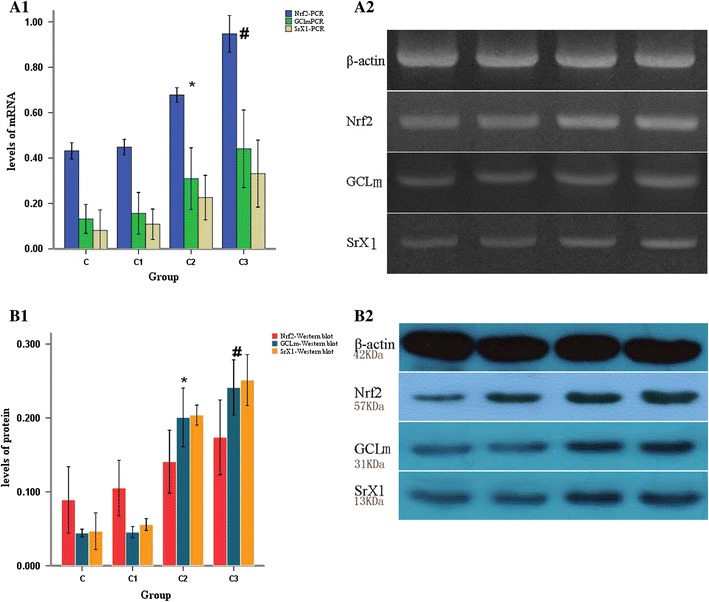
Results: The MDA levels were increased in the three treatment groups, with MDA levels highest in group C3 and lowest in group C1 (C3 > C2 > C1) (all P < 0.05). The mRNA expression of Nrf2, GCLm and SrX1 was highest in group C3 and lowest in group 1 (C3 > C2 > C1) (all P < 0.05). No significant difference was observed between group C1 and group C (P > 0.05). A Western blot analysis showed that Nrf2, GCLm and SrX1 expression was highest in group C3 and lowest in group C1 (C3 > C2 > C1) (all P < 0.05). No significant difference was observed between group C1 and group C (P > 0.05).

Conclusions: Oxidative stress and antioxidant enzyme levels in the lungs of rats were positively associated with the tidal volumes of mechanical ventilation, suggesting that higher tidal volumes cause more severe oxidative stress and increased antioxidant responses.


Figures
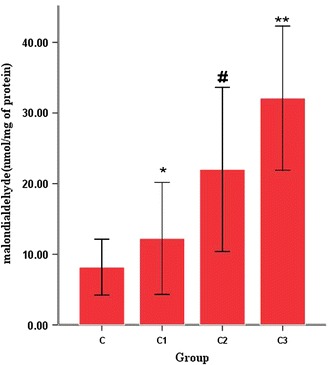
Fig. 1
Fig. 1
The levels of lung malondialdehyde (MDA) in the four groups of experimental rats. Mechanical ventilation (MV) at three different tidal volumes differentially affected lung oxidative stress responses in the rats. C1, C2, C3 Groups of rats (treatment) ventilated for 2 h with tidal volumes of 8, 30 and 42 ml/kg, respectively, C control group (no MV). The level of oxidative stress in lung tissue was measured MDA level. The MDA level was higher in group C1 than in group C (*P < 0.05), higher in group C2 than in group C1 (# P < 0.05) and higher in group C3 than group C2 (**P < 0.05)
Fig. 2
Fig. 2
The lung antioxidant response in the ventilated rats. The lung antioxidant response was induced in rats subjected to the different MV tidal volumes. a1, a2 The expression level of the housekeeping gene β-actin was used to normalize expression of the three candidate genes: nuclear factor (erythroid-derived 2)-like (Nrf2), glutamate cysteine ligase modifier subunit (GCLm) and sulfiredoxin-1(Srx1). b1, b2 The level of the housekeeping protein β-actin was used to normalize the levels of the three candidate proteins: Nrf2, GCLm and SrX1. The results are given as the mean ± standard deviation. *P < 0.05. The expression of all three genes and proteins was higher in group C2 than group C1 (P < 0.05) and higher in group C3 than group C2 (# P < 0.05) (C3 > C2 > C1). There were no significant differences between the levels of these biomarkers in group C1 and group C (P > 0.05)

References

    1. Ventrice EA, Marti-Sistac O, Gonzalvo R, Villagra A, Lopez-Aguilar J, Blanch L. [Molecular and biophysical mechanisms and modulation of ventilator-induced lung injury]. Mecanismos biofisicos, celulares y modulacion de la lesion pulmonar inducida por la ventilacion mecanica. Medicina intensiva/Sociedad Espanola de Medicina Intensiva y Unidades Coronarias. 2007;31(2):73–82. doi: 10.1016/S0210-5691(07)74779-4. - DOI - PubMed
    1. Chapman KE, Sinclair SE, Zhuang D, Hassid A, Desai LP, Waters CM. Cyclic mechanical strain increases reactive oxygen species production in pulmonary epithelial cells. Am J Physiol Lung Cell Mol Physiol. 2005;289(5):L834–L841. doi: 10.1152/ajplung.00069.2005. - DOI - PubMed
    1. Dreyfuss D, Soler P, Basset G, Saumon G. High inflation pressure pulmonary edema. Respective effects of high airway pressure, high tidal volume, and positive end-expiratory pressure. Am Rev Respir Dis. 1988;137(5):1159–1164. doi: 10.1164/ajrccm/137.5.1159. - DOI - PubMed
    1. Papaiahgari S, Yerrapureddy A, Hassoun PM, Garcia JG, Birukov KG, Reddy SP. EGFR-activated signaling and actin remodeling regulate cyclic stretch-induced NRF2-ARE activation. Am J Respir Cell Mol Biol. 2007;36(3):304–312. doi: 10.1165/rcmb.2006-0131OC. - DOI - PMC - PubMed
    1. Fu P, Murley JS, Grdina DJ, Birukova AA, Birukov KG. Induction of cellular antioxidant defense by amifostine improves ventilator-induced lung injury. Crit Care Med. 2011;39(12):2711–2721. - PMC - PubMed

Publication types