. 2015 Feb;20(1):61-75.
doi: 10.1016/j.media.2014.10.007. Epub 2014 Nov 8.

Predict brain MR image registration via sparse learning of appearance and transformation

Affiliations

Predict brain MR image registration via sparse learning of appearance and transformation

Qian Wang et al. Med Image Anal. 2015 Feb.

Abstract

We propose a new approach to register the subject image with the template by leveraging a set of intermediate images that are pre-aligned to the template. We argue that, if points in the subject and the intermediate images share similar local appearances, they may have common correspondence in the template. In this way, we learn the sparse representation of a certain subject point to reveal several similar candidate points in the intermediate images. Each selected intermediate candidate can bridge the correspondence from the subject point to the template space, thus predicting the transformation associated with the subject point at the confidence level that relates to the learned sparse coefficient. Following this strategy, we first predict transformations at selected key points, and retain multiple predictions on each key point, instead of allowing only a single correspondence. Then, by utilizing all key points and their predictions with varying confidences, we adaptively reconstruct the dense transformation field that warps the subject to the template. We further embed the prediction-reconstruction protocol above into a multi-resolution hierarchy. In the final, we refine our estimated transformation field via existing registration method in effective manners. We apply our method to registering brain MR images, and conclude that the proposed framework is competent to improve registration performances substantially.

Keywords: Brain MR image registration; Correspondence detection; Deformable image registration; Sparsity learning; Transformation prediction.


Figures

Figure 1
Figure 1
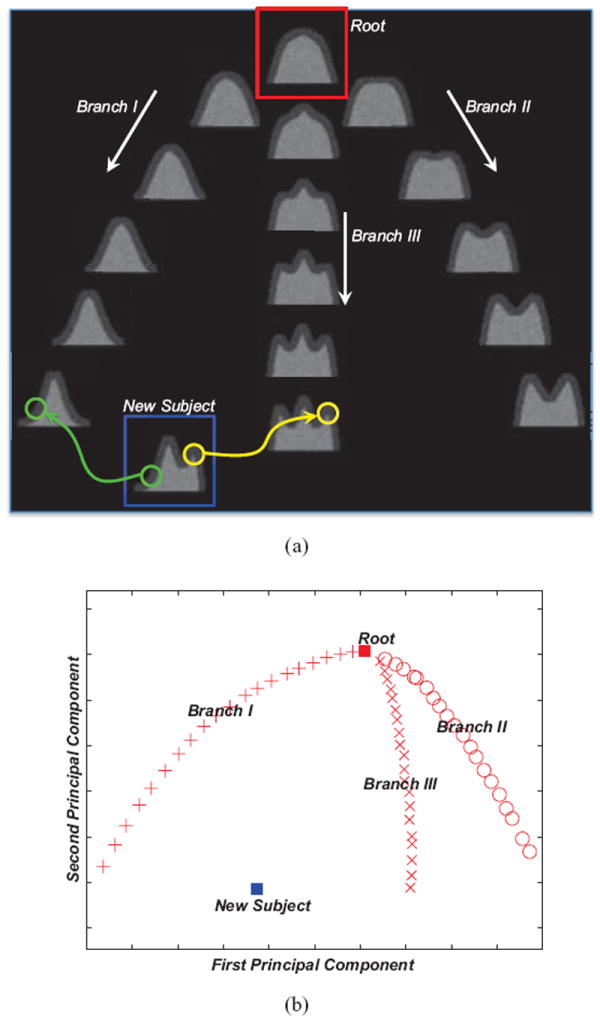
In (a), three branches, as well as the new subject, are simulated by deforming the root. The new subject is able to utilize the patch-scale guidance from individual intermediate images for the registration with the root. The distribution of all images, after being projected to the 2D PCA plane, is shown in (b).
Figure 2
Figure 2
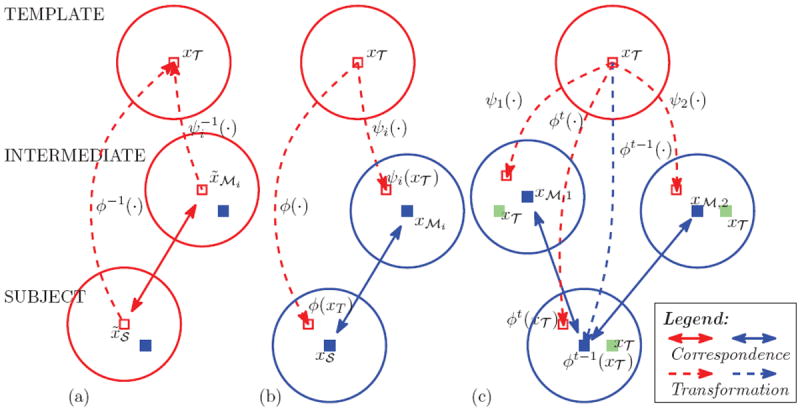
Illustration of the predictability of the transformation: (a) The correspondence between the template point xT and the subject point S is established as both points identify Mi as their correspondence in the intermediate image; (b) The subject transformation ϕ(xT) is predictable from the intermediate transformation ψi(xT) as in Eq. 1, if xMi and xS are correspondences to each other; (c) Multiple correspondence candidates of xM might be detected, thus resulting in multiple predictions upon the subject transformation ϕ(xT).
Figure 3
Figure 3
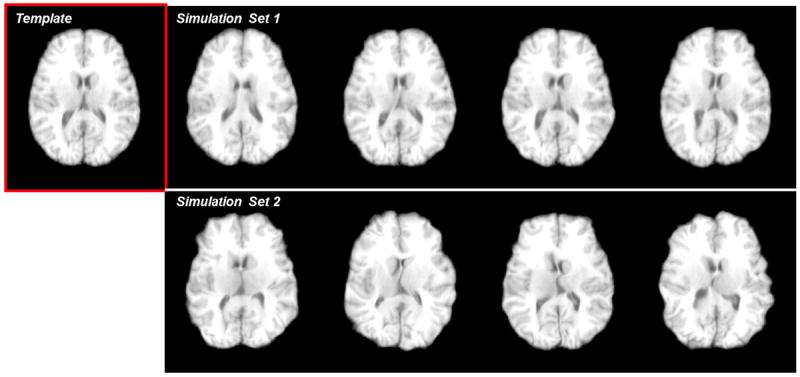
The template (highlighted by the red box) and samples of the simulated images for Section 3.1. In the first set, the B-Spline coefficients of the control points are uniformly sampled from −10mm to +10mm. In the second set, the coefficients are sampled from −20mm to +20mm. All control points are placed 8mm apart isotropically.
Figure 4
Figure 4
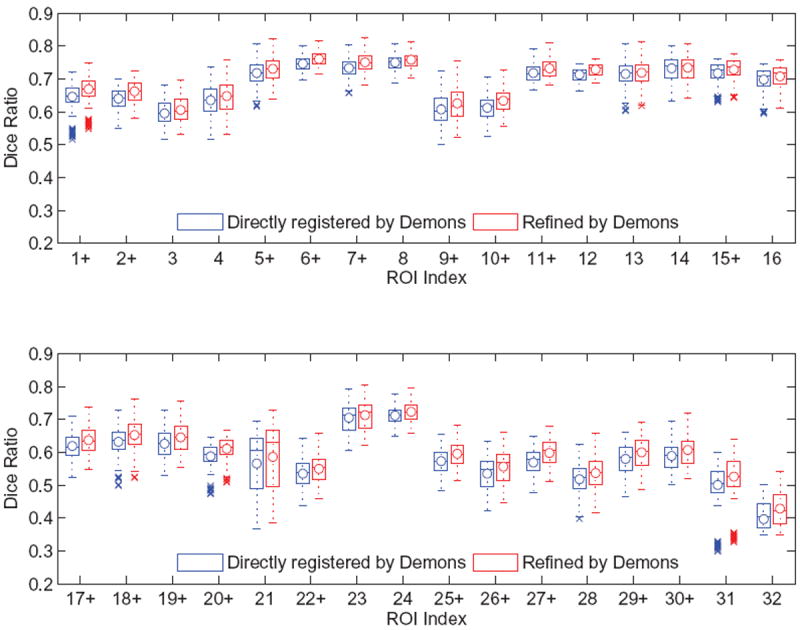
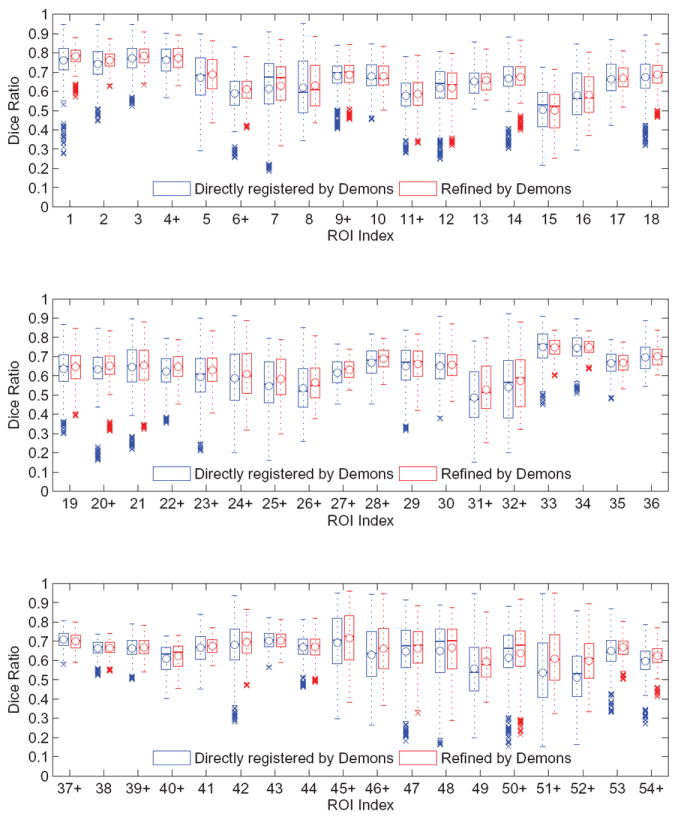
The box and whisker plots of the Dice ratios upon the NIREP NA0 dataset after (1) direct registration by Demons and (2) refining the outputs of our method by Demons. The ROI names corresponding to their indices are listed in Table 5.
Figure 5
Figure 5
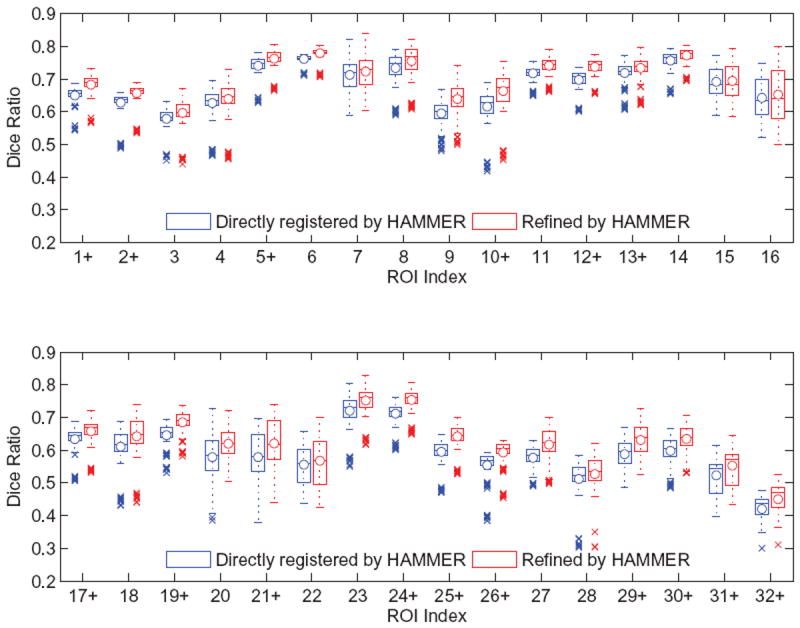
The box and whisker plots of the Dice ratios upon the NIREP NA0 dataset after (1) direct registration by HAMMER and (2) refining the outputs of our method by HAMMER. The ROI names corresponding to their indices are listed in Table 5.
Figure 6
Figure 6
The box and whisker plots of the Dice ratios upon the LONI LPBA40 dataset after (1) direct registration by Demons and (2) refining the outputs of our method by Demons. The ROI names corresponding to their indices are listed in Table 6.
Figure 7
Figure 7
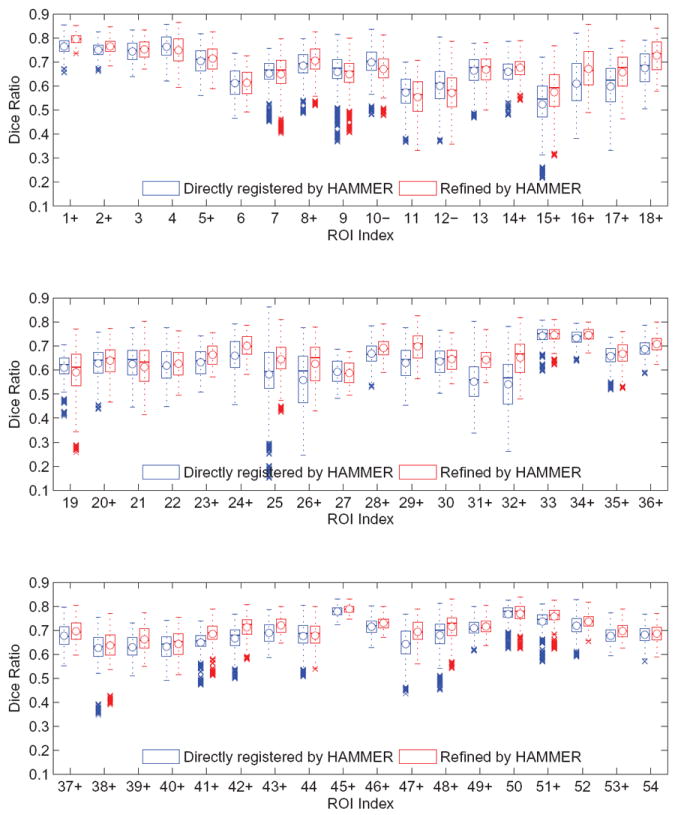
The box and whisker plots of the Dice ratios upon the LONI LPBA40 dataset after (1) direct registration by HAMMER and (2) refining the outputs of our method by HAMMER. The ROI names corresponding to their indices are listed in Table 6.

References

    1. Aljabar P, Wolz R, Rueckert D. Machine Learning in Computer-Aided Diagnosis: Medical Imaging Intelligence and Analysis. IGI Global; 2012. Manifold learning for medical image registration, segmentation, and classification.
    1. Bookstein FL. Principal warps: thin-plate splines and the decomposition of deformations. Pattern Analysis and Machine Intelligence, IEEE Transactions on. 1989;11:567–585.
    1. Chou CR, Frederick B, Mageras G, Chang S, Pizer S. 2d/3d image registration using regression learning. Computer Vision and Image Understanding. 2013;117:1095–1106. - PMC - PubMed
    1. Chui H, Rangarajan A. A new point matching algorithm for non-rigid registration. Computer Vision and Image Understanding. 2003;89:114–141.
    1. Dalal P, Shi F, Shen D, Wang S. Multiple cortical surface correspondence using pairwise shape similarity. In: Jiang T, Navab N, Pluim J, Viergever M, editors. Medical Image Computing and Computer-Assisted Intervention – MICCAI 2010. Springer; Berlin Heidelberg: 2010. pp. 349–356. - PMC - PubMed

Publication types

MeSH terms