. 2015 Jan;25(1):141-50.
doi: 10.1016/j.euroneuro.2014.07.014. Epub 2014 Aug 4.

Cognitive deficits associated with combined HIV gp120 expression and chronic methamphetamine exposure in mice

Collaborators, Affiliations

Cognitive deficits associated with combined HIV gp120 expression and chronic methamphetamine exposure in mice

James P Kesby et al. Eur Neuropsychopharmacol. 2015 Jan.

Abstract

Methamphetamine abuse is common among individuals infected by human immunodeficiency virus (HIV). Neurocognitive outcomes tend to be worse in methamphetamine users with HIV. However, it is unclear whether discrete cognitive domains are susceptible to impairment after combined HIV infection and methamphetamine abuse. The expression of HIV/gp120 protein induces neuropathology in mice similar to HIV-induced pathology in humans. We investigated the separate and combined effects of methamphetamine exposure and gp120 expression on cognitive function in transgenic (gp120-tg) and control mice. The mice underwent an escalating methamphetamine binge regimen and were tested in novel object/location recognition, object-in-place recognition, and Barnes maze tests. gp120 expression disrupted performance in the object-in-place test (i.e. similar time spent with all objects, regardless of location), indicating deficits in associative recognition memory. gp120 expression also altered reversal learning in the Barnes maze, suggesting impairments in executive function. Methamphetamine exposure impaired spatial strategy in the Barnes maze, indicating deficits in spatial learning. Methamphetamine-exposed gp120-tg mice had the lowest spatial strategy scores in the final acquisition trials in the Barnes maze, suggesting greater deficits in spatial learning than all of the other groups. Although HIV infection involves interactions between multiple proteins and processes, in addition to gp120, our findings in gp120-tg mice suggest that humans with the dual insult of HIV infection and methamphetamine abuse may exhibit a broader spectrum of cognitive deficits than those with either factor alone. Depending on the cognitive domain, the combination of both insults may exacerbate deficits in cognitive performance compared with each individual insult.

Keywords: Behavior; Recognition memory; Spatial learning; Transgenic.


Conflict of interest statement

Conflicts of interest

AM has received contract research support from Bristol-Myers Squibb, Forest Laboratories, and Astra-Zeneca and honoraria/consulting fees from AbbVie during the past 3 years. The remaining authors report no financial conflicts of interest.

Figures
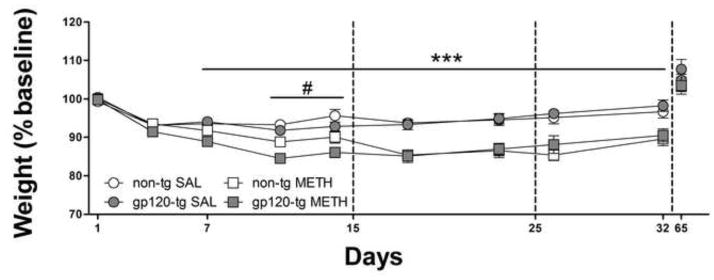
Fig. 1
Fig. 1
Effects of an escalating methamphetamine (METH) binge on fluctuations in the percentage of baseline weight. Methamphetamine-exposed mice lost significantly more weight than saline (SAL)-exposed mice from day 7–32 of the regimen. Furthermore, gp120-tg mice lost more weight than non-tg mice on days 11 and 14 of the regimen, regardless of methamphetamine or saline exposure. The data are expressed as mean ± SEM. ***p < 0.001, significant difference between saline- and methamphetamine-exposed mice; #p < 0.05, significant difference between non-tg and gp120-tg mice.
Fig. 2
Fig. 2
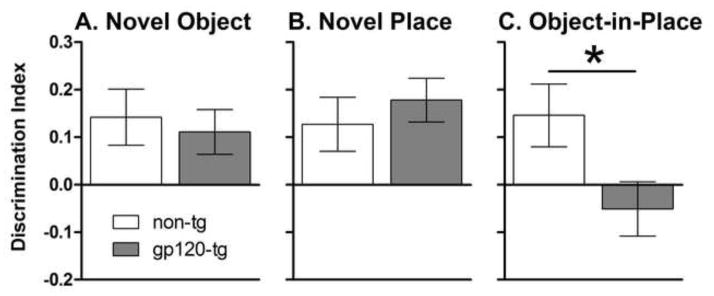
Novel object (A), novel place (B), and object-in-place (C) recognition tasks in non-tg and gp120-tg mice. The expression of gp120 led to a significantly reduced discrimination index ([novel - familiar]/total) in the object-in-place recognition task compared with non-tg mice. No significant effects of methamphetamine exposure were evident; therefore, the data were collapsed for the purpose of representing genotype effects. The data are expressed as mean ± SEM. *p < 0.05.
Fig. 3
Fig. 3
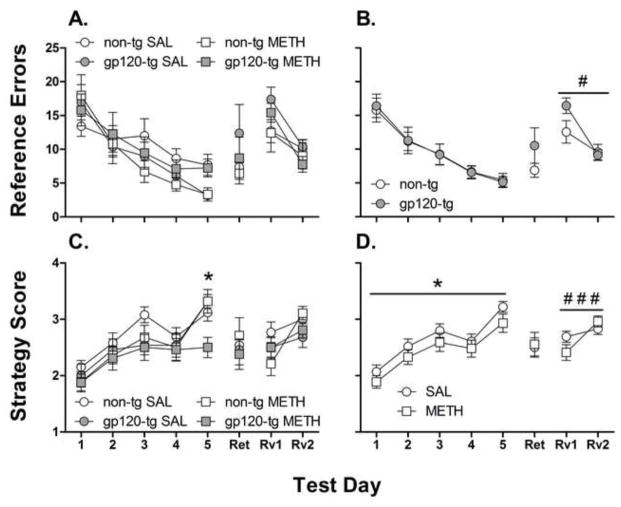
Average reference errors made (A, B) and strategy scores (C, D) in the Barnes maze during acquisition (days 1–5), retention (Ret), and reversal learning on days 1 and 2 (Rv1 and Rv2, respectively). gp120-tg mice tended to make more errors on the first day of reversal learning (B) compared with non-tg mice. Methamphetamine (METH)-exposed gp120-tg mice had significantly worse strategy scores on day 5 of acquisition (C) than all of the other groups, suggesting that gp120 expression further impaired methamphetamine-induced spatial strategy deficits during acquisition (D). Methamphetamine-exposed mice used a worse average strategy on reversal learning day 1 vs. day 2 (D), whereas saline (SAL)-exposed mice did not improve from day 1 to day 2 of reversal learning. The data are expressed as mean ± SEM. (B) #p < 0.05, significant Genotype × Day interaction; (C) *p < 0.05, methamphetamine-exposed gp120-tg mice significantly different from all other groups; (D) *p < 0.05, significant main effect of Methamphetamine; ###p < 0.001, significant difference between day 1 and day 2 in methamphetamine-exposed mice.
Fig. 4
Fig. 4
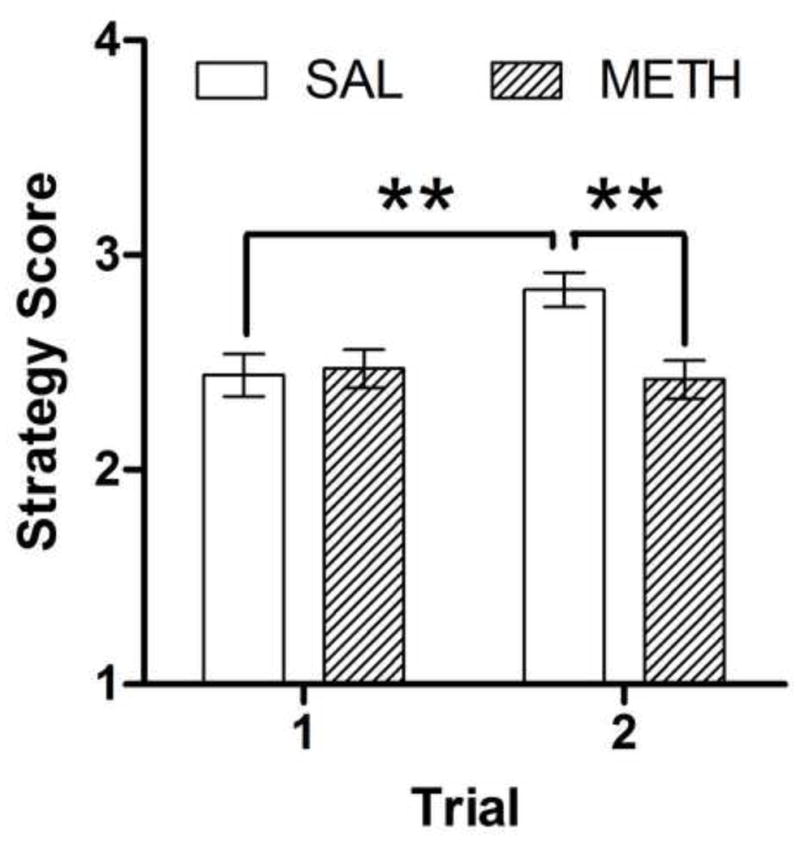
Comparison of strategy scores between saline (SAL)- and methamphetamine (METH)-exposed mice in the first and second trials of each day of acquisition in the Barnes maze. Saline-exposed mice showed a significantly improved strategy score in trial 2 compared with trial 1, whereas methamphetamine-exposed mice did not. No significant effects of genotype were detected; therefore, the data were collapsed for the purpose of representing methamphetamine effects. The data are expressed as mean ± SEM. **p < 0.01.

References

    1. Achim CL, Adame A, Dumaop W, Everall IP, Masliah E. Increased accumulation of intraneuronal amyloid beta in HIV-infected patients. J Neuroimmune Pharm. 2009;4:190–199. - PMC - PubMed
    1. Barnes CA. Memory deficits associated with senescence: a neurophysiological and behavioral study in the rat. J Comp Physiol Psychol. 1979;93:74–104. - PubMed
    1. Barker GRI, Warburton EC. When is the hippocampus involved in recognition memory? J Neurosci. 2011;31:10721–10731. - PMC - PubMed
    1. Barker GRI, Warburton EC. Object-in-place associative recognition memory depends on glutamate receptor neurotransmission within two defined hippocampal-cortical circuits: a critical role for AMPA and NMDA receptors in the hippocampus, perirhinal, and prefronal cortices. Cerebral Cortex. 2013 in press. - PMC - PubMed
    1. Barker GRI, Bird F, Alexander V, Warburton EC. Recognition memory for objects, place, and temporal order: a disconnection analysis of the role of the medial prefrontal cortex and perirhinal cortex. J Neurosci. 2007;27:2948–2957. - PMC - PubMed

Publication types

MeSH terms

Substances