


doi: 10.1373/clinchem.2014.223016.
Epub 2014 Dec 4.
Nanopore sequencing: from imagination to reality
Affiliations
- PMID: 25477535
- PMCID: PMC4404466
- DOI: 10.1373/clinchem.2014.223016
Item in Clipboard
Nanopore sequencing: from imagination to reality
Clin Chem.
2015 Jan.
No abstract available
Conflict of interest statement
Figures
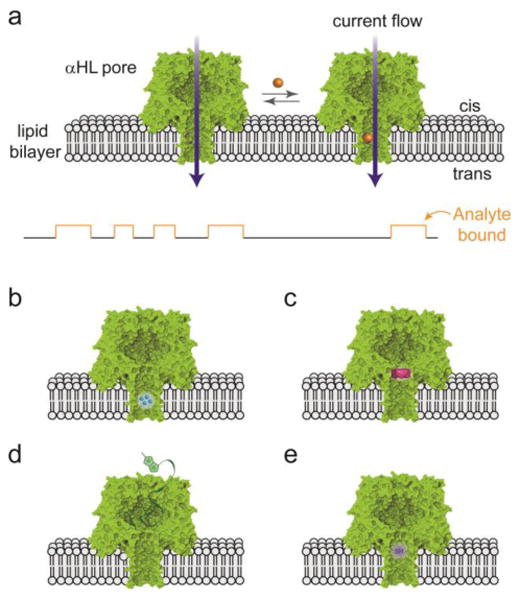
A), Sensing with the αHL pore. The current carried by aqueous ions through an individual pore is monitored. Analytes binding at a site within the pore lumen are detected through a transient change in the current. Binding sites can be formed by: B), genetic engineering, C), targeted chemical modification, e.g. with a molecule adapter (as shown). Large analytes can be detected by a ligand presented outside the pore lumen: D), ligand on a polymer chain. E), Covalent chemical reactions occurring within the pore can also be detected. Here a single reactive thiol group is shown. Adapted from (5).
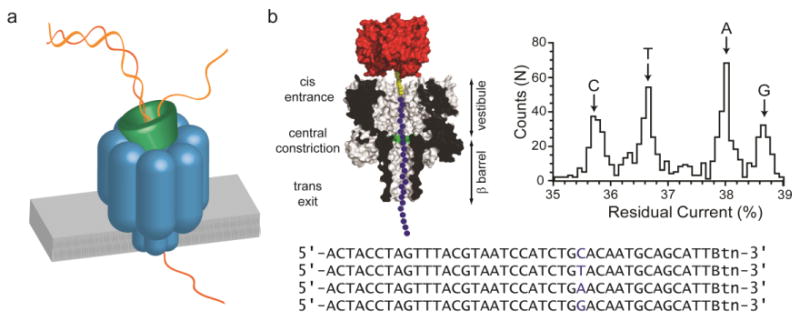
A), Basis of nanopore sequencing. ssDNA is fed through an individual protein pore by an enzyme that handles dsDNA. The sequence is determined by analysis of fluctuations in the ionic current. B), Early base identification experiments. ssDNAs were suspended in an αHL pore by attachment to streptavidin to mimic the ratcheting motion of the enzyme. The bases G, A, T and C in a DNA hetero-oligomer each gave a different residual ionic current. Adapted from (25).
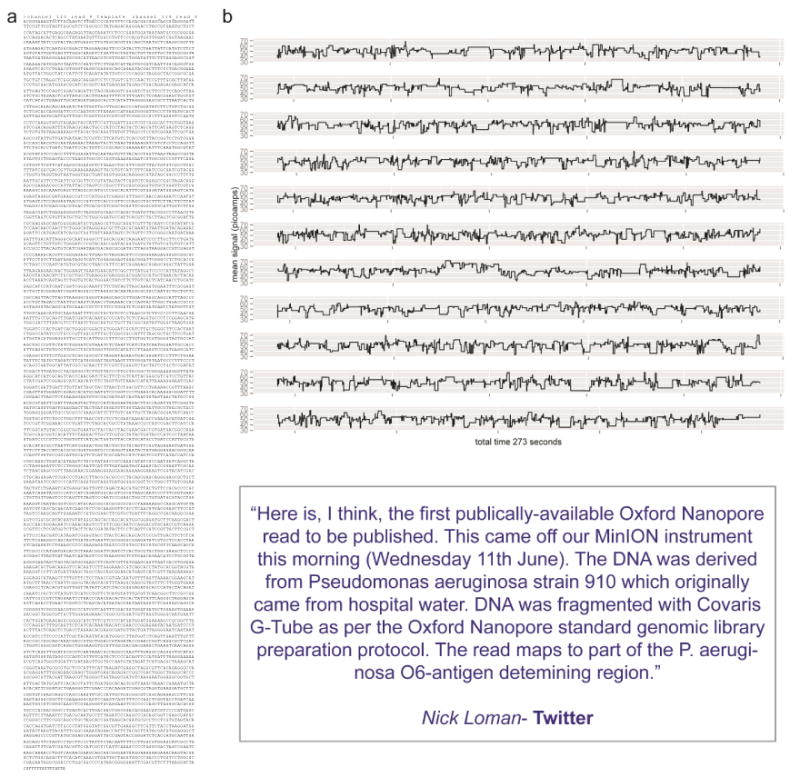
A), The first accessible sequence, from Pseudomonas aeruginosa 910: released on twitter on 11th June 2014 by N. Loman, University of Birmingham. B), Ionic current data from the MinION in the form of a “wiggle plot” (32).
References
-
- Tobkes N, Wallace BA, Bayley H. Secondary structure and assembly mechanism of an oligomeric channel protein. Biochemistry. 1985;24:1915–20. - PubMed
-
- Bayley H. Membrane-protein structure: Piercing insights. Nature. 2009;459:651–2. - PubMed
-
- Song L, et al. Structure of staphylococcal α-hemolysin, a heptameric transmembrane pore. Science. 1996;274:1859–65. - PubMed
-
- Braha O, et al. Designed protein pores as components for biosensors. Chem Biol. 1997;4:497–505. - PubMed
-
- Bayley H, Cremer PS. Stochastic sensors inspired by biology. Nature. 2001;413:226–30. 2001. - PubMed
Publication types
MeSH terms
Substances
Grants and funding
LinkOut - more resources
Full Text Sources
Other Literature Sources
