


Heritability and genetic advance among chili pepper genotypes for heat tolerance and morphophysiological characteristics
- PMID: 25478590
- PMCID: PMC4248334
- DOI: 10.1155/2014/308042
Heritability and genetic advance among chili pepper genotypes for heat tolerance and morphophysiological characteristics
Abstract
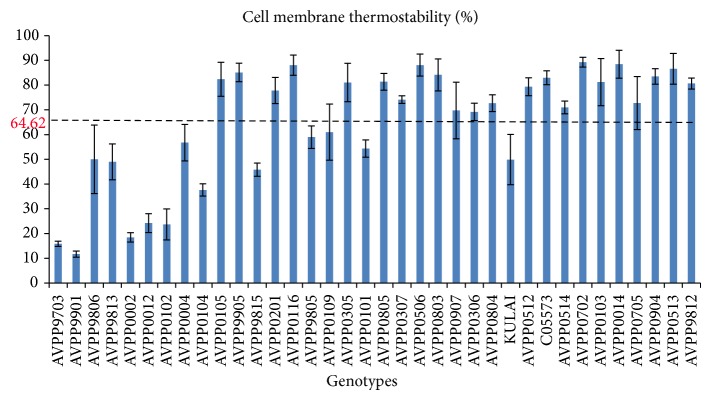
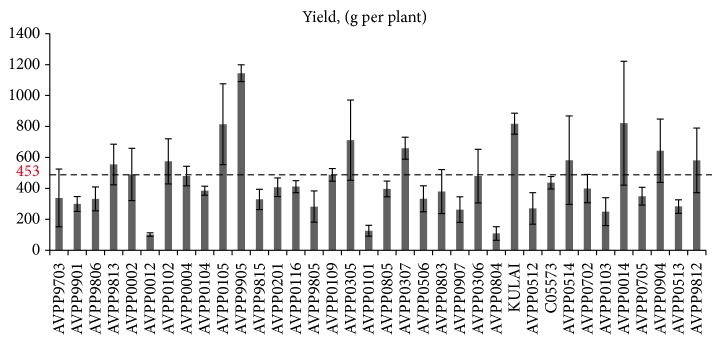
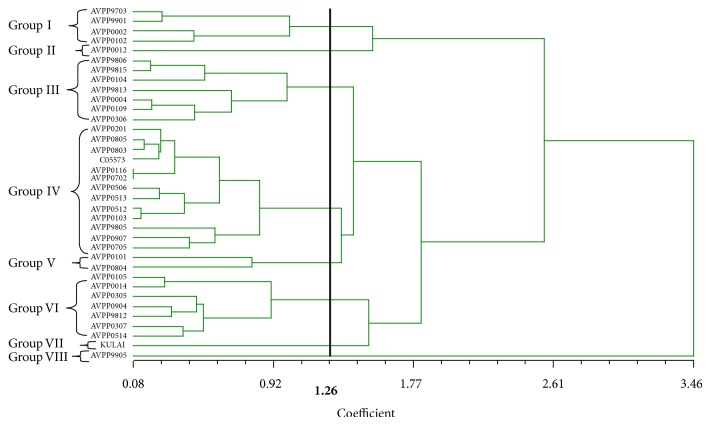
High temperature tolerance is an important component of adaptation to arid and semiarid cropping environment in chili pepper. Two experiments were carried out to study the genetic variability among chili pepper for heat tolerance and morphophysiological traits and to estimate heritability and genetic advance expected from selection. There was a highly significant variation among the genotypes in response to high temperature (CMT), photosynthesis rate, plant height, disease incidence, fruit length, fruit weight, number of fruits, and yield per plant. At 5% selection intensity, high genetic advance as percent of the mean (>20%) was observed for CMT, photosynthesis rate, fruit length, fruit weight, number of fruits, and yield per plant. Similarly, high heritability (>60%) was also observed indicating the substantial effect of additive gene more than the environmental effect. Yield per plant showed strong to moderately positive correlations (r = 0.23-0.56) at phenotypic level while at genotypic level correlation coefficient ranged from 0.16 to 0.72 for CMT, plant height, fruit length, and number of fruits. Cluster analysis revealed eight groups and Group VIII recorded the highest CMT and yield. Group IV recorded 13 genotypes while Groups II, VII, and VIII recorded one each. The results showed that the availability of genetic variance could be useful for exploitation through selection for further breeding purposes.
Figures
References
-
- Dahal K., Sharma M., Dhakal D., Shakya S. Evaluation of heat tolerant chilli (Capsicum annuum L.) genotypes in western terai of nepal. Journal of the Institute of Agriculture and Animal Science. 2006;27:59–64.
-
- Berke T., Black L. L., Talekar N. S., Wang J. F., Gniffke P., Green S. K., Wang T. C., Morris R. International Co-Operator's Guide. 2005. Suggested cultural practices for chilli pepper.
-
- Anim Agriculture Technology, 2013, http://animagro.blogspot.com/2011/10/chilliinMalaysia.html.
-
- Craufurd P. Q., Prasad P. V. V., Kakani V. G., Wheeler T. R., Nigam S. N. Heat tolerance in groundnut. Field Crops Research. 2003;80(1):63–77. doi: 10.1016/S0378-4290(02)00155-7. - DOI
-
- Nechif O., Filimon R., Szilagyi L. Genetic variability, heritability and expected genetic advance as indices for yield and yield components selection in common bean (Phaseolus vulgaris L.) Scientific Papers, UASVM Bucharest, Series A. 2011;(1222-5339)
Publication types
MeSH terms
LinkOut - more resources
Full Text Sources
Other Literature Sources
