. 2014 Dec 4;6(12):3326-43.
doi: 10.1093/gbe/evu265.

Is it an ant or a butterfly? Convergent evolution in the mitochondrial gene order of Hymenoptera and Lepidoptera

Affiliations

Is it an ant or a butterfly? Convergent evolution in the mitochondrial gene order of Hymenoptera and Lepidoptera

Massimiliano Babbucci et al. Genome Biol Evol. .

Abstract

Insect mitochondrial genomes (mtDNA) are usually double helical and circular molecules containing 37 genes that are encoded on both strands. The arrangement of the genes is not constant for all species, and produces distinct gene orders (GOs) that have proven to be diagnostic in defining clades at different taxonomic levels. In general, it is believed that distinct taxa have a very low chance of sharing identically arranged GOs. However, examples of identical, homoplastic local rearrangements occurring in distinct taxa do exist. In this study, we sequenced the complete mtDNAs of the ants Formica fusca and Myrmica scabrinodis (Formicidae, Hymenoptera) and compared their GOs with those of other Insecta. The GO of F. fusca was found to be identical to the GO of Dytrisia (the largest clade of Lepidoptera). This finding is the first documented case of an identical GO shared by distinct groups of Insecta, and it is the oldest known event of GO convergent evolution in animals. Both Hymenoptera and Lepidoptera acquired this GO early in their evolution. Using a phylogenetic approach combined with new bioinformatic tools, the chronological order of the evolutionary events that produced the diversity of the hymenopteran GOs was determined. Additionally, new local homoplastic rearrangements shared by distinct groups of insects were identified. Our study showed that local and global homoplasies affecting the insect GOs are more widespread than previously thought. Homoplastic GOs can still be useful for characterizing the various clades, provided that they are appropriately considered in a phylogenetic and taxonomic context.

Keywords: Hymenoptera; Lepidoptera; convergent evolution; gene order analysis; gene order evolution; mitochondrial genomics.


Figures

F<sc>ig</sc>. 1.—
Fig. 1.—
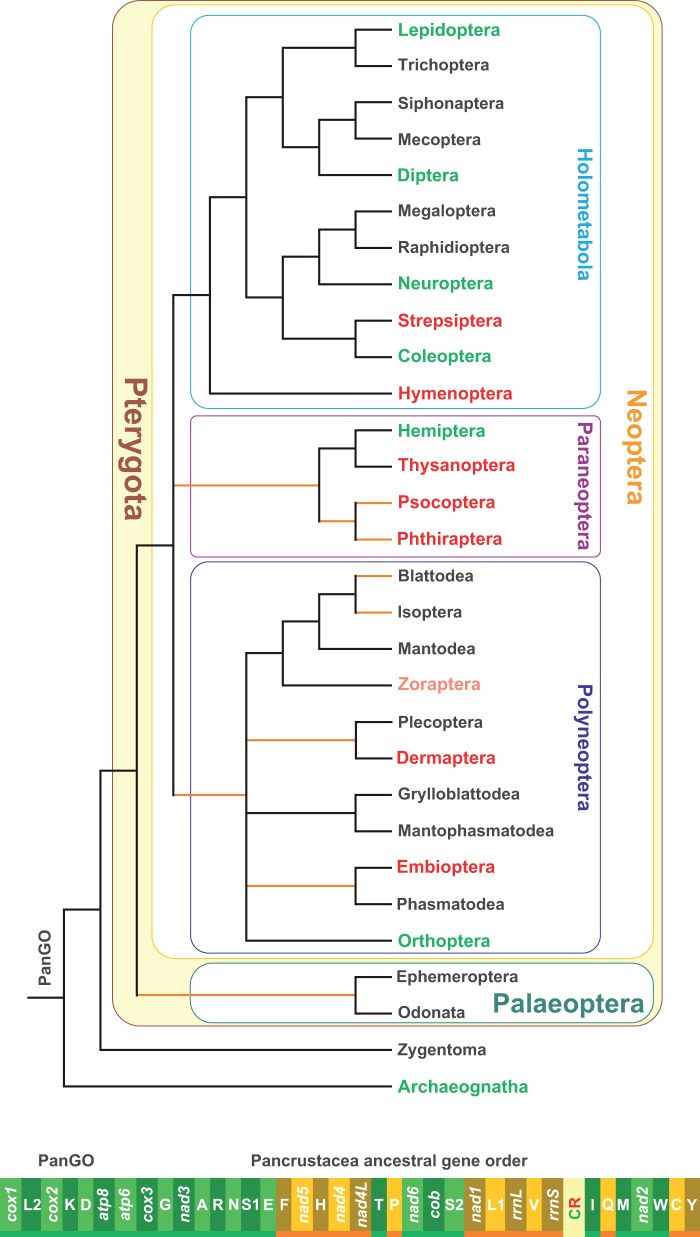
The PanGO and the distribution of GOs in the different orders of Insecta. The PanGO is linearized starting from cox1. The genes encoded on the α-strand (orientation from right to left in fig. 1) are represented in a light/deep green background, whereas those encoded on the β-strand (orientation from left to right in fig. 1) are depicted with a bright yellow/light brown background. The genes on the α-strand are underlined in green, whereas those on the β-strand are underlined in orange. Genes nomenclature: atp6 and atp8: ATP synthase subunits 6 and 8; cob: apocytochrome b; cox1-3: cytochrome c oxidase subunits 1–3; nad1-6 and nad4 L: NADH dehydrogenase subunits 1–6 and 4 L; rrnS and rrnL: small and large subunit ribosomal RNA (rRNA) genes; X: transfer RNA (tRNA) genes, where X is the one-letter abbreviation of the corresponding amino acid, in particular L1 (CTN codon family) L2 (TTR codon family), S1 (AGN codon family) S2 (TCN codon family). The consensus phylogenetic tree depicts the phylogenetic relationships among the 30 existing orders forming the class Insecta. The tree was based principally on the papers of Trautwein et al. (2012) and Peters et al. (2014). The orange branches denote uncertain relationships or possible nonmonophyly of terminal taxa. The orders with black names possess only the PanGO. The pink label for the order Zoraptera denotes that for this taxon, there are no complete mtDNA data currently available. The orders with a green label possess both PanGO as well as alternative GOs. The orders with red label have only GOs that are different from PanGO.
F<sc>ig</sc>. 2.—
Fig. 2.—
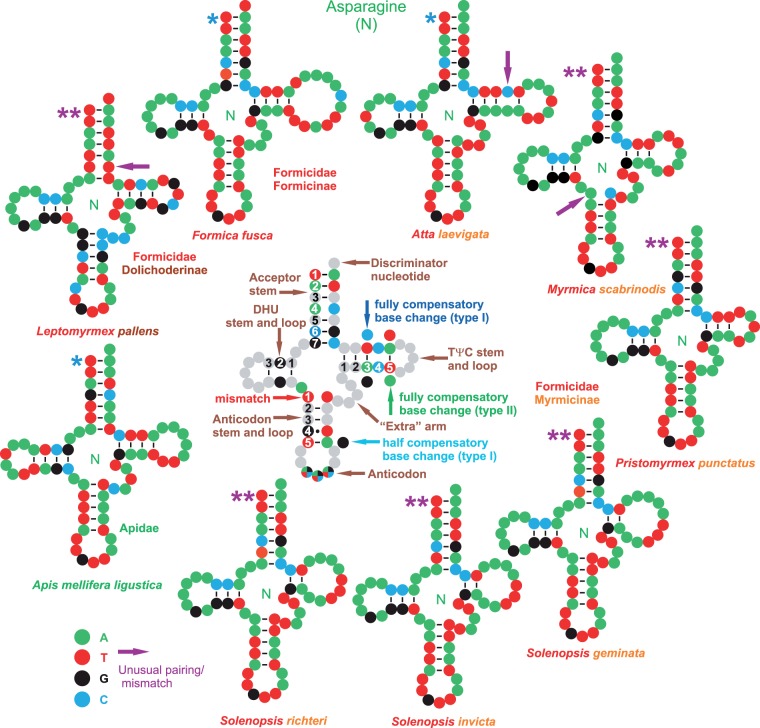
Secondary structures of the ant trnNs. Fully compensatory base changes are substitutions that do not disrupt base pairing in the stem. They are classed here as type 1 (purine—pyrimidine vs. purine—pyrimidine, and vice versa) and type 2 ((purine—pyrimidine vs. pyrimidine—purine, and vice versa). A half compensatory change implies the substitution of a single base without the disruption of the base pairing in the stem (e.g., A-T vs. G-T). A mismatch implies the disruption of the pairing in the stem. See the supplementary multiple alignment, Supplementary material online, for examples. *, trnN structure predicted by tRNAscan-Se program; **, trnN structure produced through homology modeling.
F<sc>ig</sc>. 3.—
Fig. 3.—
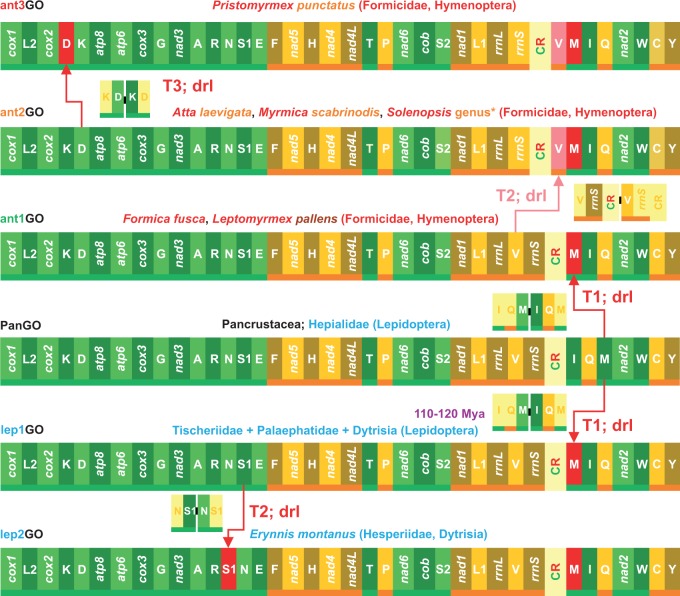
Pairwise comparisons and GO evolution in ants and Lepidoptera mtDNAs. Rearrangements in the GOs of Lepidoptera and ants are investigated and depicted with respect to PanGO. T1–T3, transposition events; dlr, duplication random loss, mechanism producing the observed re-arrangement. *, related to the species of Solenopsis analysed in this article (supplementary table S1, Supplementary Material online). The time dating is expressed in millions of years and was obtained from Grimaldi and Engel (2005). The genomic and genetic nomenclature, as well as the color scheme, are the same as in figure 1. The genes that changed position relative to PanGO are shown with a pink/red background.
F<sc>ig</sc>. 4.—
Fig. 4.—
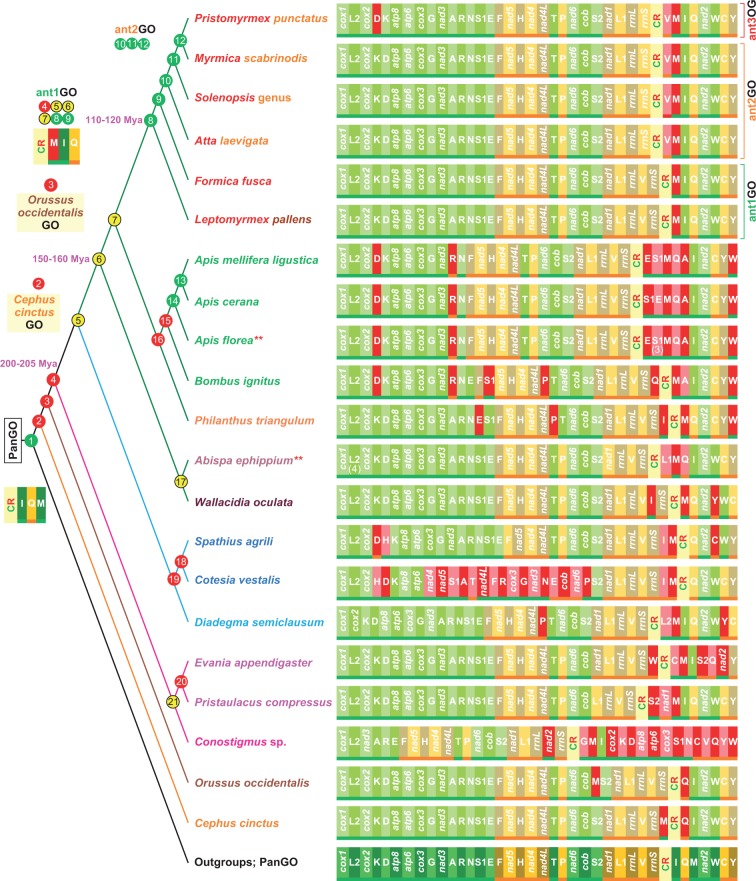
The evolution of GOs in Hymenoptera. Nodes are colored according the output of the TreeREx program (Bernt et al. 2008). Green node, consistent node. Yellow node, 1-consistent node; red node, fallback node. The different colors reflect the level of uncertainty that characterizes the reconstruction of the GO. The red nodes exhibit the highest level of uncertainty with respect to alternative GOs, whereas yellow and green nodes are more reliable in their reconstructions. The GO reconstructions are provided solely for nodes that are pivotal to this article. For a detailed reconstruction for all nodes, included the TreeREx scores see the supplementary figure S3, Supplementary Material online. *, multiple copies of S1 (3) considered just once in the TreeREx analysis; **, multiple copies of L2 considered just once in TreeREx analysis. The dating times are expressed in millions of years and were obtained from Grimaldi and Engel (2005). The genomic and genetic nomenclature, as well as the color scheme, are the same as in figure 1. The genes that changed their position relative to PanGO are shown with a pink/red background.
F<sc>ig</sc>. 5.—
Fig. 5.—
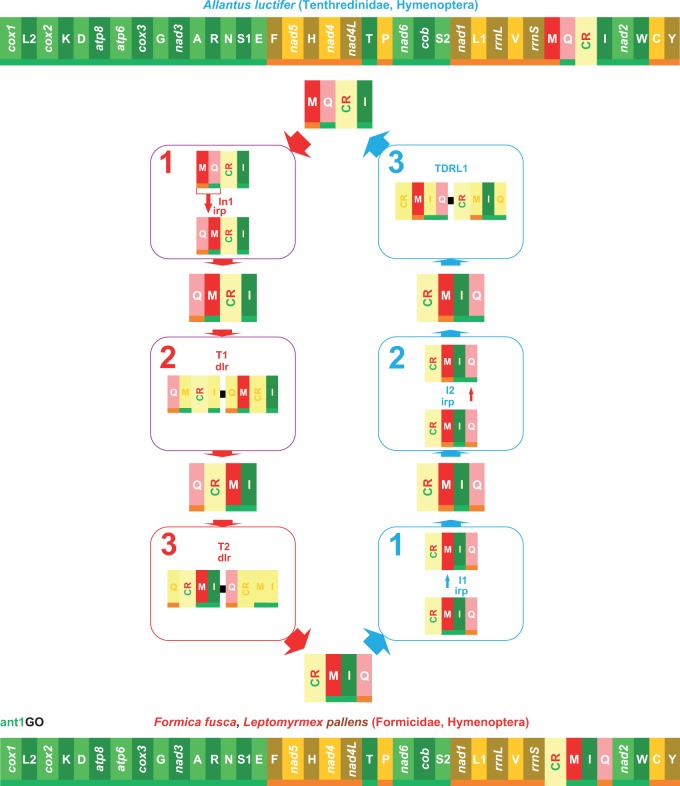
Transformational pathways between ant1GO and Al. luctifer GO. Numbered in blue are the steps of the transformation pathway leading from ant1GO to Al. luctifer GO, whereas numbered in red are the steps of the opposite pathway. T1–T3, transposition events; dlr, duplication random loss, mechanism producing the observed rearrangement; I1-I2, inversion events; irp, intramitochondrial recombination process generating the observed re-arrangement. The genomic and genetic nomenclature, as well as the color scheme, are the same as in figure 1. The genes that changed position relative to PanGO are shown with a pink/red background.

References

    1. Aguiar AP, et al. Order Hymenoptera. Zootaxa. 2013;3703:051–062.
    1. Altschul SF, Gish W, Miller W, Myers EW, Lipman DJ. Basic local alignment search tool. J Mol Biol. 1990;215:403–410. - PubMed
    1. Beard CB, Hamm DM, Collins FH. The mitochondrial genome of the mosquito Anopheles gambiae: DNA sequence, genome organization, and comparisons with mitochondrial sequences of other insects. Insect Mol Biol. 1993;2:103–124. - PubMed
    1. Behura SK, et al. Complete sequences of mitochondria genomes of Aedes aegypti and Culex quinquefasciatus and comparative analysis of mitochondrial DNA fragments inserted in the nuclear genomes. Insect Biochem Mol Biol. 2011;41:770–777. - PMC - PubMed
    1. Berman M, Austin CM, Miller AD. Characterisation of the complete mitochondrial genome and 13 microsatellite loci through next-generation sequencing for the New Caledonian spider-ant Leptomyrmex pallens. Mol Biol Rep. 2014;41:1179–1187. - PubMed

Publication types

LinkOut - more resources