


Chemotherapy dose adjustment for obese patients undergoing hematopoietic stem cell transplantation: a survey on behalf of the Acute Leukemia Working Party of the European Society for Blood and Marrow Transplantation
- PMID: 25480827
- PMCID: PMC4294603
- DOI: 10.1634/theoncologist.2014-0187
Chemotherapy dose adjustment for obese patients undergoing hematopoietic stem cell transplantation: a survey on behalf of the Acute Leukemia Working Party of the European Society for Blood and Marrow Transplantation
Abstract
Background: Appropriate chemotherapy dosing for obese patients with malignant diseases is a significant challenge because limiting chemotherapy doses in these patients may negatively influence outcome. There is a paucity of information addressing high-dose chemotherapy in obese patients undergoing hematopoietic stem cell transplantation (HSCT).
Methods: The Acute Leukemia Working Party of the European Society for Blood and Marrow Transplantation (EBMT) designed an electronic survey to assess current practice of dose adjustment of chemotherapy in obese patients undergoing HSCT.
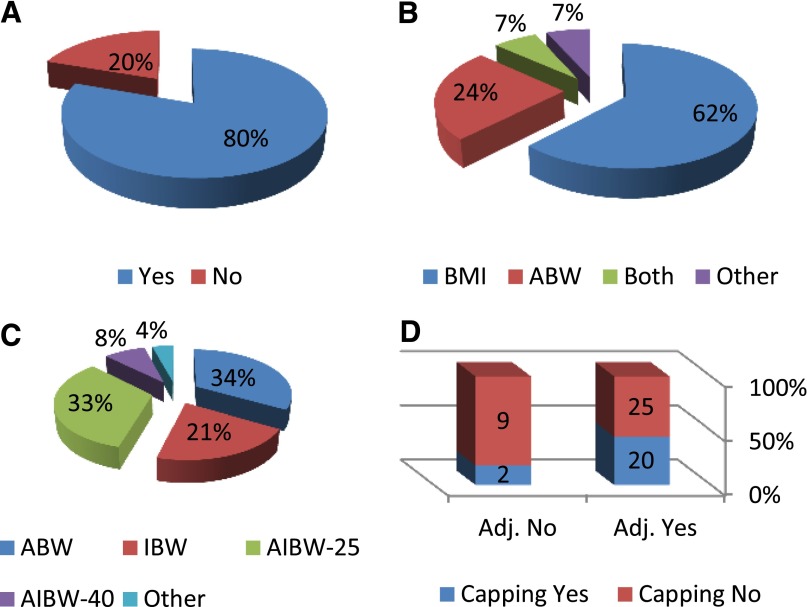
Results: A total of 56 EBMT centers from 27 countries responded to the online survey. Overall, 45 centers declared that they routinely adjust chemotherapy doses for obese patients (80.5%), and only 11 (19.5%) declared they do not adjust dose. Among the former group, most used body mass index as the parameter for defining obesity (28 centers, 62%). The method for determining the weight for chemotherapy calculation was actual body weight (ABW) in 16 centers, ideal body weight (IBW) in 10 centers, IBW plus 25% of the difference between IBW and ABW in 16 centers, and other methods for the rest. Among centers that used dose adjustment, 44% also capped the dose at 2 m(2) for a chemotherapy dose based on body surface area (BSA), whereas 56% did not cap. Interestingly, most of the centers (9 of 11) that did not adjust dose for weight also did not cap the BSA at 2 m(2).
Conclusion: This EBMT survey revealed large diversity among transplant centers regarding dose-adjustment practice for high-dose conditioning chemotherapy. Our next step is to analyze outcomes of transplantation according to dose-adjustment practice and, subsequently, to formulate a methodology for future prospective studies.
Keywords: Conditioning; Dose adjustment; Hematopoietic stem cell transplantation; Obesity.
©AlphaMed Press.
Conflict of interest statement
Disclosures of potential conflicts of interest may be found at the end of this article.
Figures
References
-
- Flegal KM, Carroll MD, Ogden CL, et al. Prevalence and trends in obesity among US adults, 1999-2000. JAMA. 2002;288:1723–1727. - PubMed
-
- Finkelstein EA, Khavjou OA, Thompson H, et al. Obesity and severe obesity forecasts through 2030. Am J Prev Med. 2012;42:563–570. - PubMed
-
- Allison DB, Fontaine KR, Manson JE, et al. Annual deaths attributable to obesity in the United States. JAMA. 1999;282:1530–1538. - PubMed
-
- Calle EE, Thun MJ, Petrelli JM, et al. Body-mass index and mortality in a prospective cohort of U.S. adults. N Engl J Med. 1999;341:1097–1105. - PubMed
-
- Calle EE, Rodriguez C, Walker-Thurmond K, et al. Overweight, obesity, and mortality from cancer in a prospectively studied cohort of U.S. adults. N Engl J Med. 2003;348:1625–1638. - PubMed
MeSH terms
LinkOut - more resources
Full Text Sources
Other Literature Sources
Medical
Miscellaneous
