. 2015 Jan:158:192-201.
doi: 10.1016/j.aquatox.2014.11.016. Epub 2014 Nov 26.

Targeted mutagenesis of aryl hydrocarbon receptor 2a and 2b genes in Atlantic killifish (Fundulus heteroclitus)

Affiliations

Targeted mutagenesis of aryl hydrocarbon receptor 2a and 2b genes in Atlantic killifish (Fundulus heteroclitus)

Neelakanteswar Aluru et al. Aquat Toxicol. 2015 Jan.

Abstract

Understanding molecular mechanisms of toxicity is facilitated by experimental manipulations, such as disruption of function by gene targeting, that are especially challenging in non-standard model species with limited genomic resources. While loss-of-function approaches have included gene knock-down using morpholino-modified oligonucleotides and random mutagenesis using mutagens or retroviruses, more recent approaches include targeted mutagenesis using zinc finger nuclease (ZFN), transcription activator-like effector nuclease (TALENs) and clustered regularly interspaced short palindromic repeats (CRISPR)-Cas9 technology. These latter methods provide more accessible opportunities to explore gene function in non-traditional model species. To facilitate evaluation of toxic mechanisms for important categories of aryl hydrocarbon pollutants, whose actions are known to be receptor mediated, we used ZFN and CRISPR-Cas9 approaches to generate aryl hydrocarbon receptor 2a (AHR2a) and AHR2b gene mutations in Atlantic killifish (Fundulus heteroclitus) embryos. This killifish is a particularly valuable non-traditional model, with multiple paralogs of AHR whose functions are not well characterized. In addition, some populations of this species have evolved resistance to toxicants such as halogenated aromatic hydrocarbons. AHR-null killifish will be valuable for characterizing the role of the individual AHR paralogs in evolved resistance, as well as in normal development. We first used five-finger ZFNs targeting exons 1 and 3 of AHR2a. Subsequently, CRISPR-Cas9 guide RNAs were designed to target regions in exon 2 and 3 of AHR2a and AHR2b. We successfully induced frameshift mutations in AHR2a exon 3 with ZFN and CRISPR-Cas9 guide RNAs, with mutation frequencies of 10% and 16%, respectively. In AHR2b, mutations were induced using CRISPR-Cas9 guide RNAs targeting sites in both exon 2 (17%) and exon 3 (63%). We screened AHR2b exon 2 CRISPR-Cas9-injected embryos for off-target effects in AHR paralogs. No mutations were observed in closely related AHR genes (AHR1a, AHR1b, AHR2a, AHRR) in the CRISPR-Cas9-injected embryos. Overall, our results demonstrate that targeted genome-editing methods are efficient in inducing mutations at specific loci in embryos of a non-traditional model species, without detectable off-target effects in paralogous genes.

Keywords: Adaptation; CRISPR-Cas9; Gene knock-outs; Mummichog; Non-model organisms; Zinc finger nucleases.


Figures

Figure 1
Figure 1
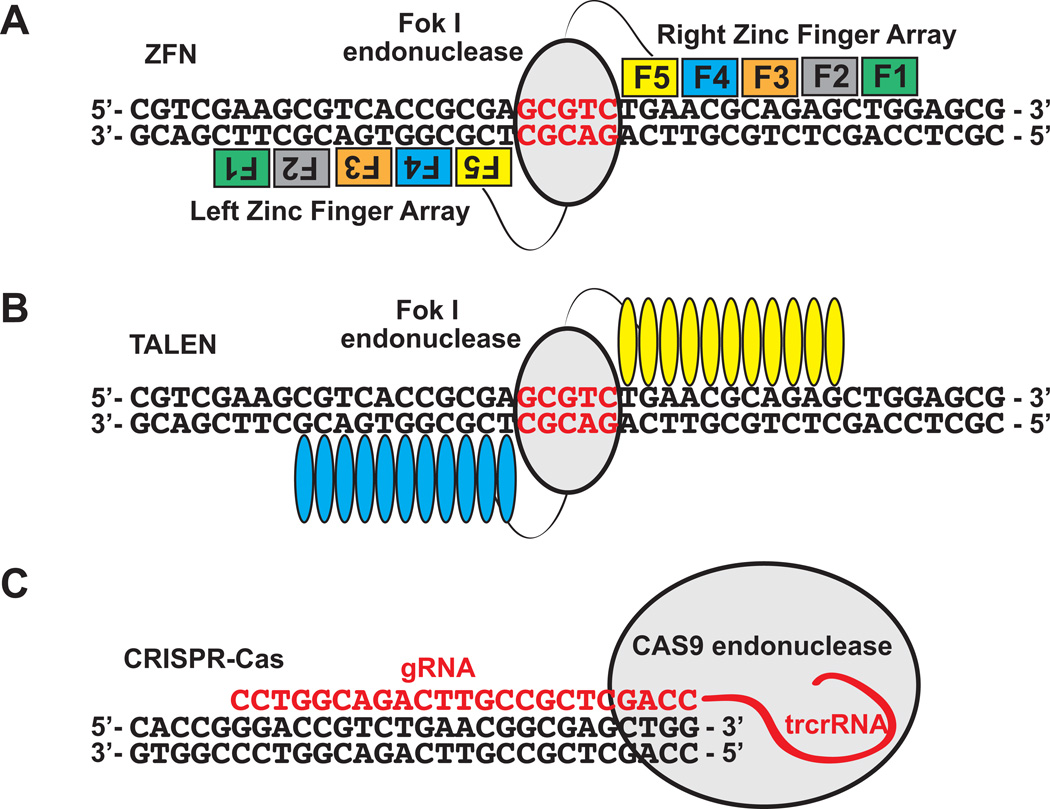
Outline of the targeted mutagenesis techniques currently used in generating mutants. A. Zinc finger nucleases B. TALENs and C. CRISPR-Cas system.
Figure 2
Figure 2
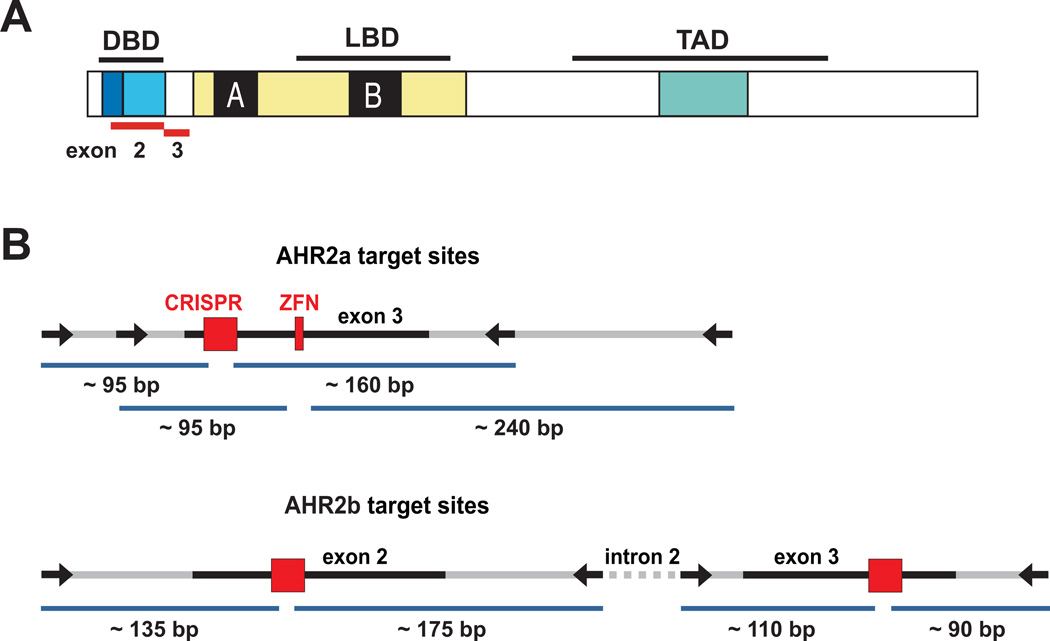
AHR target sites. A. Functional domain structure of the AHR protein. The location of the targeted exons 2 and 3 in relation to the functional domains is shown as red bars. DBD: DNA-binding domain, LBD: ligand-binding domain, TAD: transcriptional activation domain. B. Schematic representations of the ZFN and CRISPR-Cas target regions in AHR2a and AHR2b loci. Arrows represent the primers used in the PCR amplification of genomic DNA for screening. Surveyor nuclease fragments are shown below the target regions.
Figure 3
Figure 3
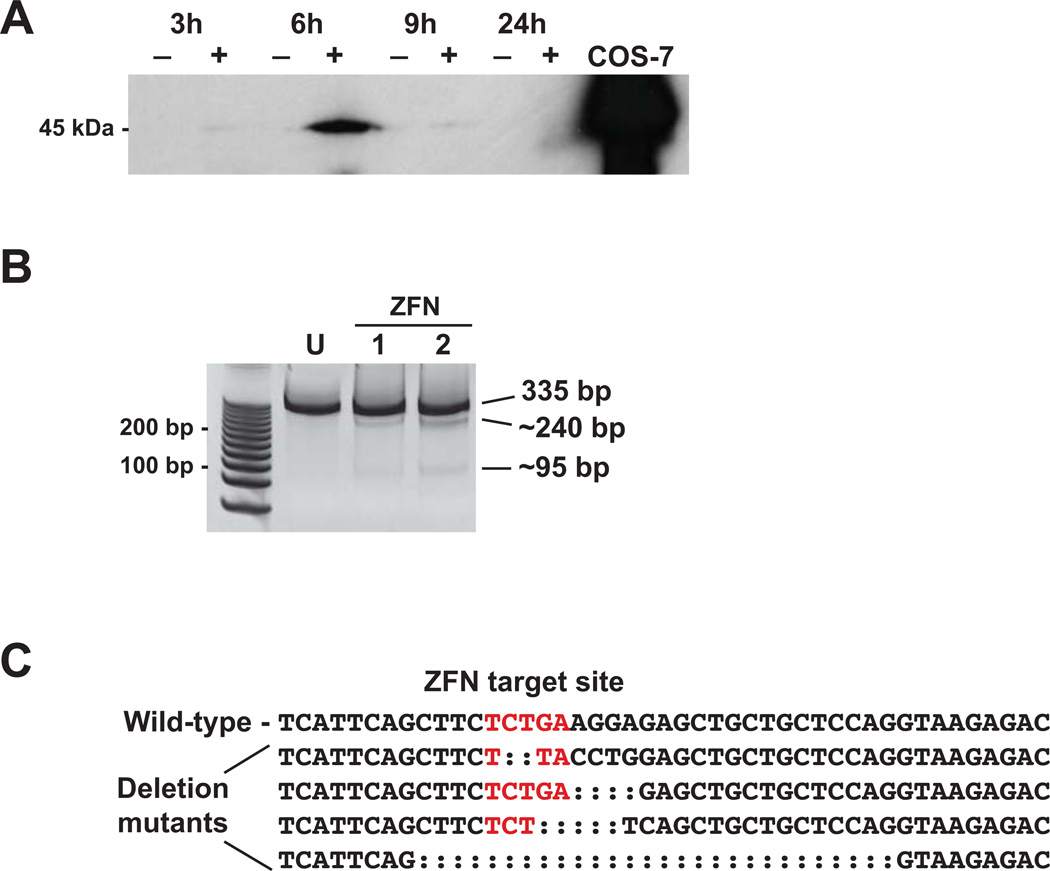
ZFN-mediated mutagenesis of killifish AHR2a. A. ZFN protein expression in killifish embryos. Uninjected (−) or ZFN-injected (+) embryos were sampled at 3, 6, 9, and 24 hours after micro-injection. Homogenates were resolved on SDS-PAGE and probed with a Flag-tag antibody. Lysate from COS-7 cells transfected with the ZFN expression plasmid was run as a positive control. B. Surveyor nuclease detection of mutations in the ZFN target region of AHR2a. Each lane represents a pool of 5 embryos from which a 335 bp genomic DNA fragment was amplified. U: uninjected control, ZFN: injected embryos. Lanes 1 and 2 are two representative samples that were positive in the mutation detection assay. Approximate sizes of the Surveyor nuclease-digested fragments containing the deletions are shown (240 and 95 bp). The full-length PCR product from sample 2 was cloned and sequenced. C. AHR2a exon 3 sequence surrounding the ZFN target site (in red). Four types of deletion mutants were observed among the sequenced clones (deletions of 2, 4, 5, and 28 nucleotides).
Figure 4
Figure 4
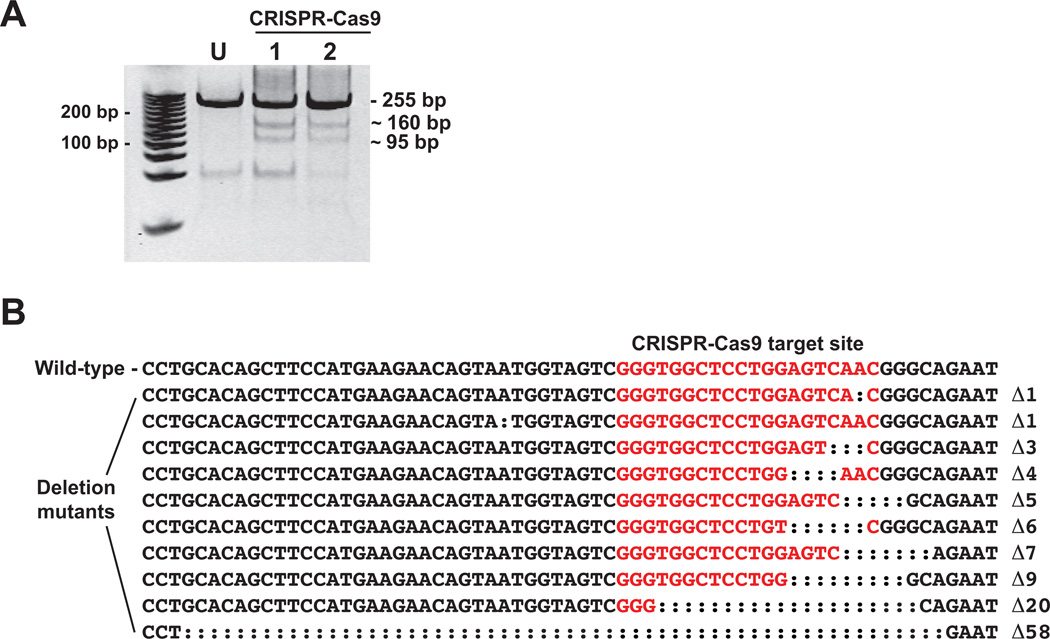
CRISPR-Cas9-mediated mutagenesis of killifish AHR2a targeting exon 3. A. Surveyor nuclease detection of mutations in the CRISPR-Cas9 target region of AHR2a exon 3. Each lane represents a pool of 5 embryos from which a 255 bp genomic DNA fragment was amplified. U: uninjected, lanes 1 and 2: CRISPR-Cas9-injected embryos. Approximate sizes of the digested fragments containing the deletions and insertions are shown (160 and 95 bp). The full-length PCR products from samples 1 and 2 were pooled, cloned, and sequenced. B. AHR2a exon 3 sequence surrounding the CRISPR-Cas9 target site (in red). Ten different deletion mutants were observed among the sequenced clones.
Figure 5
Figure 5
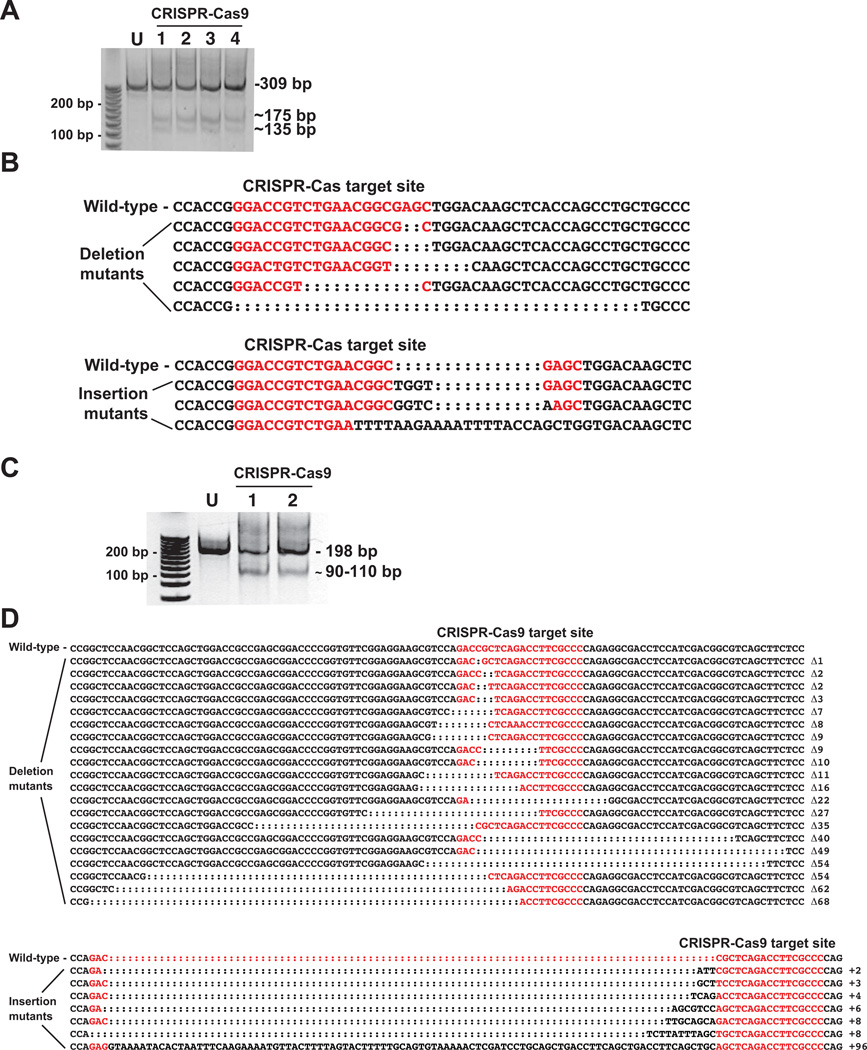
CRISPR-Cas9-mediated mutagenesis of killifish AHR2b targeting exon 2 and exon 3. A. Surveyor nuclease detection of mutations in the AHR2b CRISPR-Cas9 target region. Each lane represents a pool of 5 embryos from which a 309 bp genomic DNA fragment was amplified. U: uninjected control, lanes 1–4: CRISPR-Cas9-injected embryos. Approximate sizes of the digested fragments containing the deletions and insertions are shown (175 and 135 bp). The full-length PCR products from samples 1–4 were pooled, cloned, and sequenced. B. AHR2b exon 2 sequence surrounding the CRISPR-Cas9 target site (in red). Five types of deletion mutants and 3 types of insertions were observed among the sequenced clones. C. Surveyor nuclease detection of mutations in the CRISPR-Cas9 target region of AHR2b exon 3. Each lane represents a pool of 5 embryos from which a 198 bp genomic DNA fragment was amplified. U: uninjected, lanes 1 and 2: CRISPR-Cas9-injected embryos. Approximate sizes of the digested fragments containing the deletions and insertions are shown (110 and 90 bp). The full-length PCR products from samples 1 and 2 were pooled, cloned, and sequenced. D. AHR2b exon 3 sequence surrounding the CRISPR-Cas9 target site (in red). Twenty different types of deletion mutants and seven types of insertion mutants were observed among the sequenced clones.
Figure 6
Figure 6
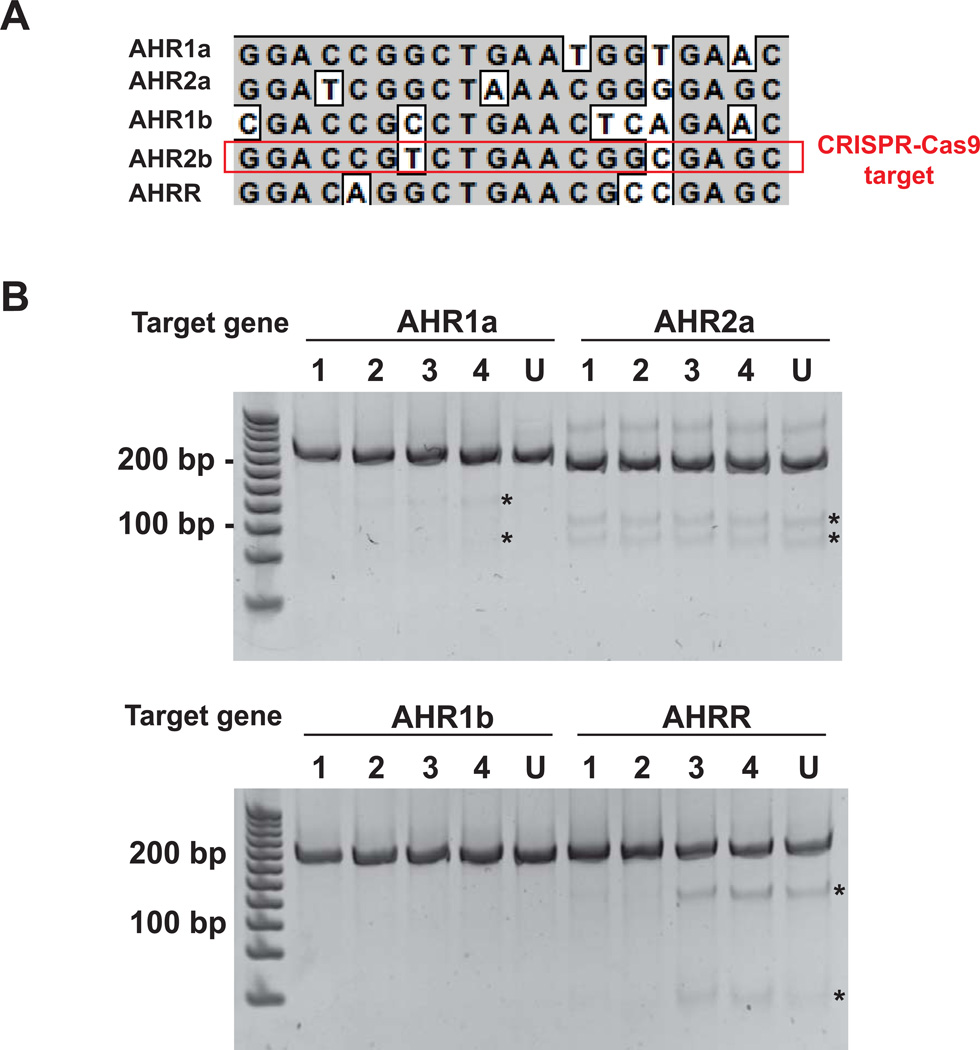
AHR2b CRISPR-Cas9 off-target analysis. A. Nucleotide sequence alignment of the AHR2b CRISPR-Cas9 target sequence with the corresponding regions of closely related genes. AHR1a, AHR2a, AHR1b, and AHRR have 4, 4, 6, and 3 mismatches to AHR2b in this region, respectively. B. Surveyor nuclease detection of mutations in AHR1a, AHR2a, AHR1b, and AHRR in the AHR2b CRISPR-Cas9 target region. Digested fragments are indicated by a *. Each lane represents a pool of 5 embryos from which genomic DNA fragments were amplified. U: uninjected control, 1–4: CRISPR-Cas9 injected embryos. AHR1a, AHR2a, and AHRR PCR products from uninjected and injected embryos were sequenced.

References

    1. Aluru N, Karchner SI, Jenny MJ, Franks D, Hahn ME. Understanding the physiological role of aryl hydrocarbon receptor repressor (AHRR) using gene knock-down and targeted mutagenesis in zebrafish. Annual Meeting of Society of Toxicology; San Antonio, Texas. 2013.
    1. Ansai S, Inohaya K, Yoshiura Y, Schartl M, Uemura N, Takahashi R, Kinoshita M. Design, evaluation, and screening methods for efficient targeted mutagenesis with transcription activator-like effector nucleases in medaka. Dev Growth Differ. 2014;56:98–107. - PubMed
    1. Ansai S, Ochiai H, Kanie Y, Kamei Y, Gou Y, Kitano T, Yamamoto T, Kinoshita M. Targeted disruption of exogenous EGFP gene in medaka using zinc-finger nucleases. Dev Growth Differ. 2012;54:546–556. - PubMed
    1. Ansai S, Sakuma T, Yamamoto T, Ariga H, Uemura N, Takahashi R, Kinoshita M. Efficient targeted mutagenesis in medaka using custom-designed transcription activatorlike effector nucleases. Genetics. 2013;193:739–749. - PMC - PubMed
    1. Armstrong PB, Child JS. Stages in Normal Development of Fundulus heteroclitus. Biol Bull. 1965;128:143–168.

Publication types

Substances

LinkOut - more resources