. 2014 Jul-Aug;5(4):281-6.
doi: 10.4161/nucl.29577.

"Dark matter" worlds of unstable RNA and protein

Affiliations

"Dark matter" worlds of unstable RNA and protein

Sabyasachi Baboo et al. Nucleus. 2014 Jul-Aug.

Abstract

Astrophysicists use the term "dark matter" to describe the majority of the matter and/or energy in the universe that is hidden from view, and biologists now apply it to the new families of RNA they are uncovering. We review evidence for an analogous hidden world containing peptides. The critical experiments involved pulse-labeling human cells with tagged amino acids for periods as short as five seconds. Results are extraordinary in two respects: both nucleus and cytoplasm become labeled, and most signals disappear with a half-life of less than one minute. Just as the synthesis of each mature mRNA is regulated by the abortive production of hundreds of shorter transcripts that are quickly degraded, it seems that the synthesis of each full-length protein in the stable proteome is regulated by an apparently wasteful production and degradation of shorter peptides. Some of the nuclear synthesis is probably a byproduct of nuclear ribosomes proofreading newly-made RNA for inappropriately-placed termination codons (a process that triggers "nonsense-mediated decay"). We speculate that some "dark-matter" peptides will play other important roles in the cell.

Keywords: RNA turnover; open-reading frame; protein turnover; translation; uORF.


Figures
None
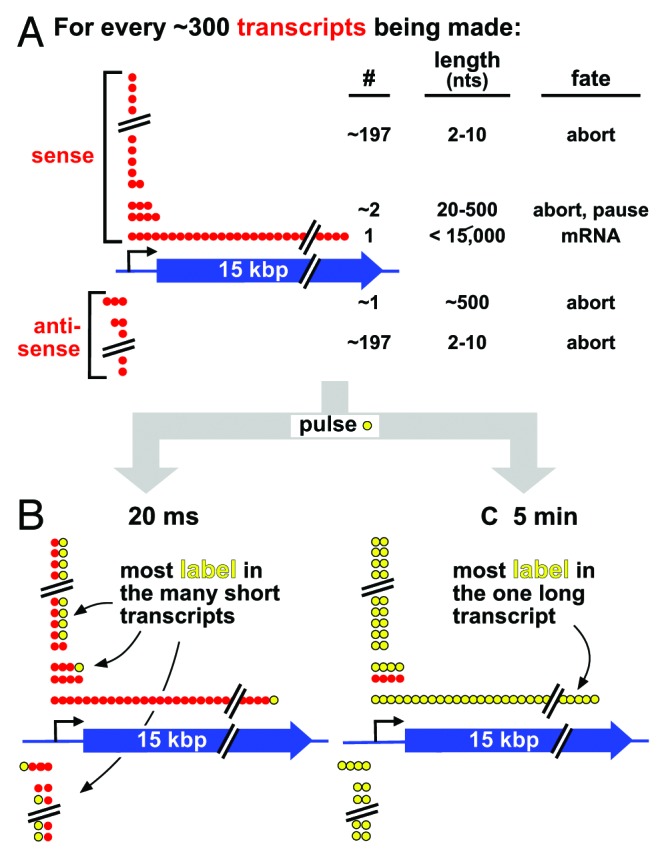
Figure 1. The inefficiency of transcription, and a thought experiment. (A) Strings of red spheres depict nucleotides (nts) incorporated into ~300 transcripts being copied from sense/anti-sense strands of a 15-kbp gene in a cell population. Most polymerases abort prematurely to yield short unstable transcripts of 2–10 nucleotides from both strands, a few pause/abort after generating unstable transcripts of 20–500 nucleotides, and only one generates a stable full-length transcript. The numbers of transcripts in each class are not known, and are included for illustrative purposes only; however, there are probably so many short aborting ones of 2–10 nucleotides that the same general conclusion can be drawn irrespective of precise numbers. (B) After 20 ms (when an elongating polymerase incorporates ~1 labeled nucleotide; yellow), most incorporated label is in short transcripts that soon abort and are quickly degraded; the long transcript contains one label, which goes undetected using most current methods. (C) After 5 min (when a polymerase incorporates ~15 000 nucleotides), the one stable transcript is completely filled with label; however, label incorporated early during the pulse into the many short aborting transcripts has turned over (and so goes undetected).
None
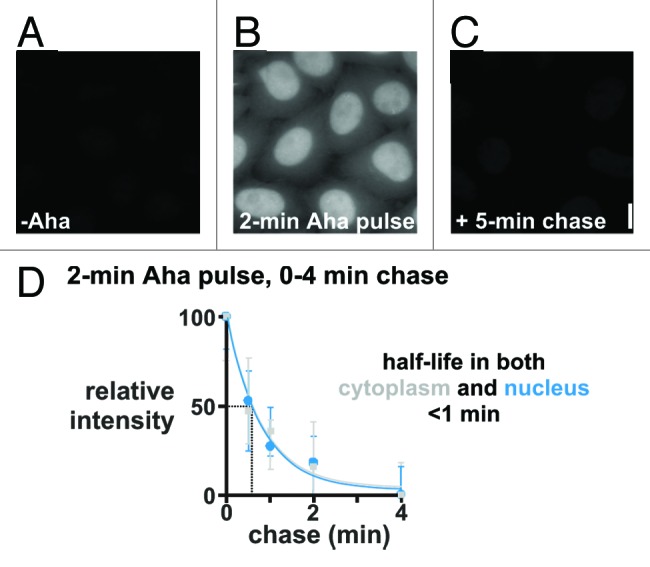
Figure 2. Peptides made in both nucleus and cytoplasm turn over rapidly. HeLa cells were starved of Met for 15 min to deplete pools, pulsed for 2 min ± 2 mM Aha, and chased (0–5 min; 0.2 mM Met without Aha). After fixation and “clicking” on Alexa 555, DNA was counterstained with DAPI, images collected using a wide-field microscope, and fluorescence intensities of Alexa 555 (± SD) seen during the chase in the cytoplasm and nucleus normalized relative to values at 0 min. Bar: 10 μm. (A) If Aha is omitted, no fluorescence is seen. (B) After a 2 min Aha pulse, nuclei appear the brightest; however, integration over the larger area of the cytoplasm indicates that this compartment contains slightly more signal. (C) If the 2 min pulse is followed by a 5 min chase, essentially no signal is seen. (D) Alexa 555 fluorescence in both nucleus and cytoplasm declines rapidly during a chase. From Baboo et al.
None
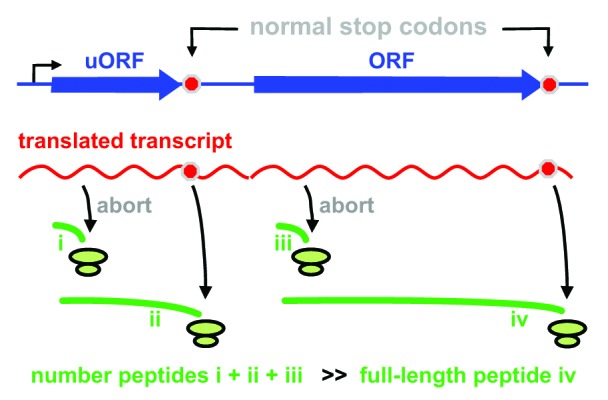
Figure 3. A model illustrating how dark-matter peptides (green lines i-iii) and the mature proteome (iv) might arise. Most initiated ribosomes terminate prematurely (giving i and iii), and some translate to the end of the uORF (giving ii); the resulting peptides are rapidly degraded (half-life < 1 min), to give rise to the astonishing turnover seen using short pulses. A minority of ribosomes translates the whole ORF (giving iv); such peptides are the ones detected conventionally using long pulses (they are generally stable and contribute to the mature proteome). From Baboo et al.

Comment on

  • Baboo S, Bhushan B, Jiang H, Grovenor CR, Pierre P, Davis BG, Cook PR. Most Human Proteins Made in Both Nucleus and Cytoplasm Turn Over within Minutes. PLoS One. 2014;9:e99346. doi: 10.1371/journal.pone.0099346. doi: 10.1371/journal.pone.0099346

References

    1. Kapranov P, St Laurent G. Dark matter RNA: existence, function, and controversy. Front Genet. 2012;3:60. doi: 10.3389/fgene.2012.00060. - DOI - PMC - PubMed
    1. Harris H. An RNA heresy in the fifties. Trends Biochem Sci. 1994;19:303–5. doi: 10.1016/0968-0004(94)90011-6. - DOI - PubMed
    1. Coulon A, Chow CC, Singer RH, Larson DR. Eukaryotic transcriptional dynamics: from single molecules to cell populations. Nat Rev Genet. 2013;14:572–84. doi: 10.1038/nrg3484. - DOI - PMC - PubMed
    1. Goldman SR, Ebright RH, Nickels BE. Direct detection of abortive RNA transcripts in vivo. Science. 2009;324:927–8. doi: 10.1126/science.1169237. - DOI - PMC - PubMed
    1. Ehrensberger AH, Kelly GP, Svejstrup JQ. Mechanistic interpretation of promoter-proximal peaks and RNAPII density maps. Cell. 2013;154:713–5. doi: 10.1016/j.cell.2013.07.032. - DOI - PubMed

Publication types