Review
. 2014 Sep-Oct;5(5):427-40.
doi: 10.4161/nucl.36289.

Diverse lamin-dependent mechanisms interact to control chromatin dynamics. Focus on laminopathies

Affiliations
Review

Diverse lamin-dependent mechanisms interact to control chromatin dynamics. Focus on laminopathies

Daria Camozzi et al. Nucleus. 2014 Sep-Oct.

Abstract

Interconnected functional strategies govern chromatin dynamics in eukaryotic cells. In this context, A and B type lamins, the nuclear intermediate filaments, act on diverse platforms involved in tissue homeostasis. On the nuclear side, lamins elicit large scale or fine chromatin conformational changes, affect DNA damage response factors and transcription factor shuttling. On the cytoplasmic side, bridging-molecules, the LINC complex, associate with lamins to coordinate chromatin dynamics with cytoskeleton and extra-cellular signals. Consistent with such a fine tuning, lamin mutations and/or defects in their expression or post-translational processing, as well as mutations in lamin partner genes, cause a heterogeneous group of diseases known as laminopathies. They include muscular dystrophies, cardiomyopathy, lipodystrophies, neuropathies, and progeroid syndromes. The study of chromatin dynamics under pathological conditions, which is summarized in this review, is shedding light on the complex and fascinating role of the nuclear lamina in chromatin regulation.

Keywords: Emery-Dreifuss muscular dystrophy; Hutchinson-Gilford progeria; LADs; chromatin; familial partial lipodystrophy; laminopathies; lamins; mandibuloacral dysplasia; nuclear envelope proteins.


Figures

None
Figure 1.LMNA splicing products involved in diseases and prelamin A forms accumulated in laminopathies. (A) Genomic organization and protein domain structure of the LMNA splicing products involved in laminopathies: prelamin A, progerin, and lamin C. (B) Prelamin A processing steps. The four different prelamin A forms are represented. Below each prelamin A processing intermediate structure, the disease(s) showing accumulation of that form are indicated in parentheses. The processing steps of progerin seem to be the same as for prelamin A and are not represented in this scheme. Question marks indicate possible accumulation in laminopathies.
None
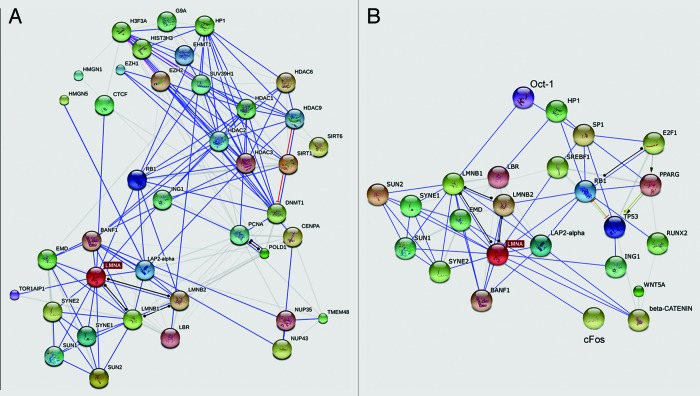
Figure 2. Known and Predicted nuclear lamina-chromatin networks. (A) The group of nuclear envelope proteins is shown in the left end corner. Chromatin-associated proteins are shown in the right upper corner. (B) The group of nuclear envelope proteins is shown in the left end corner. Transcription factors and transcriptional regulators are shown in the right upper corner. The gene name is reported in most cases. Light gray lines indicate co-occurrence. The graphs have been obtained using String 9.1 application (http://string-db.org/).
None
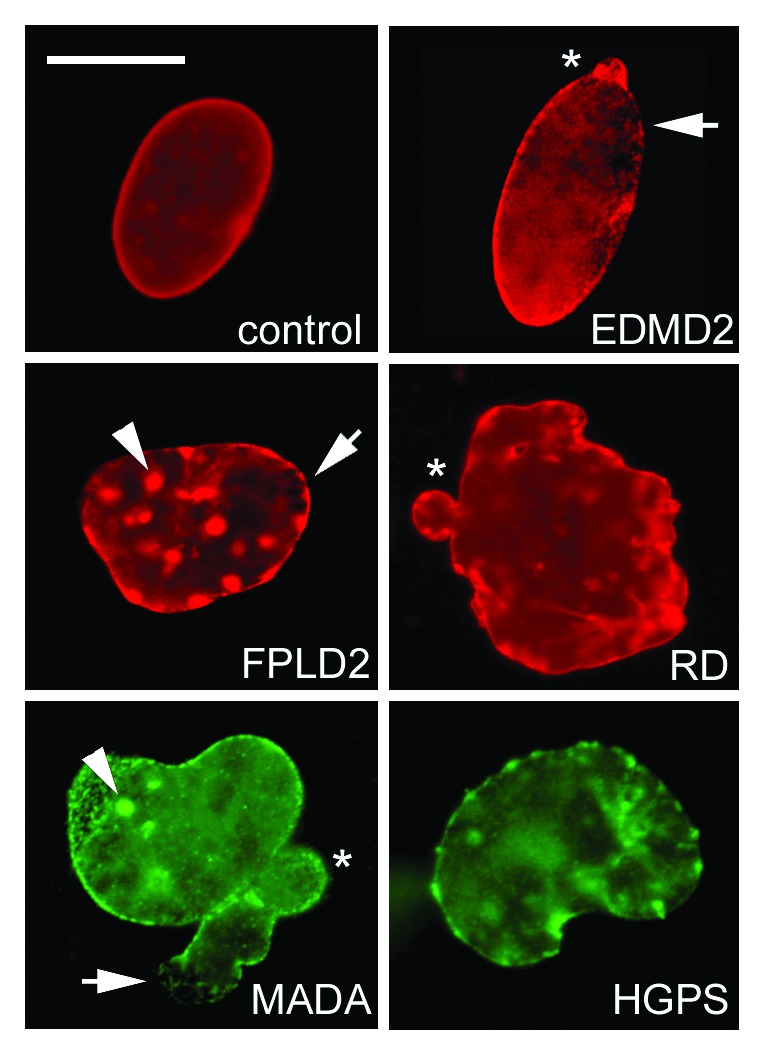
Figure 3. Altered nuclear shape in laminopathies. Representative control, EDMD2, FPLD2, and RD nuclei labeled using anti-lamin A/C antibody (Santa Cruz Sc-6215) are shown in the upper rows, OCT-1 (Santa-Cruz) and farnesylated prelamin A staining (Diatheva 1188–2) of a MADA and HGPS nucleus, respectively, are shown in the lower row. Honeycomb structures, characteristic of EDMD2 (and EDMD1) nuclei are also observed in FPLD2 and MADA (arrows). Lamin A/C aggregates (also labeled by SUN1 and prelamin A) are observed in FPLD2 and MADA (arrowheads), nucler envelope blebs (asterisk) are found in most laminopathies. Bar, 10 μm.
None
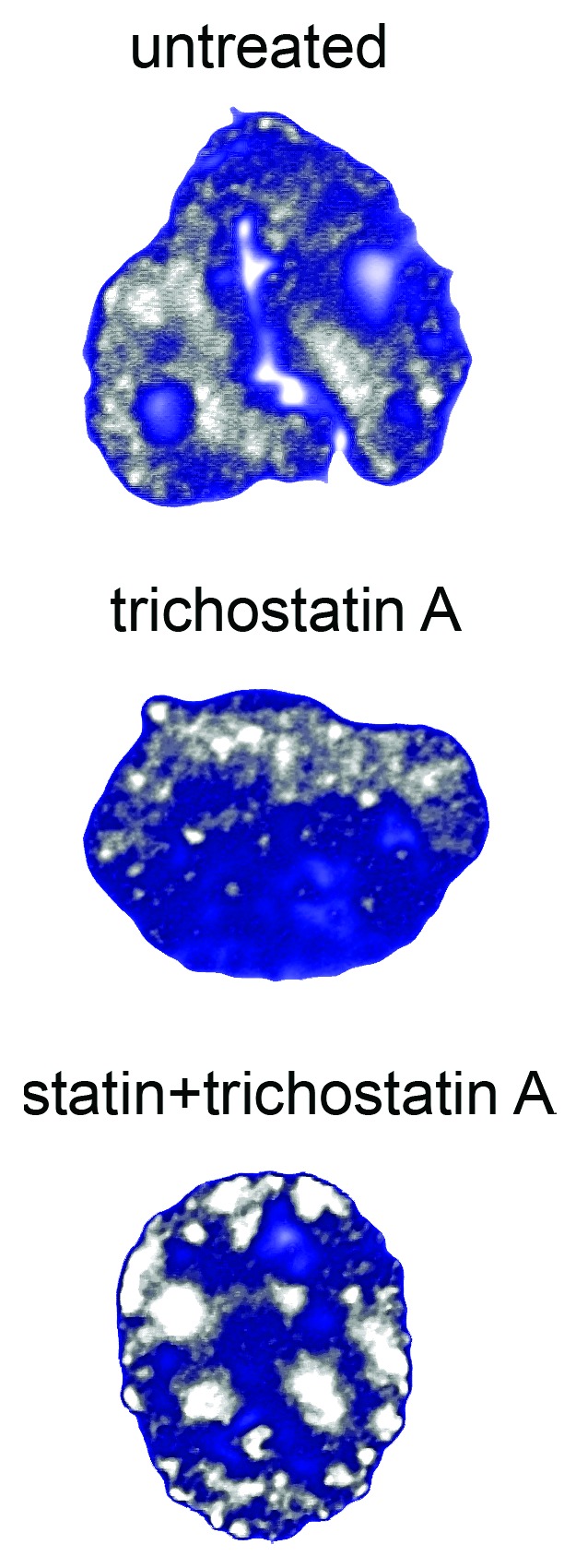
Figure 4. Chromatin remodeling in HGPS fibroblasts. The experiment was performed using the histone deacetylase inhibitor trichostatin A or combination of trichostatin A and statins (that convert progerin into its non-farnesylated form and elicit accumulation of wild-type prelamin A). The images obtained using anti-trimethyl-H3K9 antibody to label heterochromatin domains have been elaborated using Photoshop 7. Note recovery of heterochromatin domains (gray) using combined drugs, indicating that heterochromatin status in HGPS is regulated by prelamin A forms, most likely through histone deacetylase interaction.
None
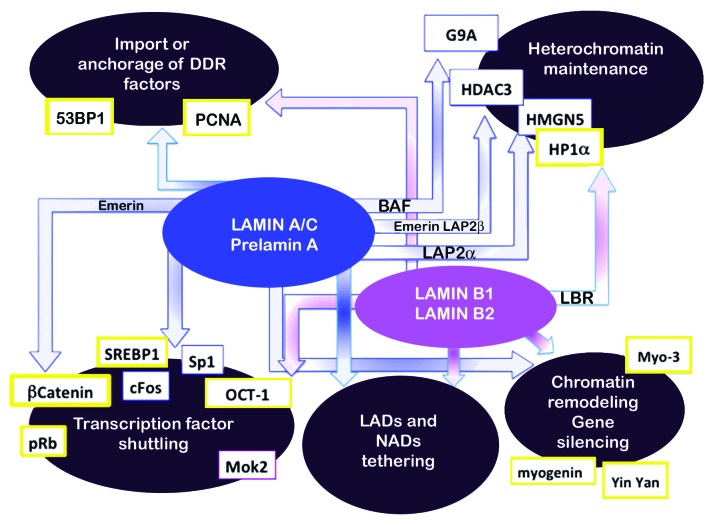
Figure 5. Chromatin dynamics dependent on lamins. Four major groups of events that contribute to chromatin dynamics are represented in the large ellipses. Blue arrows indicate A type lamin pathways, purple arrows B type pathways. Lamin partners involved in chromatin regulation are indicated in the respective arrows. Some targets of lamin activity (HP1alpha, HDAC3, SREBP1, OCT-1) are common to lamin A and lamin B-related pathways or are misregulated in diverse diseases (SREBP1, OCT-1, HP1alpha). Targets affected in laminopathies are in yellow boxes. See text for references.

References

    1. Maraldi NM, Capanni C, Cenni V, Fini M, Lattanzi G. Laminopathies and lamin-associated signaling pathways. J Cell Biochem. 2011;112:979–92. doi: 10.1002/jcb.22992. - DOI - PubMed
    1. Biamonti G, Giacca M, Perini G, Contreas G, Zentilin L, Weighardt F, Guerra M, Della Valle G, Saccone S, Riva S, et al. The gene for a novel human lamin maps at a highly transcribed locus of chromosome 19 which replicates at the onset of S-phase. Mol Cell Biol. 1992;12:3499–506. - PMC - PubMed
    1. Schütz W, Benavente R, Alsheimer M. Dynamic properties of germ line-specific lamin B3: the role of the shortened rod domain. Eur J Cell Biol. 2005;84:649–62. doi: 10.1016/j.ejcb.2005.03.001. - DOI - PubMed
    1. Davies BS, Coffinier C, Yang SH, Barnes RH, 2nd, Jung HJ, Young SG, Fong LG. Investigating the purpose of prelamin A processing. Nucleus. 2011;2:4–9. doi: 10.4161/nucl.2.1.13723. - DOI - PMC - PubMed
    1. Barrowman J, Hamblet C, Kane MS, Michaelis S. Requirements for efficient proteolytic cleavage of prelamin A by ZMPSTE24. PLoS One. 2012;7:e32120. doi: 10.1371/journal.pone.0032120. - DOI - PMC - PubMed

Publication types

MeSH terms

Supplementary concepts

LinkOut - more resources