


Cost analysis of a home-based nurse care coordination program
- PMID: 25482242
- PMCID: PMC4383646
- DOI: 10.1111/jgs.13162
Cost analysis of a home-based nurse care coordination program
Abstract
Objectives: To determine whether a home-based care coordination program focused on medication self-management would affect the cost of care to the Medicare program and whether the addition of technology, a medication-dispensing machine, would further reduce cost.
Design: Randomized, controlled, three-arm longitudinal study.
Setting: Participant homes in a large Midwestern urban area.
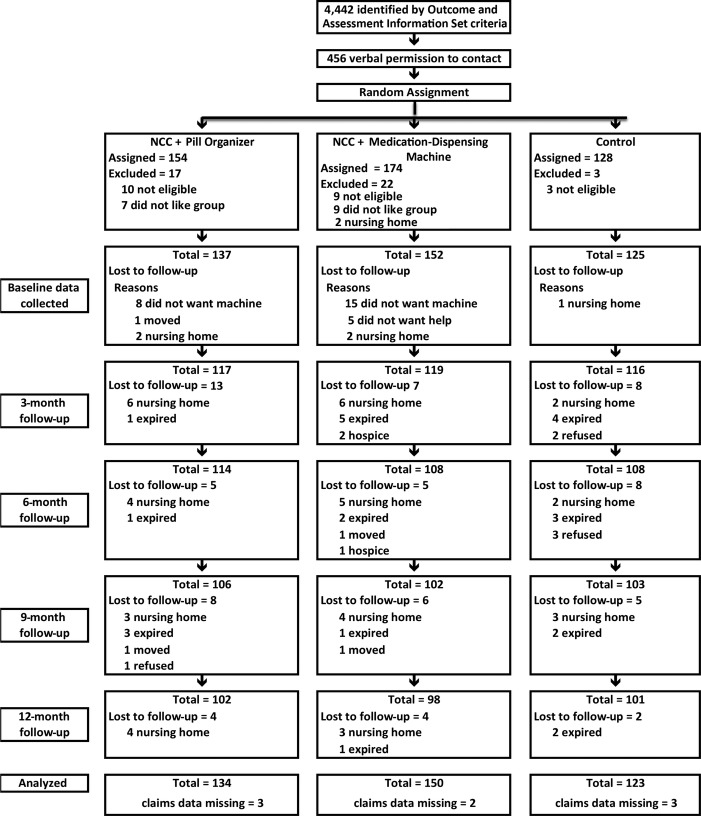
Participants: Older adults identified as having difficulty managing their medications at discharge from Medicare Home Health Care (N = 414).
Intervention: A team consisting of advanced practice nurses (APNs) and registered nurses (RNs) coordinated care for two groups: home-based nurse care coordination (NCC) plus a pill organizer group and NCC plus a medication-dispensing machine group.
Measurements: To measure cost, participant claims data from 2005 to 2011 were retrieved from Medicare Part A and B Standard Analytical Files.
Results: Ordinary least squares regression with covariate adjustment was used to estimate monthly dollar savings. Total Medicare costs were $447 per month lower in the NCC plus pill organizer group (P = .11) than in a control group that received usual care. For participants in the study at least 3 months, total Medicare costs were $491 lower per month in the NCC plus pill organizer group (P = .06) than in the control group. The cost of the NCC plus pill organizer intervention was $151 per month, yielding a net savings of $296 per month or $3,552 per year. The cost of the NCC plus medication-dispensing machine intervention was $251 per month, and total Medicare costs were $409 higher per month than in the NCC plus pill organizer group.
Conclusion: Nurse care coordination plus a pill organizer is a cost-effective intervention for frail elderly Medicare beneficiaries. The addition of the medication machine did not enhance the cost effectiveness of the intervention.
Keywords: care coordination; cost effectiveness; self-management.
© 2014 The Authors.The Journal of the American Geriatrics Society published by Wiley Periodicals, Inc. on behalf of The American Geriatrics Society.
Figures
Comment in
-
Twenty-first century home-centered medicine: it's about the touch, not the tech….J Am Geriatr Soc. 2014 Dec;62(12):2433-5. doi: 10.1111/jgs.13176. J Am Geriatr Soc. 2014. PMID: 25516039 No abstract available.
References
-
- DeVol R, Bedroussian A, Charuworn A, et al. An Unhealthy America: The Economic Burden of Chronic Disease. Santa Monica, CA: Milken Institute; 2007.
-
- Thorpe KE, Howard DH. The rise in spending among Medicare beneficiaries: The role of chronic disease prevalence and changes in treatment intensity. Health Aff (Millwood) 2006;25:w378–w388. - PubMed
-
- Dentzer S. Reform chronic illness care? Yes, we can. Health Aff (Millwood) 2009;28:12–13. - PubMed
-
- Institute of Medicine. Future Directions for the National Healthcare Quality and Disparities Reports. Washington, DC: The National Academies Press; 2010. - PubMed
-
- McDonald K, Schultz E, Albin L, et al. Care Coordination Atlas Version 3 (Contract No. 11–0023-EF) Rockville, MD: AHRQ; 2010.
Publication types
MeSH terms
Substances
Grants and funding
LinkOut - more resources
Full Text Sources
Other Literature Sources
Medical
