


Low-intensity daily walking activity is associated with hippocampal volume in older adults
- PMID: 25483019
- PMCID: PMC4425252
- DOI: 10.1002/hipo.22397
Low-intensity daily walking activity is associated with hippocampal volume in older adults
Abstract
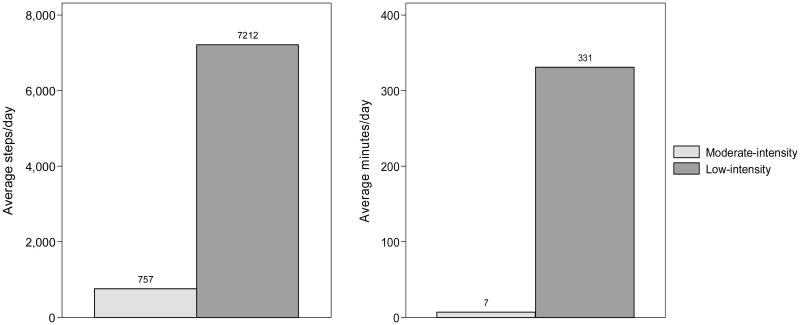
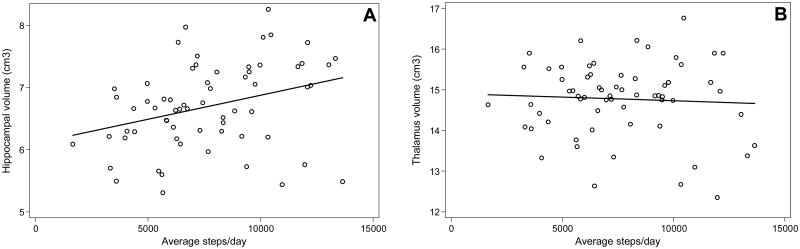
Hippocampal atrophy is associated with memory impairment and dementia and serves as a key biomarker in the preclinical stages of Alzheimer's disease. Physical activity, one of the most promising behavioral interventions to prevent or delay cognitive decline, has been shown to be associated with hippocampal volume; specifically increased aerobic activity and fitness may have a positive effect on the size of the hippocampus. The majority of older adults, however, are sedentary and have difficulty initiating and maintaining exercise programs. A modestly more active lifestyle may nonetheless be beneficial. This study explored whether greater objectively measured daily walking activity was associated with larger hippocampal volume. We additionally explored whether greater low-intensity walking activity, which may be related to leisure-time physical, functional, and social activities, was associated with larger hippocampal volume independent of exercise and higher-intensity walking activity. Segmentation of hippocampal volumes was performed using Functional Magnetic Resonance Imaging of the Brain's Software Library (FSL), and daily walking activity was assessed using a step activity monitor on 92, nondemented, older adult participants. After controlling for age, education, body mass index, cardiovascular disease risk factors, and the Mini Mental State Exam, we found that a greater amount, duration, and frequency of total daily walking activity were each associated with larger hippocampal volume among older women, but not among men. These relationships were specific to hippocampal volume, compared with the thalamus, used as a control brain region, and remained significant for low-intensity walking activity, independent of moderate- to vigorous-intensity activity and self-reported exercise. This is the first study, to our knowledge, to explore the relationship between objectively measured daily walking activity and hippocampal volume in an older adult population. Findings suggest the importance of examining whether increasing nonexercise, lifestyle physical activities may produce measurable cognitive benefits and affect hippocampal volume through molecular pathways unique to those related to moderate-intensity exercise.
Keywords: African Americans; aging; brain; cognition; physical activity.
© 2014 Wiley Periodicals, Inc.
Figures
References
-
- Abbott RD, White LR, Ross GW, Masaki KH, Curb JD, Petrovitch H. Walking and dementia in physically capable elderly men. Jama. 2004;292:1447–1453. - PubMed
-
- Adlard PA, Perreau VM, Engesser-Cesar C, Cotman CW. The timecourse of induction of brain-derived neurotrophic factor mRNA and protein in the rat hippocampus following voluntary exercise. Neurosci Lett. 2004;363:43–48. - PubMed
-
- Angevaren M, Aufdemkampe G, Verhaar HJ, Aleman A, Vanhees L. Physical activity and enhanced fitness to improve cognitive function in older people without known cognitive impairment. Cochrane Database Syst Rev. 2008:CD005381. - PubMed
Publication types
MeSH terms
Grants and funding
- P01AG027735-03/AG/NIA NIH HHS/United States
- K01 AG031332/AG/NIA NIH HHS/United States
- T32 AG000247/AG/NIA NIH HHS/United States
- P30-AG021334/AG/NIA NIH HHS/United States
- T32 AG027668/AG/NIA NIH HHS/United States
- P50 AG005146/AG/NIA NIH HHS/United States
- P01 AG027735/AG/NIA NIH HHS/United States
- P30 AG021334/AG/NIA NIH HHS/United States
- R01 HL077141/HL/NHLBI NIH HHS/United States
- R01 HL089694/HL/NHLBI NIH HHS/United States
- RC1 HL099340/HL/NHLBI NIH HHS/United States
- R21 CA127511/CA/NCI NIH HHS/United States
- U01 AG022376/AG/NIA NIH HHS/United States
LinkOut - more resources
Full Text Sources
Other Literature Sources
