


Inactivation of the budding yeast cohesin loader Scc2 alters gene expression both globally and in response to a single DNA double strand break
- PMID: 25483075
- PMCID: PMC4612677
- DOI: 10.4161/15384101.2014.964108
Inactivation of the budding yeast cohesin loader Scc2 alters gene expression both globally and in response to a single DNA double strand break
Abstract
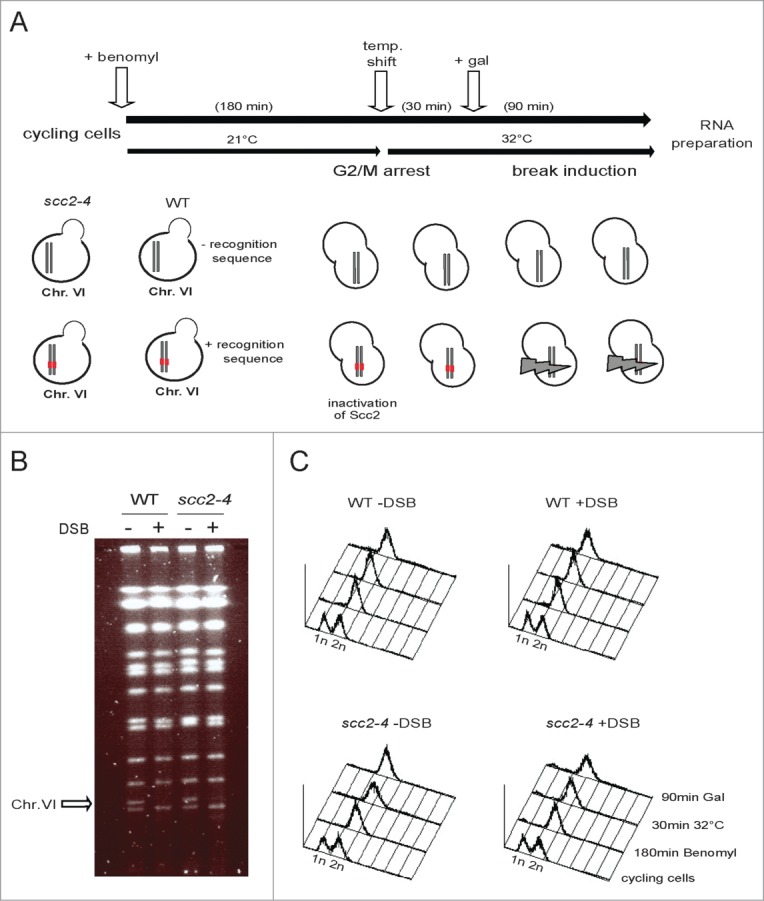
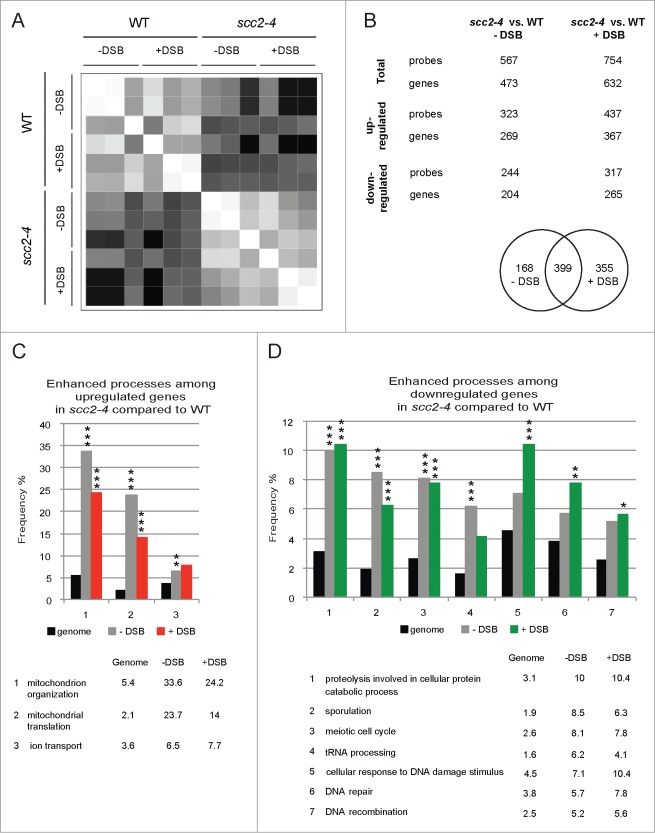
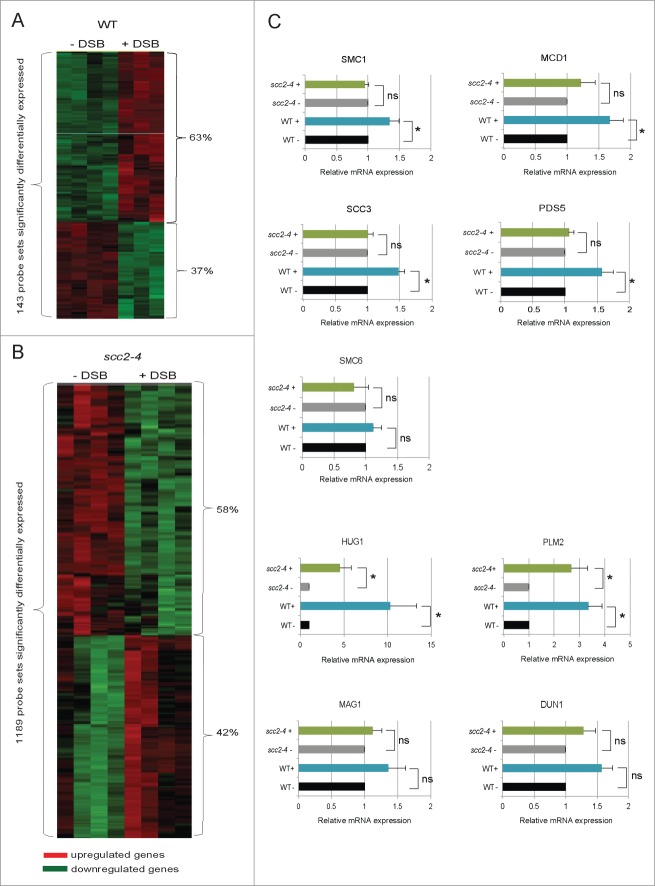
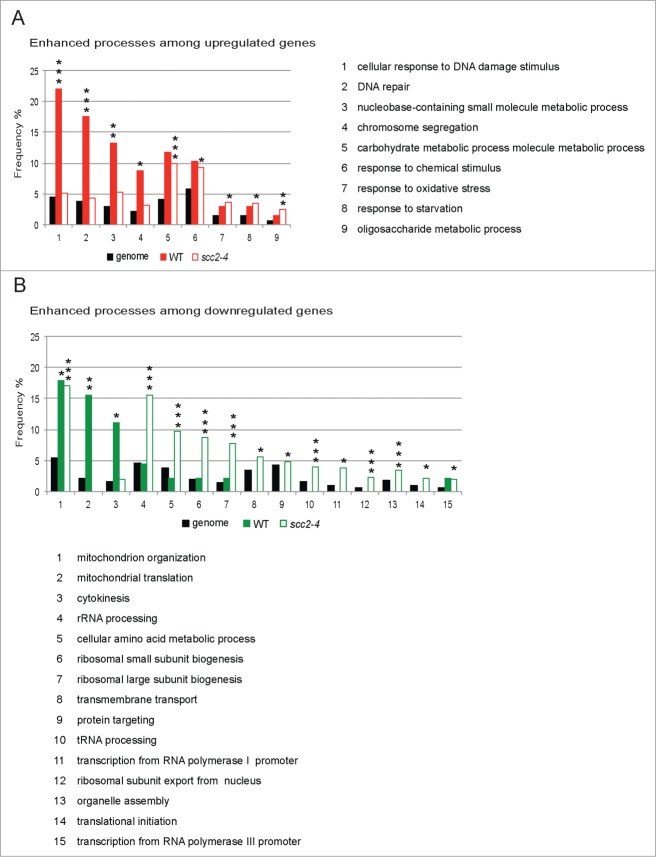
Genome integrity is fundamental for cell survival and cell cycle progression. Important mechanisms for keeping the genome intact are proper sister chromatid segregation, correct gene regulation and efficient repair of damaged DNA. Cohesin and its DNA loader, the Scc2/4 complex have been implicated in all these cellular actions. The gene regulation role has been described in several organisms. In yeast it has been suggested that the proteins in the cohesin network would effect transcription based on its role as insulator. More recently, data are emerging indicating direct roles for gene regulation also in yeast. Here we extend these studies by investigating whether the cohesin loader Scc2 is involved in regulation of gene expression. We performed global gene expression profiling in the absence and presence of DNA damage, in wild type and Scc2 deficient G2/M arrested cells, when it is known that Scc2 is important for DNA double strand break repair and formation of damage induced cohesion. We found that not only the DNA damage specific transcriptional response is distorted after inactivation of Scc2 but also the overall transcription profile. Interestingly, these alterations did not correlate with changes in cohesin binding.
Keywords: DI-cohesion, damage induced cohesion; DNA double strand break; DSB DNA, double strand break; FDR, false discovery rate; HO, homothallic switching endonuclease; S, supplementary; SCC, sister chromatid cohesion; SMC, structural maintenance of chromosomes; Scc2; WT, wild type; cohesin network; microarray; transcription profile.
Figures
Comment in
-
The SMC loader Scc2 regulates gene expression.Cell Cycle. 2015;14(7):943. doi: 10.1080/15384101.2015.1010959. Cell Cycle. 2015. PMID: 25715109 Free PMC article. No abstract available.
References
-
- Losada A, Hirano T. Dynamic molecular linkers of the genome: the first decade of SMC proteins. Genes Dev 2005; 19:1269-87; PMID:15937217; http://dx.doi.org/ 10.1101/gad.1320505 - DOI - PubMed
-
- Hirano T. At the heart of the chromosome: SMC proteins in action. Nat Rev Mol Cell Biol 2006; 7:311-22; PMID:16633335; http://dx.doi.org/ 10.1038/nrm1909 - DOI - PubMed
-
- Rowland BD, Roig MB, Nishino T, Kurze A, Uluocak P, Mishra A, Beckouet F, Underwood P, Metson J, Imre R, et al. Building sister chromatid cohesion: smc3 acetylation counteracts an antiestablishment activity. Mol Cell 2009; 33:763-74; PMID:19328069; http://dx.doi.org/ 10.1016/j.molcel.2009.02.028 - DOI - PubMed
-
- Guacci V, Koshland D, Strunnikov A. A direct link between sister chromatid cohesion and chromosome condensation revealed through the analysis of MCD1 in S. cerevisiae. Cell 1997; 91:47-57; PMID:9335334; http://dx.doi.org/ 10.1016/S0092-8674(01)80008-8 - DOI - PMC - PubMed
-
- Michaelis C, Ciosk R, Nasmyth K. Cohesins: chromosomal proteins that prevent premature separation of sister chromatids. Cell 1997; 91:35-45; PMID:9335333; http://dx.doi.org/ 10.1016/S0092-8674(01)80007-6 - DOI - PubMed
Publication types
MeSH terms
Substances
LinkOut - more resources
Full Text Sources
Other Literature Sources
Molecular Biology Databases
Research Materials
