. 2014 Dec 8:5:5736.
doi: 10.1038/ncomms6736.

Steroidal and non-steroidal third-generation aromatase inhibitors induce pain-like symptoms via TRPA1

Affiliations

Steroidal and non-steroidal third-generation aromatase inhibitors induce pain-like symptoms via TRPA1

Camilla Fusi et al. Nat Commun. .

Abstract

Use of aromatase inhibitors (AIs), exemestane, letrozole and anastrozole, for breast cancer therapy is associated with severe pain symptoms, the underlying mechanism of which is unknown. The electrophilic nature of AIs suggests that they may target the transient receptor potential ankyrin 1 (TRPA1) channel, a major pathway in pain transmission and neurogenic inflammation. AIs evoke TRPA1-mediated calcium response and current in rodent nociceptors and human cells expressing the recombinant channel. In mice, AIs produce acute nociception, which is exaggerated by pre-exposure to proalgesic stimuli, and, by releasing sensory neuropeptides, neurogenic inflammation in peripheral tissues. AIs also evoke mechanical allodynia and decreased grip strength, which do not undergo desensitization on prolonged AI administration. These effects are markedly attenuated by TRPA1 pharmacological blockade or in TRPA1-deficient mice. TRPA1 is a major mediator of the proinflammatory/proalgesic actions of AIs, thus suggesting TRPA1 antagonists for the treatment of pain symptoms associated with AI use.


Figures
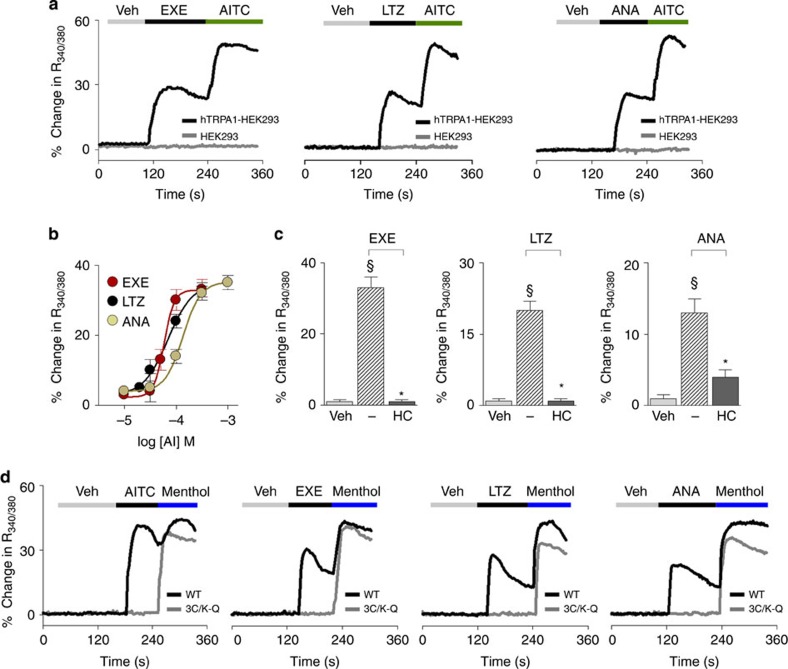
Figure 1
Figure 1. Exemestane (EXE), letrozole (LTZ) and anastrozole (ANA) selectively activate the human TRPA1 channel.
(a) Representative traces of intracellular calcium response evoked by the aromatase inhibitors (AIs), EXE (100 μM), LTZ (100 μM) and ANA (100 μM), in HEK293 cells transfected with the cDNA for human TRPA1 (hTRPA1-HEK293), which respond to the selective TRPA1 agonist, allyl isothiocyanate (AITC; 30 μM). AITC (30 μM), EXE, LTZ and ANA (all 100 μM) fail to produce any calcium response in untransfected-HEK293 cells (HEK293). (b) Concentration-response curves to EXE, LTZ and ANA, yielded EC50 (95% confidence interval) of 58 (46–72) μM, 69 (43–109) μM, and 134 (96–186) μM, respectively. (c) AI-evoked calcium response in hTRPA1-HEK293 is abolished by the selective TRPA1 antagonist, HC-030031 (HC; 30 μM). (d) Representative traces of cells transfected with the cDNA codifying for the mutant hTRPA1 channel (3C/K-Q), which are insensitive to AITC (30 μM) or AIs (100 μM), but respond to the non-electrophilic agonist, menthol (100 μM), whereas HEK293 cells transfected with the cDNA codifying for wild-type hTRPA1 (WT) respond to all the drugs. Veh is the vehicle of AIs; dash (−) indicates the vehicle of HC. Each point or column represents the mean±s.e.m. of at least 25 cells from 3–6 independent experiments. §P<0.05 versus Veh, *P<0.05 versus EXE, LTZ or ANA group; ANOVA and Bonferroni post hoc test.
Figure 2
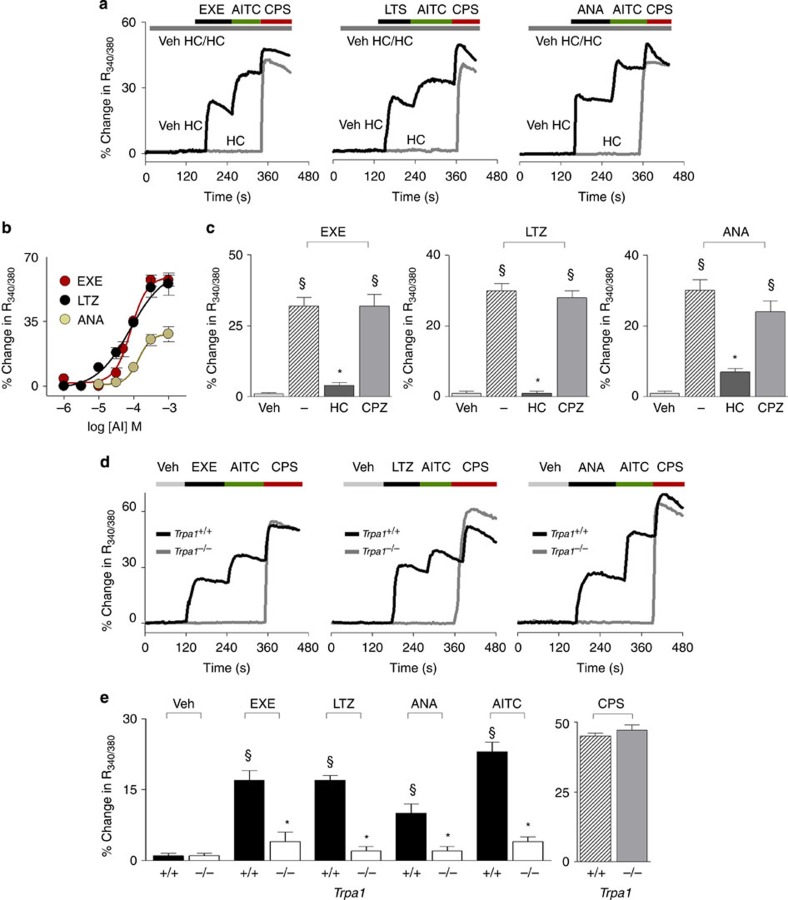
Figure 2. Exemestane (EXE), letrozole (LTZ) and anastrozole (ANA) selectively activate the native TRPA1 channel expressed in rodent dorsal root ganglion (DRG) neurons.
(a) Representative traces of calcium response evoked by EXE (100 μM), LTZ (100 μM), ANA (300 μM) in cultured rat DRG neurons, which also respond to allyl isothiocyanate (AITC; 30 μM) and capsaicin (CPS; 0.1 μM). Calcium responses evoked by AIs and AITC are abolished by the selective TRPA1 antagonist, HC-030031 (HC; 30 μM), which does not affect response to CPS. (b) Concentration-response curves of EXE, LTZ and ANA, yielded EC50 (95% confidence interval) of 82 (61–108) μM, 78 (39–152)  μM, and 135 (78–231)  μM, respectively. (c) Calcium responses induced by AIs are inhibited by HC and unaffected by the TRPV1 antagonist, capsazepine (CPZ; 10 μM). §P<0.05 versus Veh, *P<0.05 versus EXE, LTZ or ANA; ANOVA and Bonferroni post hoc test. (d) Representative traces and (e) pooled data of the calcium response evoked by EXE, LTZ, ANA (all 100 μM) or AITC (30 μM), in neurons isolated from Trpa1+/+ mice. Neurons isolated from Trpa1−/− mice do not respond to AITC, EXE, LTZ and ANA, whereas they do respond normally to CPS (0.1 μM). In DRG neurons isolated from both Trpa1+/+ and Trpa1−/− mice, calcium response is evaluated only in capsaicin responding neurons. §P<0.05 versus Veh, *P<0.05 versus EXE, LTZ, ANA or AITC-Trpa1+/+, ANOVA and Bonferroni post hoc test. Veh is the vehicle of AIs; dash (-) indicates the combination of the vehicles of HC and CPZ. Each point or column represents the mean±s.e.m. of at least 25 neurons obtained from 3 to 7 independent experiments.
Figure 3
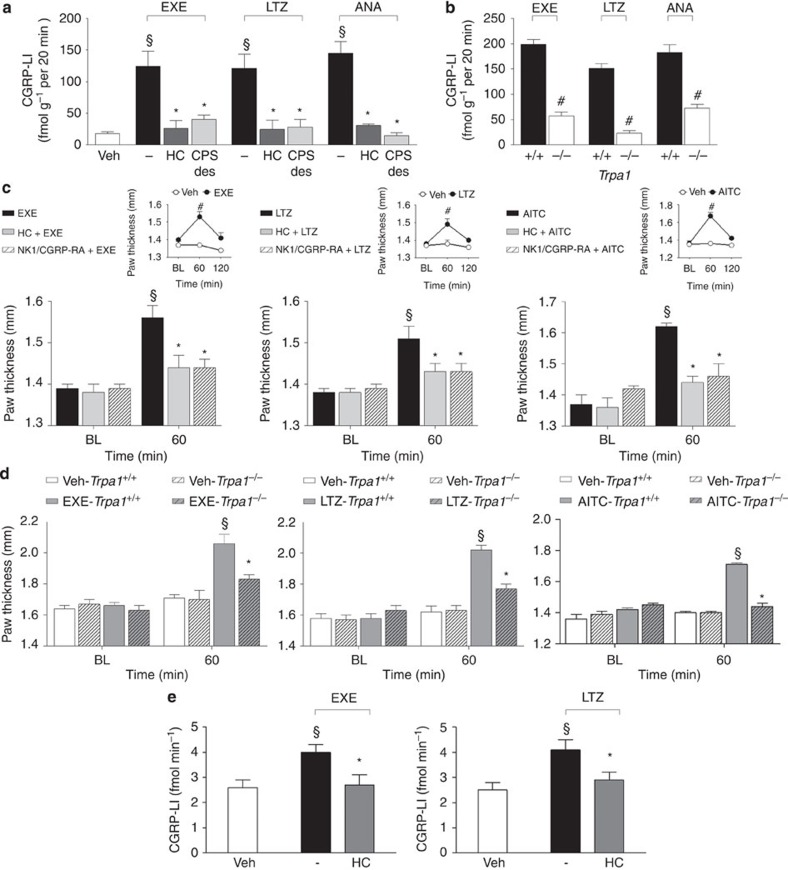
Figure 3. Aromatase inhibitors release calcitonin gene-related peptide (CGRP) and produce neurogenic edema.
(a) Exemestane (EXE), letrozole (LTZ) and anastrozole (ANA) (all 100 μM) increase the CGRP-like immunoreactivity (CGRP-LI) outflow from slices of rat dorsal spinal cord. This effect is prevented by HC-030031 (HC; 30 μM) or after exposure to capsaicin (10 μM, 20 min; CPS-des). (b) EXE, LTZ and ANA (all 100 μM) increase the CGRP-LI outflow from spinal cord slices obtained from Trpa1+/+, but not from Trpa1−/− mice. Results are mean±s.e.m. of at least four independent experiments. Veh is the vehicle of EXE, LTZ and ANA, dash (-) indicates the vehicle of HC and CPS. §P<0.05 versus Veh, *P<0.05 versus EXE, LTZ or ANA; ANOVA followed by Bonferroni post hoc test. #P<0.05 versus EXE-, LTZ-, ANA-Trpa1+/+, Student’s t-test. (c) In C57BL/6 mice intraplantar (i.pl.) injection (20 μl) of EXE (10 nmol), LTZ (20 nmol) or allyl isothiocyanate (AITC; 10 nmol) induces paw oedema, which peaks at 60 min and fades 120 min after injection (c, upper insets), and is attenuated by pretreatment with HC (100 mg kg−1 intraperitoneal, i.p.) or the combination of the selective antagonists of the neurokinin-1 receptor, (NK1-RA), L-733,060, and of the CGRP receptor (CGRP-RA), CGRP8-37, (both, 2 μmol kg−1, intravenous). (d) Paw oedema induced by EXE, LTZ and AITC (i.pl.) in Trpa1+/+ mice is markedly reduced in Trpa1−/− mice. BL=baseline level. Results are mean±s.e.m. of at least five mice for each group. Veh is the vehicle of EXE, LTZ and AITC. #P<0.05 versus Veh, Student’s t-test; §P<0.05 versus BL values, *P<0.05 versus EXE, LTZ, AITC or EXE-, LTZ-, AITC-Trpa1+/+; ANOVA followed by Bonferroni post hoc test. (e) Injection (50 μl) of EXE (5 nmol) or LTZ (10 nmol) in the rat knee increases CGRP-LI levels in the synovial fluid, an effect that is markedly attenuated by pretreatment with HC (100 mg kg−1, i.p.). Results are mean±s.e.m. of at least five mice for each group. Veh is the vehicle of EXE and LTZ, dash (-) indicates the vehicle of HC. §P<0.05 versus Veh, *P<0.05 versus EXE, LTZ; ANOVA followed by Bonferroni post hoc test.
Figure 4
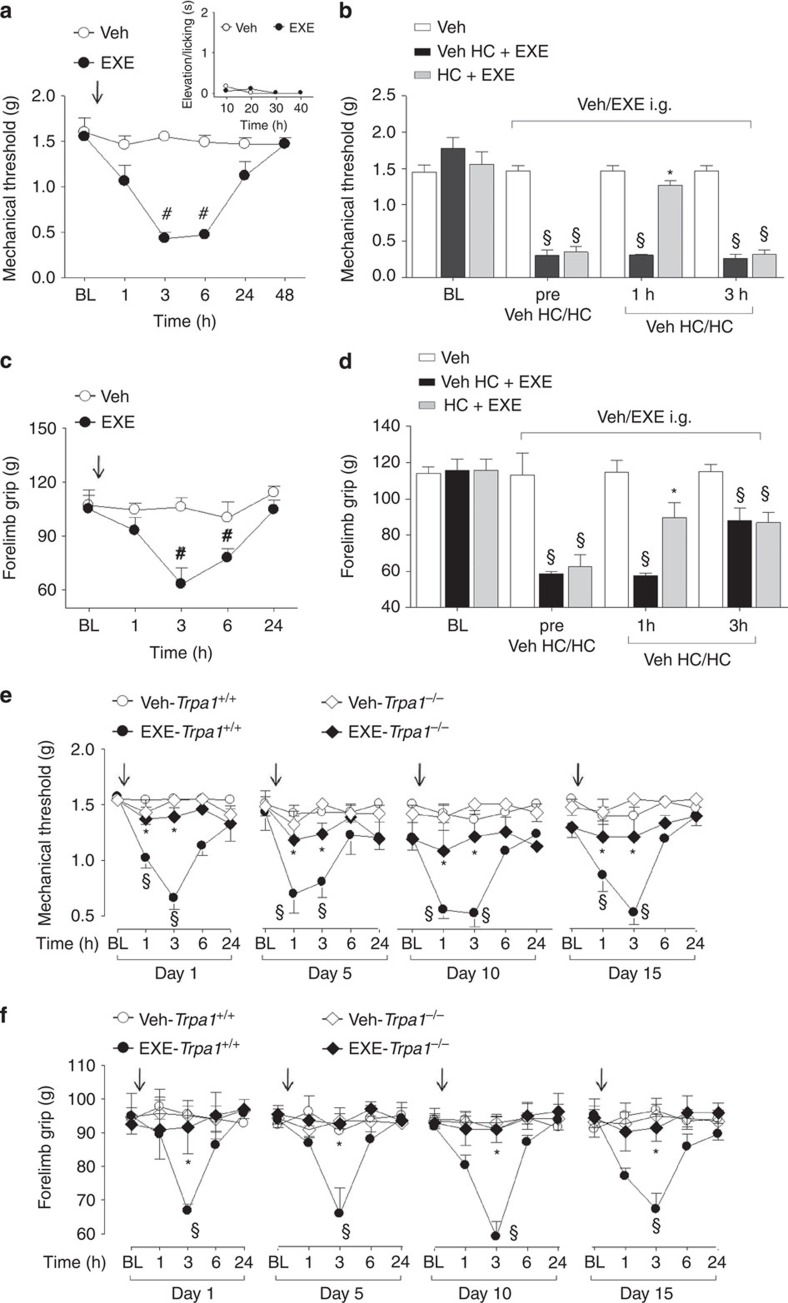
Figure 4. Intragastric exemestane (EXE) induces TRPA1-dependent prolonged mechanical allodynia and reduction in forelimb grip strength in mice.
In C57BL/6 mice intragastric (i.g.) administration of EXE (10 mg kg−1) induces (a) mechanical allodynia and (c) a reduction in forelimb grip strength that last 3–6 h after administration. EXE does not produce any acute nocifensor behaviour as measured by the indicated test (a, inset). (b,d) Three hours after EXE administration, HC-030031 (HC; 100 mg kg−1 i.p.) reverts both mechanical allodynia and the reduction in forelimb grip strength. HC inhibition is no longer visible 3 h after its administration. Veh is the vehicle of EXE. #P<0.05 versus Veh; Student’s t-test (a,c) and §P<0.05 versus Veh and *P<0.05 versus Veh HC-EXE; ANOVA followed by Bonferroni post hoc test (b,d). (e,f) EXE (once a day for 15 consecutive days, 10 mg kg−1 i.g.) induces reproducible mechanical allodynia and decrease in forelimb grip strength at day 1, 5, 10 and 15 in Trpa1+/+mice. Arrows indicate Veh or EXE administration. Both these effects are markedly reduced in Trpa1−/− mice. §P<0.05 versus Veh-Trpa1+/+, *P<0.05 versus EXE-Trpa1+/+; ANOVA followed by Bonferroni post hoc test. Results are mean±s.e.m. of at least five mice for each group. In all conditions, baseline (BL) levels were recorded 30 min before EXE administration.
Figure 5
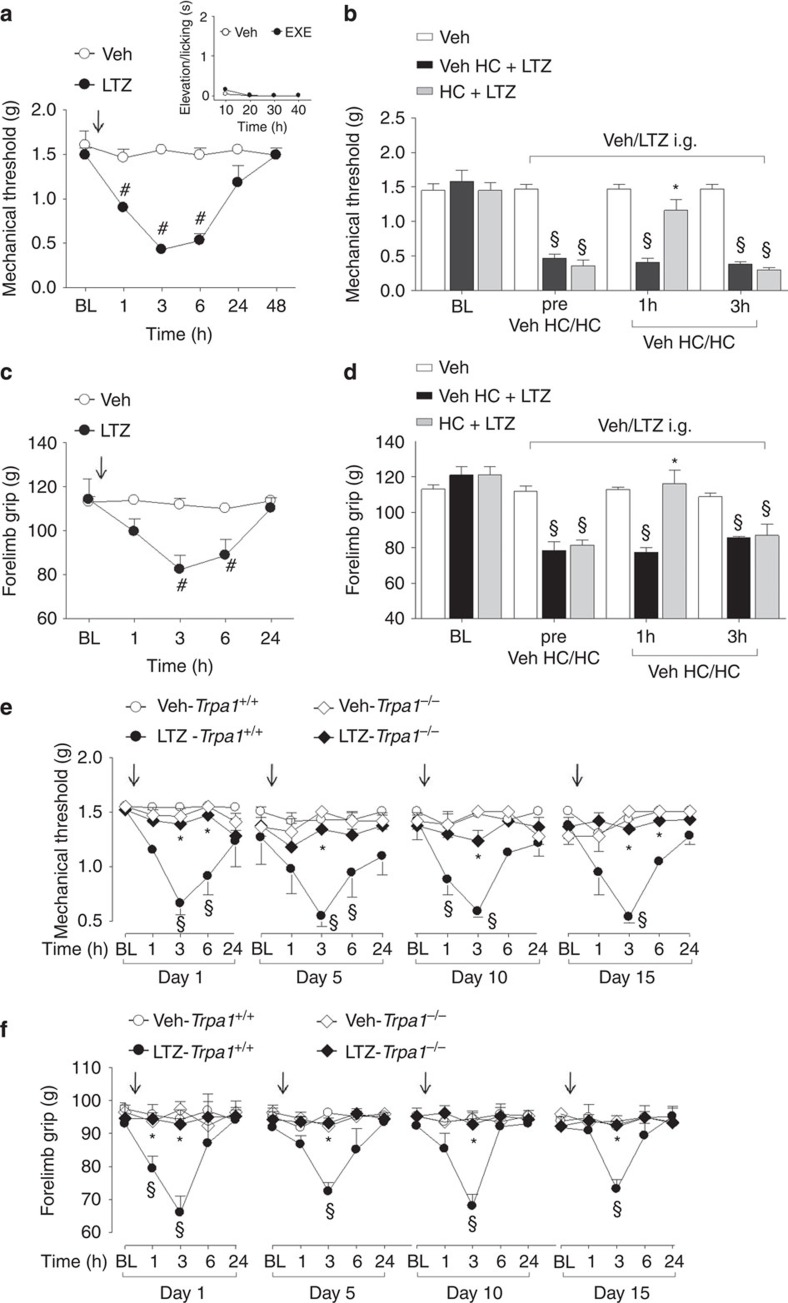
Figure 5. Intragastric letrozole (LTZ) induces TRPA1-dependent prolonged mechanical allodynia and reduction in forelimb grip strength in mice.
In C57BL/6 mice intragastric (i.g.) administration of LTZ (0.5 mg kg−1) induces (a) mechanical allodynia and (c) reduction in forelimb grip strength that last 3–6 h after administration. LTZ does not produce any acute nocifensor behaviour as measured by the indicated test (a, inset). (b,d) Three hours after LTZ administration, HC-030031 (HC; 100 mg kg−1 i.p.) reverts both mechanical allodynia and the reduction in forelimb grip strength. HC inhibition is no longer visible 3 h after its administration. Veh is the vehicle of LTZ. #P<0.05 versus Veh; Student’s t-test (a,c) and §P<0.05 versus Veh and *P<0.05 versus Veh HC-LTZ; ANOVA followed by Bonferroni post hoc test (b,d). (e,f) LTZ (once a day for 15 consecutive days, 0.5 mg kg−1 i.g.) induces reproducible mechanical allodynia and decrease in forelimb grip strength at day 1, 5, 10 and 15 in Trpa1+/+mice. Arrows indicate Veh or LTZ administration. Both effects are markedly reduced in Trpa1−/− mice. §P<0.05 versus Veh-Trpa1+/+, *P<0.05 versus LTZ-Trpa1+/+; ANOVA followed by Bonferroni post hoc test. Results are mean±s.e.m. of at least five mice for each group. In all conditions baseline (BL) levels were recorded 30 min before LTZ administration.
Figure 6
Figure 6. TRPA1 activation by exemestane (EXE) and letrozole (LTZ) is enhanced by proinflammatory stimuli.
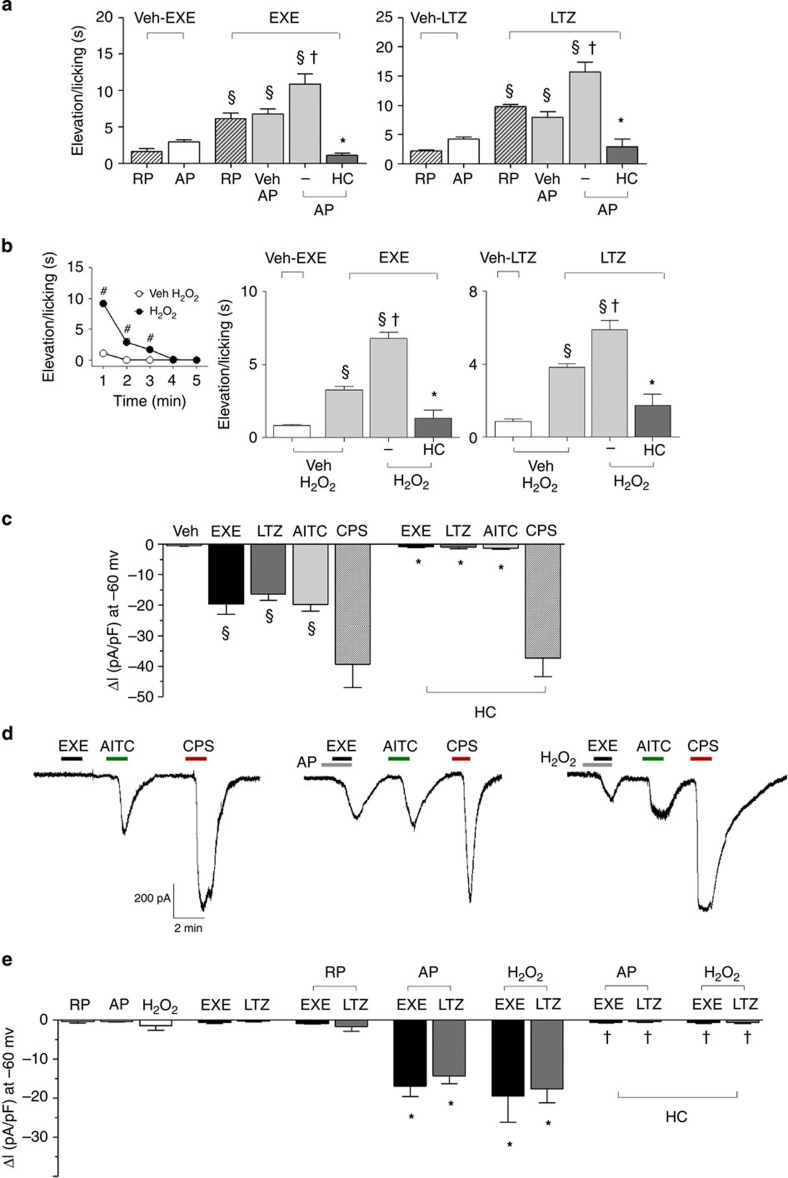
(a) Intraplantar (i.pl.; 10 μl) pretreatment (10 min) with the proteinase-activated receptor 2 (PAR2) activating peptide (AP; 1 μg), but not with the inactive PAR2 reverse peptide (RP; 1 μg), enhances nocifensor behaviour produced by EXE (1 nmol per 10 μl, i.pl.) or LTZ (10 nmol per 10 μl, i.pl.). AP and RP alone causes negligible nociception. The potentiated responses to EXE or LTZ are markedly attenuated by HC-030031 (HC; 100 mg kg−1, i.p.). (b) H2O2 (0.5 μmol per 10 μl, i.pl.) injection produces a transient nocifensor behaviour, lasting only 5 min (b, inset). Pretreatment (10 min before AI administration) with H2O2 (0.5 μmol per 10 μl, i.pl.) increases nocifensor behaviour produced by EXE (1 nmol per 10 μl, i.pl.) or LTZ (10 nmol per 10 μl, i.pl.). HC (100 mg kg−1, i.p.) inhibits the exaggerated responses to both EXE and LTZ. Dash (-) indicates the vehicle of HC. Points or columns are mean±s.e.m. of at least fiv mice for each group. §P<0.05 versus RP or AP or Veh H2O2; P<0.05 versus Veh AP/EXE or Veh AP/LTZ or Veh H2O2/EXE or Veh H2O2/LTZ; *P<0.05 versus AP/EXE or AP/LTZ or H2O2/EXE or H2O2/LTZ; ANOVA followed by Bonferroni post hoc test. #P<0.05 versus Veh H2O2, Student’s t-test. (c) An active concentration of EXE or LTZ (both 100 μM) evokes inward currents in rat dorsal root ganglion (DRG) neurons, which also respond to allyl isothiocyanate (AITC; 100 μM) and capsaicin (CPS; 1 μM). Inward currents evoked by EXE, LTZ or AITC are inhibited in the presence of HC (50 μM), which does not affect CPS-evoked currents. Typical traces (d) and pooled data (e) showing that pre-exposure to AP (100 μM) or H2O2 (100 μM) exaggerates currents evoked by a subthreshold concentration of EXE and LTZ (both 20 μM). The inactive RP does not affect responses to EXE or LTZ (both 20 μM). The potentiated responses to EXE or LTZ are markedly attenuated by HC (50 μM). Veh is the vehicle of EXE, LTZ and AITC. Results are mean±s.e.m. of at least five independent experiments. §P<0.05 versus Veh, *P<0.05 versus EXE, LTZ or AITC and P<0.05 versus EXE- or LTZ-AP and EXE- or LTZ-H2O2; ANOVA followed by Bonferroni post hoc test.

References

    1. Gibson L., Lawrence D., Dawson C. & Bliss J. Aromatase inhibitors for treatment of advanced breast cancer in postmenopausal women. Cochrane Database Syst. Rev. 7, CD003370 (2009). - PMC - PubMed
    1. Burstein H. J. et al. American Society of Clinical Oncology clinical practice guideline: update on adjuvant endocrine therapy for women with hormone receptor-positive breast cancer. J. Clin. Oncol. 28, 3784–3796 (2010). - PMC - PubMed
    1. Cuzick J. et al. Effect of anastrozole and tamoxifen as adjuvant treatment for early-stage breast cancer: 10-year analysis of the ATAC trial. Lancet Oncol. 11, 1135–1141 (2013). - PubMed
    1. Nabholtz J. M. Long-term safety of aromatase inhibitors in the treatment of breast cancer. Ther. Clin. Risk Manag. 4, 189–204 (2008). - PMC - PubMed
    1. Connor C. & Attai D. Adjuvant endocrine therapy for the surgeon: options, side effects, and their management. Ann. Surg. Oncol. 20, 3188–3193 (2013). - PubMed

Publication types

MeSH terms