. 2014 Nov 14:8:269-80.
doi: 10.2147/BTT.S67046. eCollection 2014.

Inactivation of chromatin remodeling factors sensitizes cells to selective cytotoxic stress

Affiliations

Inactivation of chromatin remodeling factors sensitizes cells to selective cytotoxic stress

Miles D Freeman et al. Biologics. .

Abstract

The SWI/SNF chromatin-remodeling complex plays an essential role in several cellular processes including cell proliferation, differentiation, and DNA repair. Loss of normal function of the SWI/SNF complex because of mutations in its subunits correlates with tumorigenesis in humans. For many of these cancers, cytotoxic chemotherapy is the primary, and sometimes the only, therapeutic alternative. Among the antineoplastic agents, anthracyclines are a common treatment option. Although effective, resistance to these agents usually develops and serious dose-related toxicity, namely, chronic cardiotoxicity, limits its use. Previous work from our laboratory showed that a deletion of the SWI/SNF factor SNF2 resulted in hypersensitivity to doxorubicin. We further investigated the contribution of other chromatin remodeling complex components in the response to cytotoxic chemotherapy. Our results indicate that, of the eight SWI/SNF strains tested, snf2, taf14, and swi3 were the most sensitive and displayed distinct sensitivity to different cytotoxic agents, while snf5 displayed resistance. Our experimental results indicate that the SWI/SNF complex plays a critical role in protecting cells from exposure to cytotoxic chemotherapy and other cytotoxic agents. Our findings may prove useful in the development of a strategy aimed at targeting these genes to provide an alternative by hypersensitizing cancer cells to chemotherapeutic agents.

Keywords: DNA damage/repair; cancer; chromatin remodeling; heat-shock response; oxidative stress.


Figures
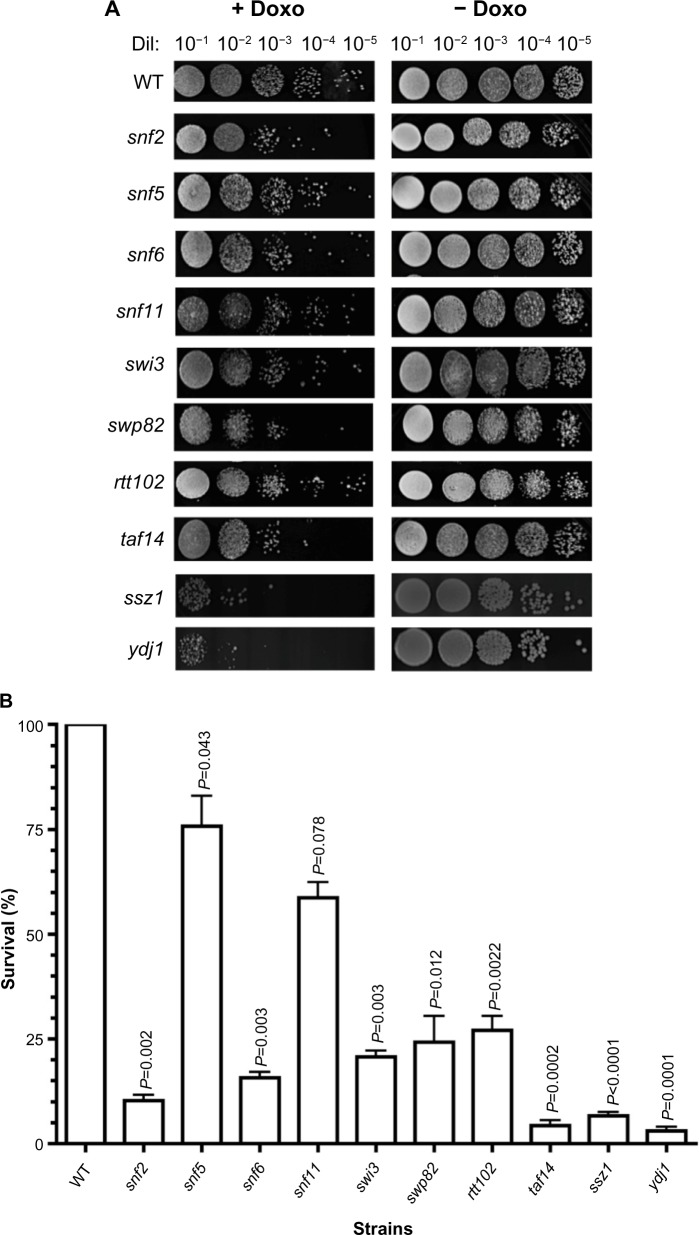
Figure 1
Figure 1
Sensitivity of SWI/SNF deletion strains to chemotherapeutic agent doxorubicin. Notes: (A) The survival of the strains to 20 μmol/L doxorubicin was determined as described in the “Materials and methods” section. Serial dilutions (1:10–1:105) of the treated cultures were spotted onto YPD plates. Growth was scored after 3 days of incubation at 30°C. The serial dilutions of the strains are shown. Positive controls sensitive to doxorubicin are the ssz1 and ydj1 deletion strains. (B) Quantification of the survival of the tested strains. Survival was determined by counting the number of colonies in the respective dilutions and calculated on the basis of the growth of strains not treated with doxorubicin. At least three sets of experiments were used in the statistical analysis. Average survival plus standard deviation is shown. The P-values are indicated for each mutant. Abbreviations: YPD, yeast extract/peptone/dextrose; WT, wild type; Dil, serial dilutions; Doxo, doxorubicin.
Figure 2
Figure 2
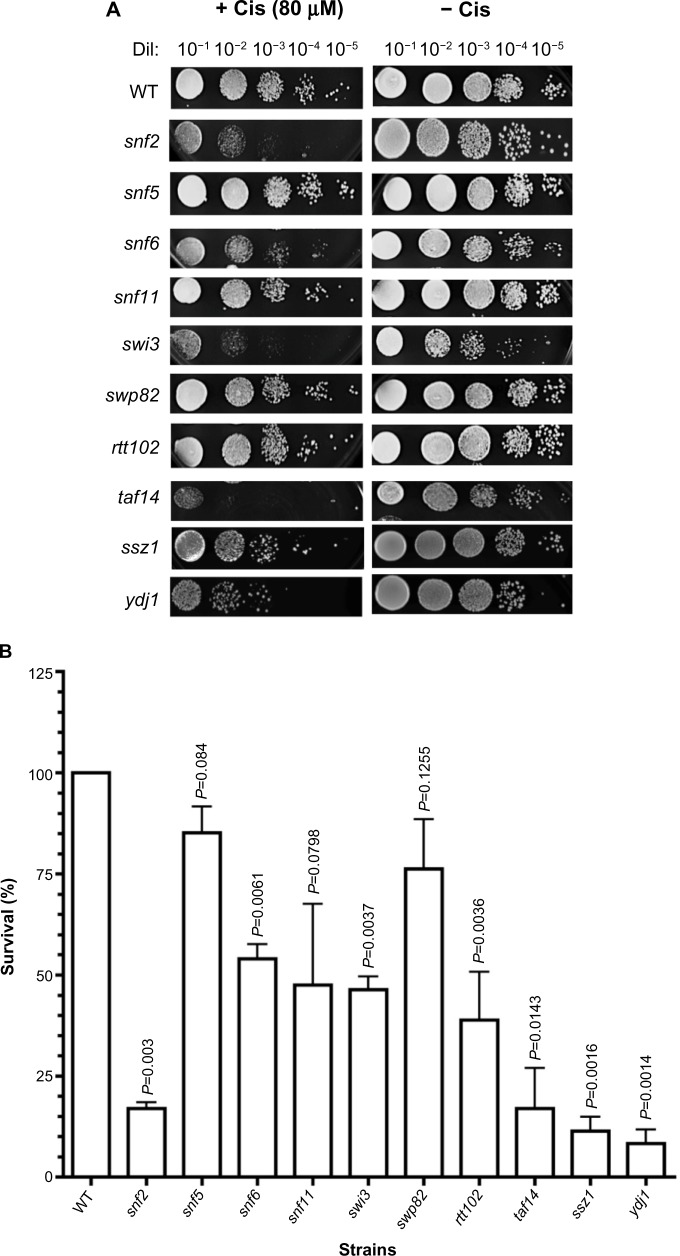
Sensitivity of SWI/SNF deletion strains to chemotherapeutic agent cisplatin. Notes: (A) Strains were exposed to cisplatin (80 μmol/L). Serial dilutions (1:10–1:105) of the treated cultures were spotted onto YPD plates. Growth was scored after 3 days of incubation at 30°C. The serial dilutions of the strains are shown. Positive controls sensitive to cisplatin are the ssz1 and ydj1 deletion strains. (B) Quantification of the survival of the tested strains. Survival was determined by counting the number of colonies in the respective dilutions and calculated on the basis of the growth of strains not treated with cisplatin. At least three sets of experiments were used in the statistical analysis. Average survival plus standard deviation is shown. Abbreviations: YPD, yeast extract/peptone/dextrose; WT, wild type; Dil, serial dilutions; Cis, cisplatin.
Figure 3
Figure 3
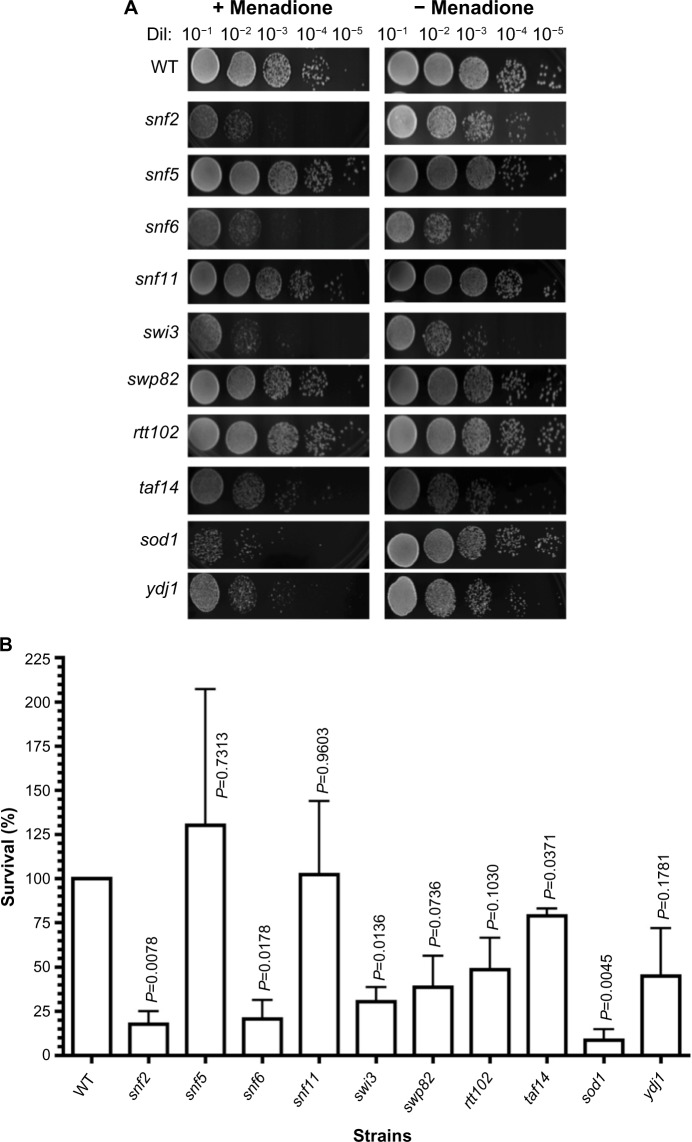
Sensitivity of SWI/SNF deletion strains to menadione. Notes: (A) SWI/SNF deletion mutants exposed to menadione (6.6 mM) were plated onto YPD agar plates. Serial dilutions of the treated strains are presented. Positive controls sensitive to menadione are the ssz1 and ydj1 deletion strains. (B) Survival was determined by growth of treated strain relative to the growth of its non-treated control. At least three sets of experiments were used in the statistical analysis. Average survival plus standard deviation is shown. Abbreviations: YPD, yeast extract/peptone/dextrose; WT, wild type; Dil, serial dilutions.
Figure 4
Figure 4
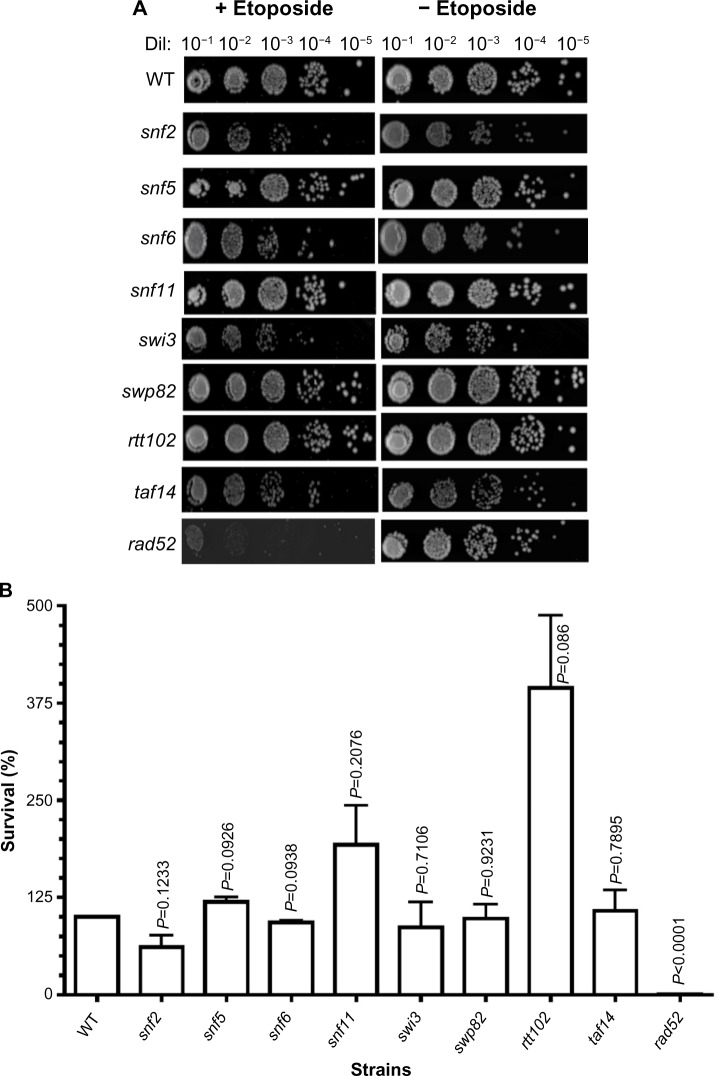
Sensitivity of SWI/SNF deletion strains to etoposide. Notes: (A) The survival of the strains to etoposide was determined. Serial dilutions of the treated strains were spotted onto YPD agar plates containing etoposide (1 mM) and incubated at 30°C. Growth was scored at 72 hours. Positive controls sensitive to etoposide is the rad52 deletion strain. (B) Survival was determined by growth of the treated strain relative to the growth of its untreated control. At least three sets of experiments were used in the statistical analysis. Average survival plus standard deviation is shown. Abbreviations: YPD, yeast extract/peptone/dextrose; WT, wild type; Dil, serial dilutions.
Figure 5
Figure 5
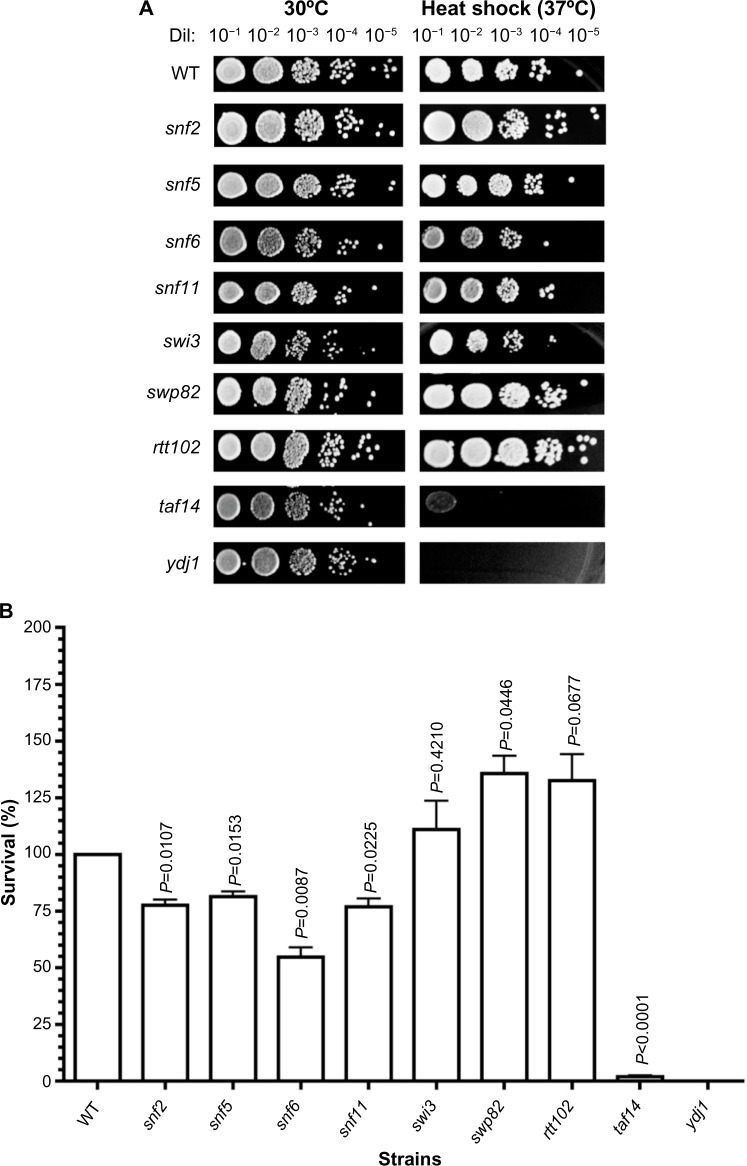
Sensitivity of SWI/SNF deletion strains to heat shock. Notes: (A) SWI/SNF deletion strains were tested for heat sensitivity. Serial dilutions of the cells were plated onto YPD agar plates and incubated at 30°C (untreated controls) and at 37°C (heat shock). Growth was scored at 72 hours. Positive controls sensitive to heat shock is the ydj1 deletion strain. (B) Survival was determined by growth of the heat-shocked strain relative to the growth of non-heat-shocked cells. At least three sets of experiments were used in the statistical analysis. Average survival plus standard deviation is shown. Abbreviations: YPD, yeast extract/peptone/dextrose; WT, wild type; Dil, serial dilutions.

References

    1. Kostriken R, Strathern JN, Klar AJ, Hicks JB, Heffron F. A site-specific endonuclease essential for mating-type switching in Saccharomyces cerevisiae. Cell. 1983;35:167–174. - PubMed
    1. Lutfiyya LL, Johnston M. Two zinc-finger-containing repressors are responsible for glucose repression of SUC2 expression. Mol Cell Biol. 1996;16:4790–4797. - PMC - PubMed
    1. Sudarsanam P, Winston F. The Swi/Snf family nucleosome-remodeling complexes and transcriptional control. Trends Genet. 2000;16:345–351. - PubMed
    1. Perez-Martin J, Johnson AD. The C-terminal domain of Sin1 interacts with the SWI-SNF complex in yeast. Mol Cell Biol. 1998;18:4157–4164. - PMC - PubMed
    1. Kingston RE, Narlikar GJ. ATP-dependent remodeling and acetylation as regulators of chromatin fluidity. Genes Dev. 1999;13:2339–2352. - PubMed

LinkOut - more resources