. 2010;5(1):12-24.
doi: 10.2174/157436210790226465.

The Role of the O-GlcNAc Modification in Regulating Eukaryotic Gene Expression

Affiliations

The Role of the O-GlcNAc Modification in Regulating Eukaryotic Gene Expression

Sandii Brimble et al. Curr Signal Transduct Ther. 2010.

Abstract

O-linked β-N-acetylglucosamine (O-GlcNAc) modification of proteins has been shown to be involved in many different cellular processes, such as cell cycle control, nutrient sensing, signal transduction, stress response and transcriptional regulation. Cells have developed complex regulatory systems in order to regulate gene expression appropriately in response to environmental and intracellular cues. Control of eukaryotic gene transcription often involves post-translational modification of a multitude of proteins including transcription factors, basal transcription machinery, and chromatin remodeling complexes to modulate their functions in a variety of manners. In this review we describe the emerging functional roles for and techniques to detect and modulate the O-GlcNAc modification and illustrate that the O-GlcNAc modification is intricately involved in at least seven different general mechanisms for the control of gene transcription.

Keywords: O-GlcNAc; post-translational modification; review; transcriptional regulation.


Figures
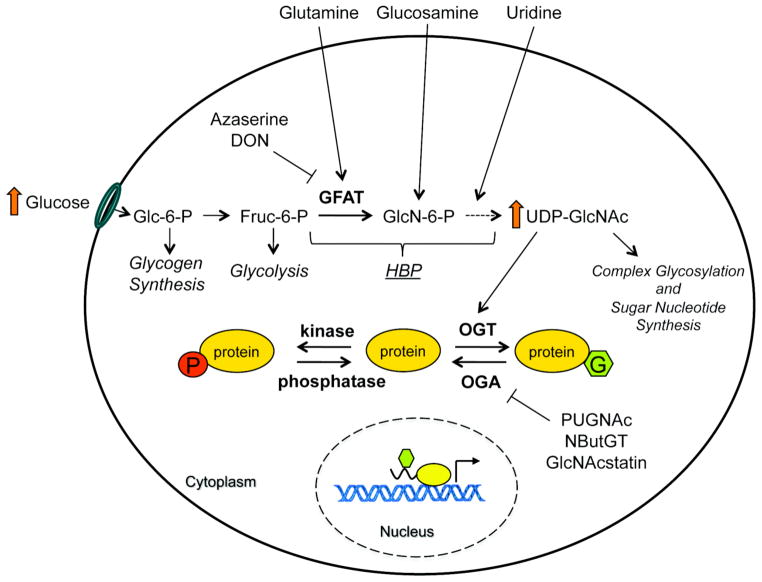
Fig. 1
Fig. 1. Modulation of cellular O-GlcNAc levels using HBP flux and specific enzyme inhibitors
The end product of the HBP, UDP-GlcNAc, is sensitive to changes in nutrient levels. Glucosamine enters the HBP downstream of the rate-limiting enzyme GFAT to elevate UDP-GlcNAc levels. The use of the amidotransferase inhibitors azaserine or DON decreases UDP-GlcNAc levels. Proteins can be reciprocally modified by glycosylation and phosphorylation. However, unlike phosphorylation, which is regulated by hundreds of kinases and phosphatases, O-GlcNAc modification is cycled by the result of gene products from only two genes, ogt and oga. OGT transfers the GlcNAc onto serine and threonine residues of nuclear and cytosolic proteins and is responsive to changes in UDP-GlcNAc concentrations. Global O-GlcNAc levels can also be raised by the use of OGA inhibitors PUGNAc, NButGT and GlcNAc-statin. Enzymes are depicted in bold and biological pathways are in italics.
Fig. 2
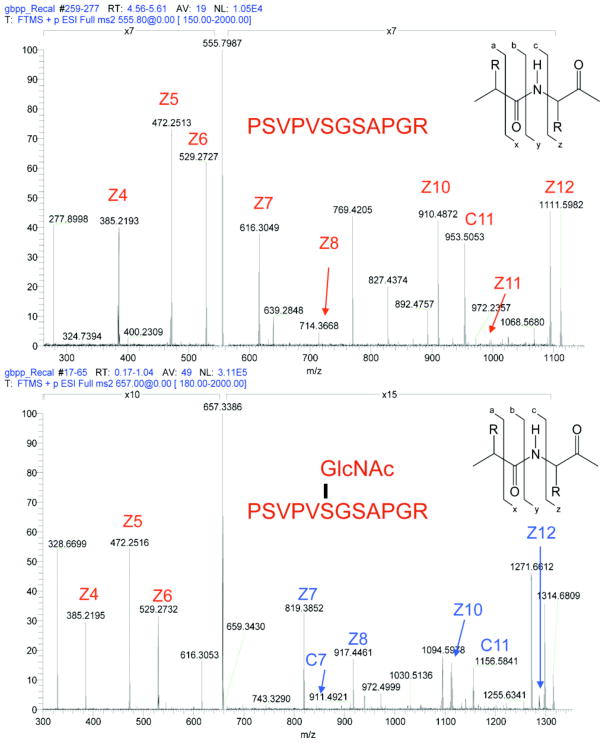
Fig. 2. Site-mapping of O-GlcNAc sites is facilitated by electron dissociation techniques
UL32, a synthetic O-GlcNAc modified protein, is efficiently fragmented and the site of modification (from three possible sites) is easily assigned via electron capture dissociation. When comparing the spectra from unglycosylated (top) and glycosylated peptide (bottom), singly charged fragments retaining the O-GlcNAc modified serine (shown in BLUE) show an increase in mass to charge of 203 daltons, the weight of a single GlcNAc residue.
Fig. 3
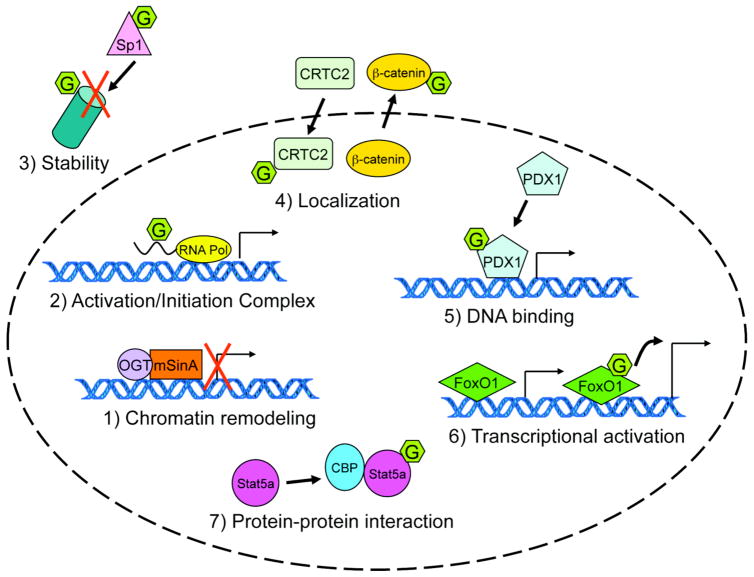
Fig. 3. Transcriptional regulation by O-GlcNAc can occur via seven different mechanisms
The O-GlcNAc modification has been demonstrated to regulate transcription by modulating proteins involved in chromatin remodeling and transcriptional initiation, as well as protein-protein associations, localization, stability, DNA binding, and transactivation capacity of individual transcription factors.

References

    1. Brivanlou AH, Darnell JE., Jr Signal transduction and the control of gene expression. Science. 2002;1;295:813–8. - PubMed
    1. Orphanides G, Reinberg D. A unified theory of gene expression. Cell. 2002;108:439–51. - PubMed
    1. Levine M, Tjian R. Transcription regulation and animal diversity. Nature. 2003;424:147–51. - PubMed
    1. Heintzman ND, Ren B. The gateway to transcription: identifying, characterizing and understanding promoters in the eukaryotic genome. Cell Mol Life Sci. 2007;64:386–400. - PMC - PubMed
    1. Khidekel N, Hsieh-Wilson LC. A ‘molecular switchboard’--covalent modifications to proteins and their impact on transcription. Org Biomol Chem. 2004;2:1–7. - PubMed

LinkOut - more resources