. 2014 Nov 21:5:659.
doi: 10.3389/fpls.2014.00659. eCollection 2014.

Extracellular ATP activates MAPK and ROS signaling during injury response in the fungus Trichoderma atroviride

Affiliations

Extracellular ATP activates MAPK and ROS signaling during injury response in the fungus Trichoderma atroviride

Elizabeth Medina-Castellanos et al. Front Plant Sci. .

Abstract

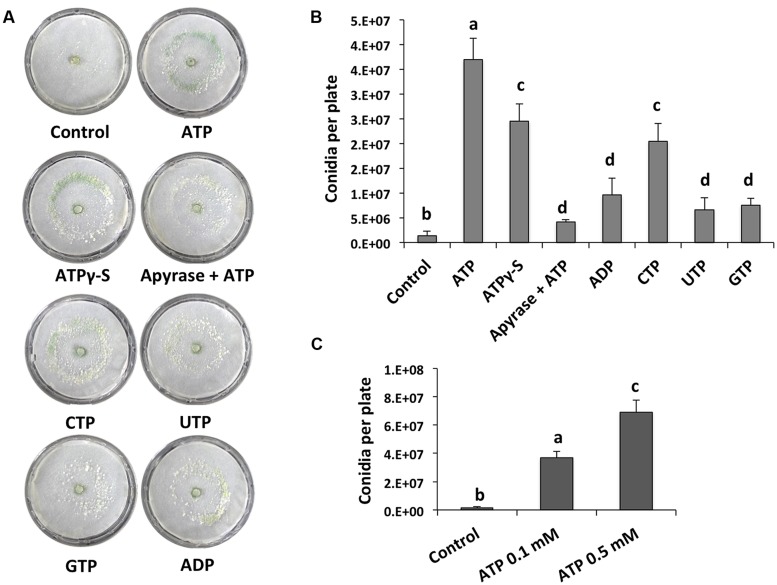
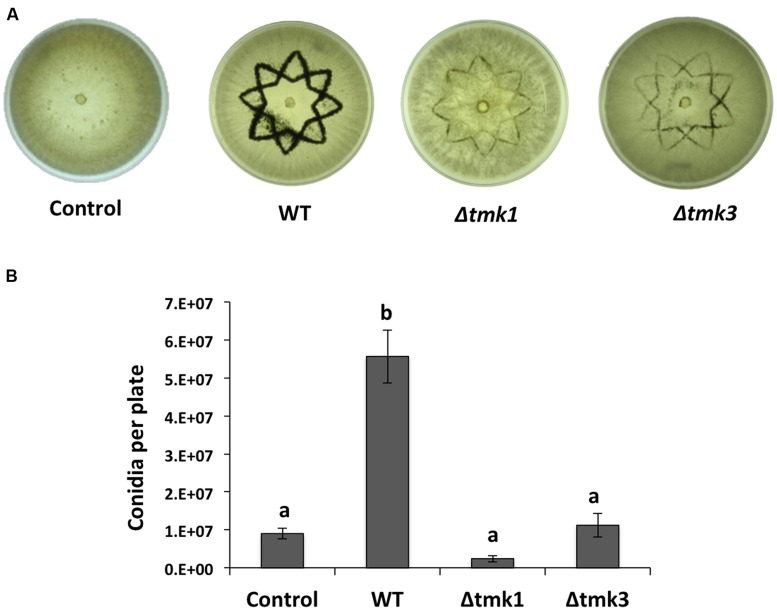
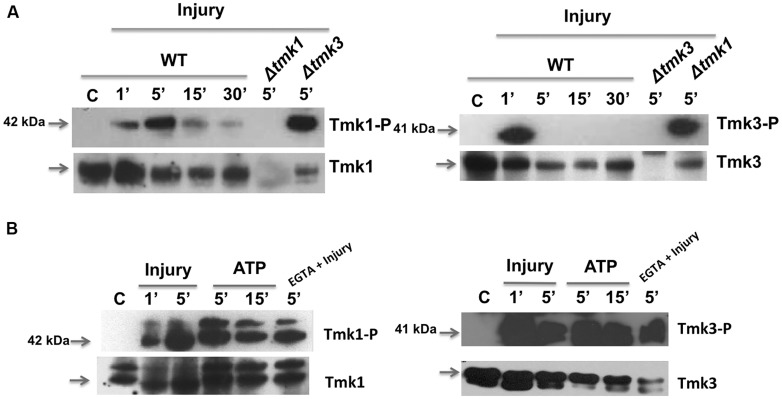
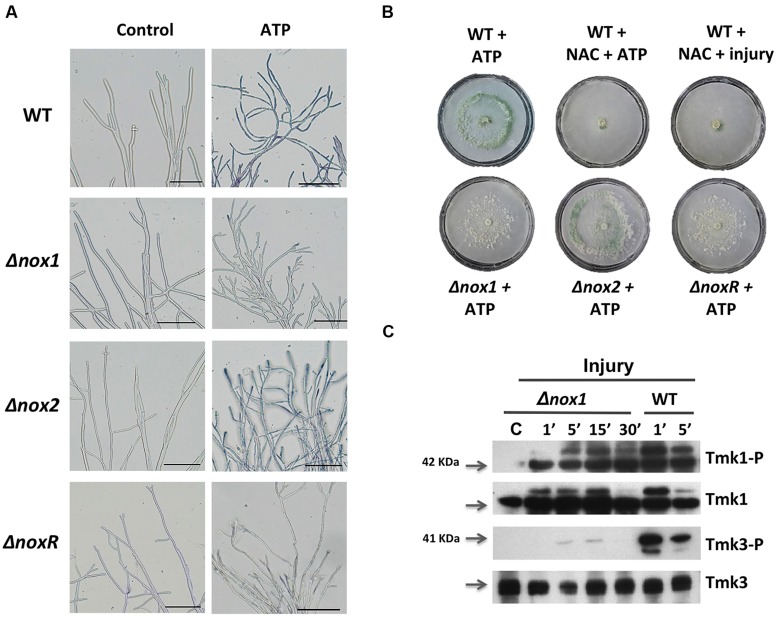
The response to mechanical damage is crucial for the survival of multicellular organisms, enabling their adaptation to hostile environments. Trichoderma atroviride, a filamentous fungus of great importance in the biological control of plant diseases, responds to mechanical damage by activating regenerative processes and asexual reproduction (conidiation). During this response, reactive oxygen species (ROS) are produced by the NADPH oxidase complex. To understand the underlying early signaling events, we evaluated molecules such as extracellular ATP (eATP) and Ca(2+) that are known to trigger wound-induced responses in plants and animals. Concretely, we investigated the activation of mitogen-activated protein kinase (MAPK) pathways by eATP, Ca(2+), and ROS. Indeed, application of exogenous ATP and Ca(2+) triggered conidiation. Furthermore, eATP promoted the Nox1-dependent production of ROS and activated a MAPK pathway. Mutants in the MAPK-encoding genes tmk1 and tmk3 were affected in wound-induced conidiation, and phosphorylation of both Tmk1 and Tmk3 was triggered by eATP. We conclude that in this fungus, eATP acts as a damage-associated molecular pattern (DAMP). Our data indicate the existence of an eATP receptor and suggest that in fungi, eATP triggers pathways that converge to regulate asexual reproduction genes that are required for injury-induced conidiation. By contrast, Ca(2+) is more likely to act as a downstream second messenger. The early steps of mechanical damage response in T. atroviride share conserved elements with those known from plants and animals.

Keywords: calcium; conidiation; extracellular ATP (eATP); injury response; mitogen-activated protein kinase (MAPK); reactive oxygen species (ROS).


Figures
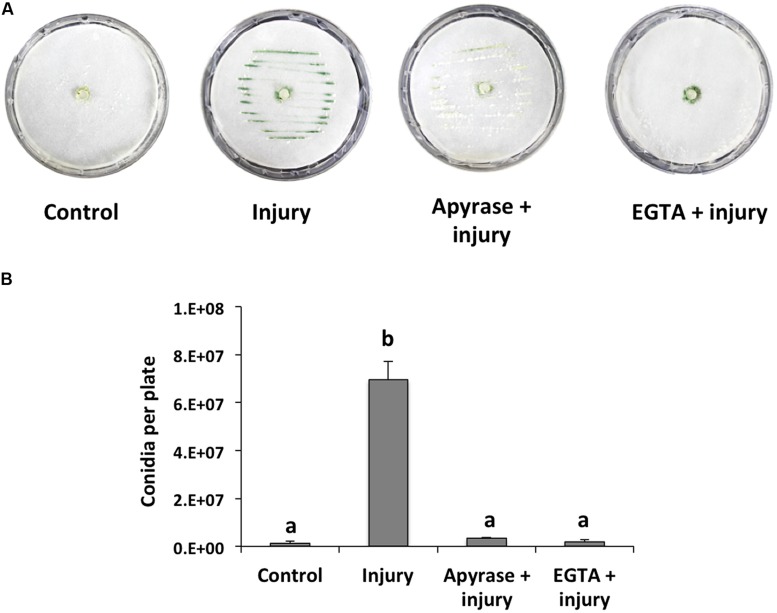
FIGURE 1
FIGURE 1
Effect of EGTA and apyrase on injury-induced conidiation. (A) Colonies of the fungus were damaged using a scalpel to induce conidiation (visualized as green lines). Prior to damage, apyrase or 15mM EGTA were added. Photographs were taken 48 hours after injury. An undamaged colony is shown as control. (B) Quantification of conidia produced after injury. Error bars represent the mean ± SEM of three biological replicas. Bars with different letters indicate treatments that were significantly different (P < 0.001).
FIGURE 2
FIGURE 2
eATP stimulates conidiation. (A) Analysis of the WT strain in response to ATP, ATPγS, ADP, CTP, UTP, and GTP (0.1 mM), or ATP and 2 units of apyrase. Photographs were taken 48 hours after treatment. An undamaged colony is shown as control. (B) Quantification of conidia produced after the treatments shown in (A). (C) Quantification of conidia produced in response to different ATP concentrations. Error bars represent the mean ± SEM of three biological replicates. Bars with different letters indicate treatments that were significantly different (P < 0.01).
FIGURE 3
FIGURE 3
Injury response of the Tmk1 and Tmk3 mutants. (A) The WT, Δtmk1 and Δtmk3 strains growing on PDA were damaged with a cookie mold, and photographs taken 48 hours later. An undamaged WT strain is shown as control. (B) Quantification of conidia produced after injury for each strain. Error bars represent the mean ± SEM of three biological replicas. Bars with different letters indicate treatments that were significantly different (P < 0.001).
FIGURE 4
FIGURE 4
Phosphorylation of TMK1 and TMK3 in response to injury and eATP. (A) The WT strain was injured and mycelial samples collected at the indicated times. Mycelium from an undamaged colony was included as control (C). Proteins were extracted, separated by SDS-PAGE, and used for immunoblotting. Blots were probed with anti-Tmk1 (anti-p42/p44) and Tmk1-P (anti-Phospho-p42/p44) antibodies (left panel) or anti-Tmk3 (antip38) and Tmk3-P (anti-Phospho-p38) antibodies (right panel). Note that the anti-Tmk1 antibodies also recognize Tmk2 (p44), as previously shown (Mendoza-Mendoza et al., 2003). (B) The WT strain was ATP induced (0.1 mM) or treated with EGTA (15 mM) and mycelial samples collected at the indicated times. Proteins were extracted, separated by SDS-PAGE, and used for immunoblotting. Blots were probed as in (A). Arrows indicate the bands corresponding to Tmk1 or Tmk3. The Δtmk1 and Δtmk3 mutants were included as controls. The experiments were repeated three times with similar results.
FIGURE 5
FIGURE 5
Production of superoxide in response to extracellular ATP (eATP). (A) Detection of superoxide. WT, Δnox1, Δnox2, and ΔnoxR strains were incubated with ATP (0.1 mM), followed by incubation in a 0.3 mM NBT solution and examined by bright-field microscopy (BF). The blue/purple coloration indicates the production of superoxide (formazan generation). The scale bar = 10 μm. (B) eATP-induced conidiation. The WT strain was treated with ATP (0.1 mM), or a combination of NAC (60 mM) and ATP, or NAC and injured with a scalpel. The Δnox1, Δnox2, and ΔnoxR mutants were induced with ATP (0.1 mM). (C) The Δnox1 mutant was injured and mycelial samples collected at the indicated times. Proteins were extracted, separated by SDS-PAGE, and used for immunoblotting with anti-Tmk1 (anti-p42/p44), Tmk1-P (anti-Phospho-p42/p44), anti-Tmk3 (antip38) and Tmk3-P (anti-Phospho-p38) antibodies. Mycelium from an undamaged colony was included as control (C). Arrows indicate the bands corresponding to Tmk1 or Tmk3. The experiments were repeated two times with similar results.
FIGURE 6
FIGURE 6
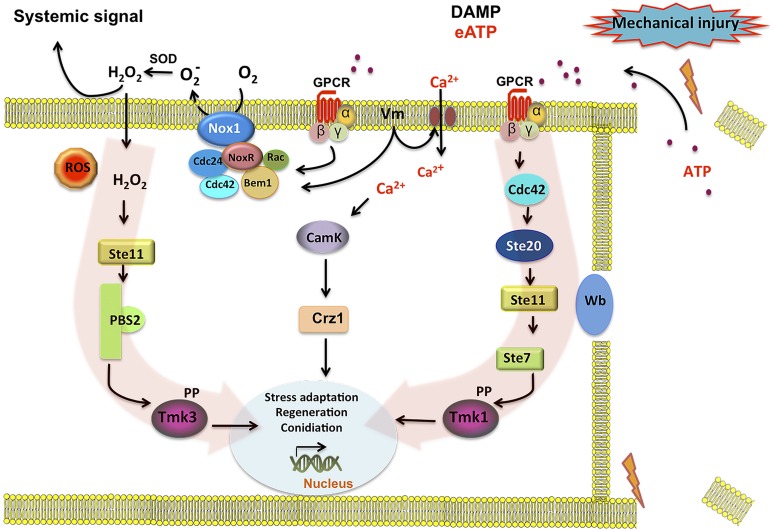
Model for injury-induced signaling in Trichoderma atroviride. Broken hyphae release ATP as a signal molecule. ATP is perceived by a putative G protein-coupled receptor (GPCR) activating the Tmk1 and Tmk3 MAPK pathways (highlighted by red arrows). Activation of the GPCR turns on the Cdc42 GTPase in coordination with an increase of Nox1-dependent reactive oxygen species (ROS) production. Cdc42 may in turn activate the Ste20 MAPK pathway, leading to Tmk1 phosphorylation. In a parallel pathway increases in intracellular calcium and CamK kinases, regulate targets required for the damage response. Calcium influx may also lead to changes in membrane potential (Vm) and/or directly activate the Rac GTPase component of the NADPH oxidase (Nox1/NoxR) complex, generating O2. A superoxide dismutase (Sod) converts O2 into H2O2 that can diffuse into the cell, activating the Ste11 MAPK pathway, leading to Tmk3 phosphorylation. Phosphorylation of Tmk1 and/or Tmk3 results in the activation of the developmental program that results in the formation conidia.

References

    1. Abbracchio M. P., Burnstock G., Boeynaems J.-M., Barnard E. A., Boyer J. L., Kennedy C., et al. (2006). International union of pharmacology LVIII: update on the P2Y G protein-coupled nucleotide receptors: from molecular mechanisms and pathophysiology to therapy. Pharmacol. Rev. 58 281–341 10.1124/pr.58.3.3 - DOI - PMC - PubMed
    1. Aguirre J., Ríos-Momberg M., Hewitt D., Hansberg W. (2005). Reactive oxygen species and development in microbial eukaryotes. Trends Microbiol. 13 111–118 10.1016/j.tim.2005.01.007 - DOI - PubMed
    1. Arimura G. I., Maffei M. E. (2010). Calcium and secondary CPK signaling in plants in response to herbivore attack. Biochem. Biophys. Res. Commun. 400 455–460 10.1016/j.bbrc.2010.08.134 - DOI - PubMed
    1. Bayram Ö., Bayram Ö. S., Ahmed Y. L., Maruyama J., Valerius O., Rizzoli S. O., et al. (2012). The Aspergillus nidulans MAPK module AnSte11-Ste50-Ste7-Fus3 controls development and secondary metabolism. PLoS Genet. 8:e1002816 10.1371/journal.pgen.1002816 - DOI - PMC - PubMed
    1. Beneloujaephajri E., Costa A., L’haridon F., Métraux J.-P., Binda M. (2013). Production of reactive oxygen species and wound-induced resistance in Arabidopsis thaliana against Botrytis cinerea are preceded and depend on a burst of calcium. BMC Plant Biol. 13:160 10.1186/1471-2229-13-160 - DOI - PMC - PubMed

LinkOut - more resources