


Intercropping enhances productivity and maintains the most soil fertility properties relative to sole cropping
- PMID: 25486249
- PMCID: PMC4259307
- DOI: 10.1371/journal.pone.0113984
Intercropping enhances productivity and maintains the most soil fertility properties relative to sole cropping
Abstract
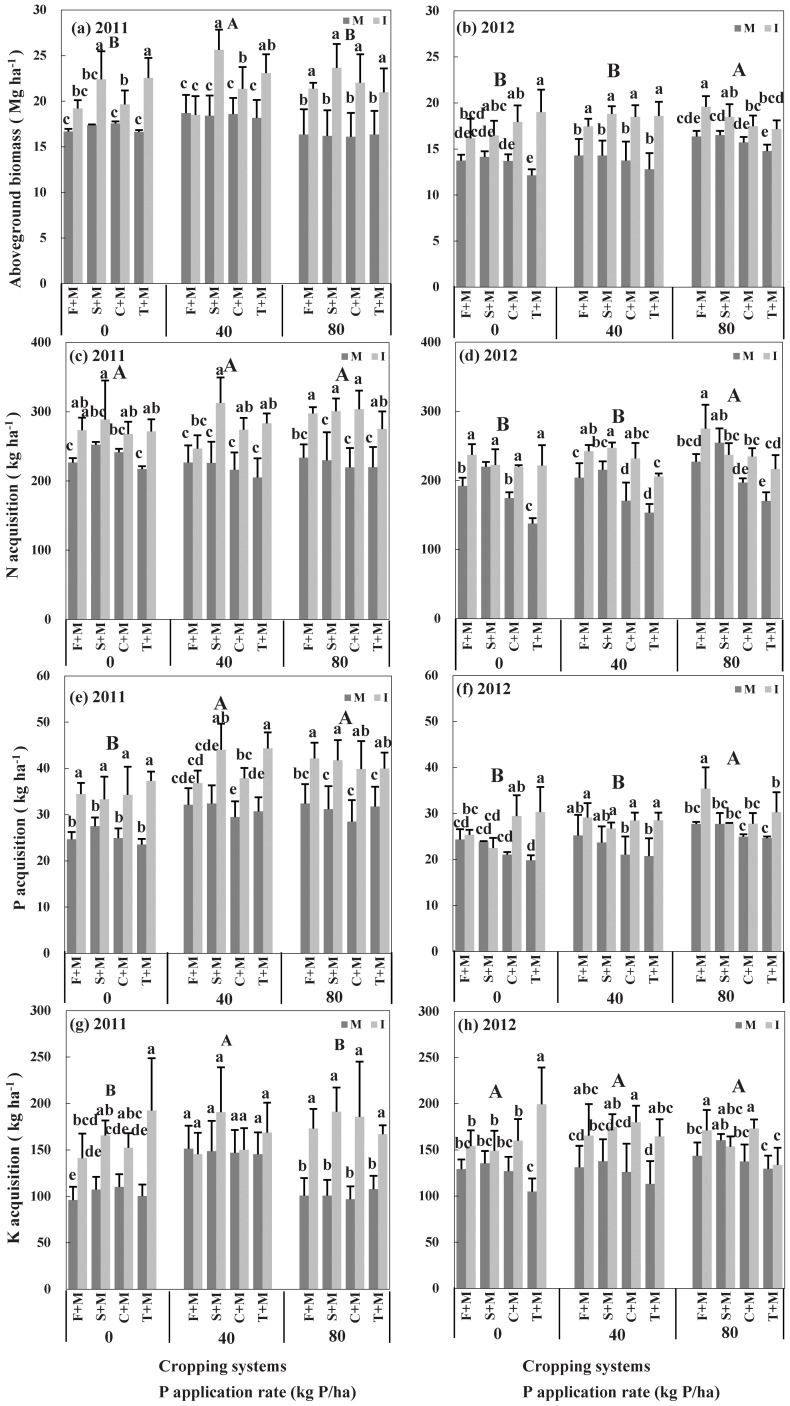
Yield and nutrient acquisition advantages are frequently found in intercropping systems. However, there are few published reports on soil fertility in intercropping relative to monocultures. A field experiment was therefore established in 2009 in Gansu province, northwest China. The treatments comprised maize/faba bean, maize/soybean, maize/chickpea and maize/turnip intercropping, and their correspoding monocropping. In 2011 (the 3rd year) and 2012 (the 4th year) the yields and some soil chemical properties and enzyme activities were examined after all crop species were harvested or at later growth stages. Both grain yields and nutrient acquisition were significantly greater in all four intercropping systems than corresponding monocropping over two years. Generally, soil organic matter (OM) did not differ significantly from monocropping but did increase in maize/chickpea in 2012 and maize/turnip in both years. Soil total N (TN) did not differ between intercropping and monocropping in either year with the sole exception of maize/faba bean intercropping receiving 80 kg P ha-1 in 2011. Intercropping significantly reduced soil Olsen-P only in 2012, soil exchangeable K in both years, soil cation exchangeable capacity (CEC) in 2012, and soil pH in 2012. In the majority of cases soil enzyme activities did not differ across all the cropping systems at different P application rates compared to monocrops, with the exception of soil acid phosphatase activity which was higher in maize/legume intercropping than in the corresponding monocrops at 40 kg ha-1 P in 2011. P fertilization can alleviate the decline in soil Olsen-P and in soil CEC to some extent. In summary, intercropping enhanced productivity and maintained the majority of soil fertility properties for at least three to four years, especially at suitable P application rates. The results indicate that maize-based intercropping may be an efficient cropping system for sustainable agriculture with carefully managed fertilizer inputs.
Conflict of interest statement
Figures
References
-
- Vandermeer JH (1992) The ecology of intercropping. Cambridge University Press.
-
- Francis CA (1986) Multiple cropping systems. Macmillan Publishing Company.
-
- Ouma G (2009) Intercropping and its application to banana production in East Africa: A review. Journal of Plant Breeding and Crop Science 1:13–15.
-
- Zomer RJ, Trabucco A, Coe R, Place F (2009) Trees on farm: Analysis of global extent and geographical patterns of agroforestry. ICRAF Working Paper no 89. Nairobi, Kenya: World Agroforestry Centre.
-
- Willey RW (1979) Intercropping: Its importance and research needs. CAB.
Publication types
MeSH terms
Substances
LinkOut - more resources
Full Text Sources
Other Literature Sources
Research Materials
