


Effective dose of cone beam CT (CBCT) of the facial skeleton: a systematic review
- PMID: 25486387
- PMCID: PMC4277388
- DOI: 10.1259/bjr.20140658
Effective dose of cone beam CT (CBCT) of the facial skeleton: a systematic review
Abstract
Objective: To estimate effective dose of cone beam CT (CBCT) of the facial skeleton with focus on measurement methods and scanning protocols.
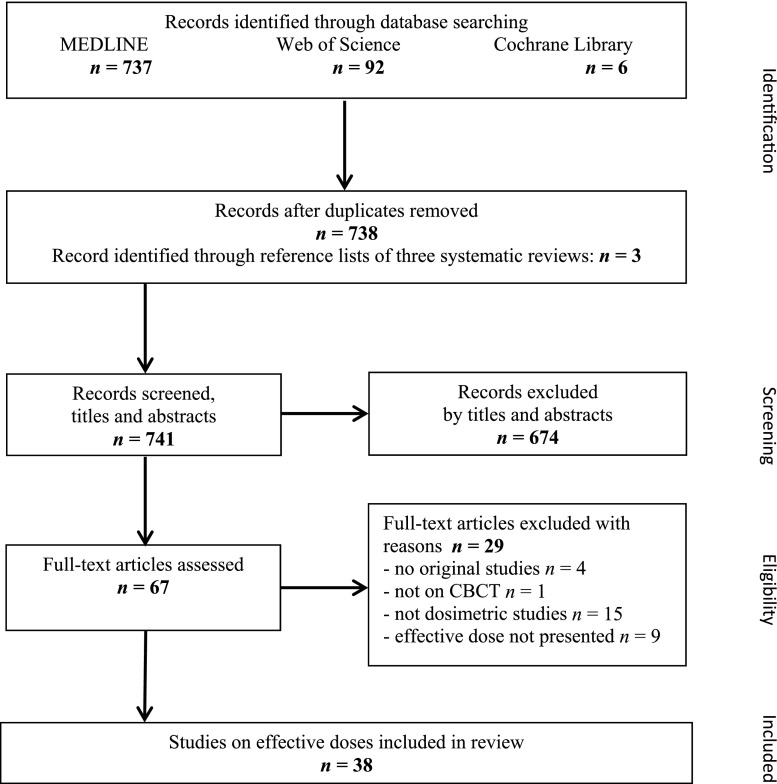
Methods: A systematic review, which adhered to the preferred reporting items for systematic reviews (PRISMA) Statement, of the literature up to April 2014 was conducted. Data sources included MEDLINE®, The Cochrane Library and Web of Science. A model was developed to underpin data extraction from 38 included studies.
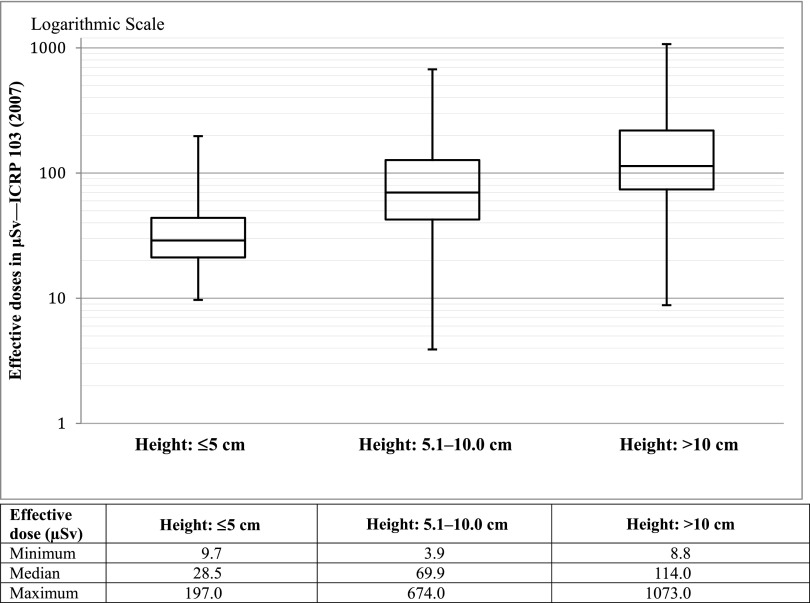
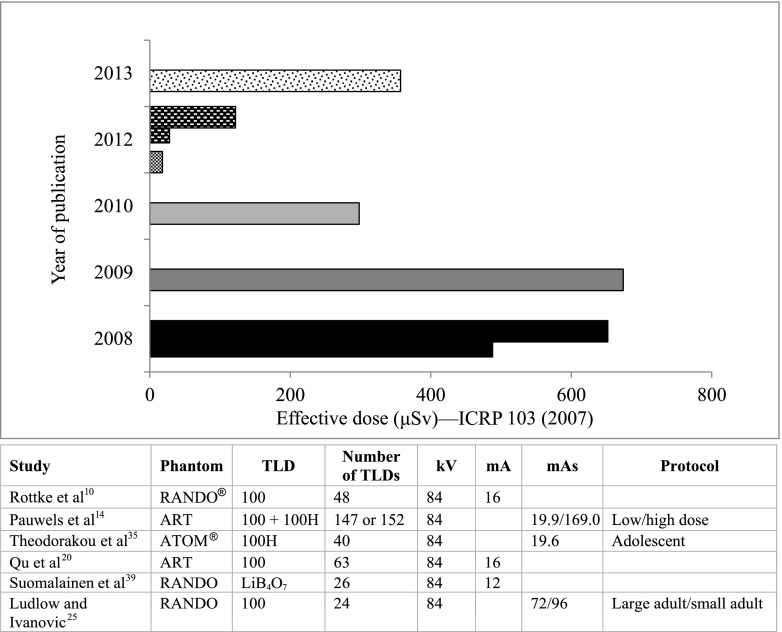
Results: Technical specifications of the CBCT units were insufficiently described. Heterogeneity in measurement methods and scanning protocols between studies made comparisons of effective doses of different CBCT units and scanning protocols difficult. Few studies related doses to image quality. Reported effective dose varied across studies, ranging between 9.7 and 197.0 μSv for field of views (FOVs) with height ≤5 cm, between 3.9 and 674.0 μSv for FOVs of heights 5.1-10.0 cm and between 8.8 and 1073.0 μSv for FOVs >10 cm. There was an inconsistency regarding reported effective dose of studies of the same CBCT unit with the same FOV dimensions.
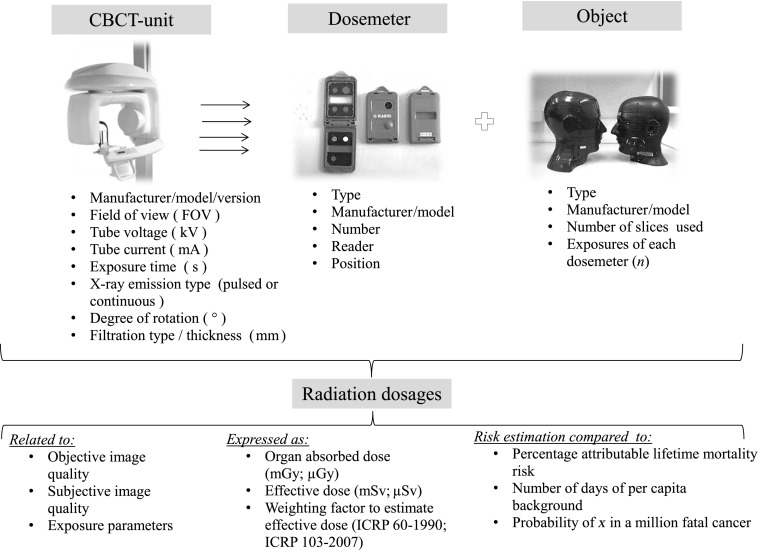
Conclusion: The review reveals a need for studies on radiation dosages related to image quality. Reporting quality of future studies has to be improved to facilitate comparison of effective doses obtained from examinations with different CBCT units and scanning protocols. A model with minimum data set on important parameters based on this observation is proposed.
Advances in knowledge: Data important when estimating effective dose were insufficiently reported in most studies. A model with minimum data based on this observation is proposed. Few studies related effective dose to image quality.
Figures
References
-
- European Commission. Radiation protection no. 172: cone beam CT for dental and maxillofacial radiology. Evidence based guidelines. A report prepared by the SEDENTEXCT project. Luxembourg: European Commission; 2011. [Cited 27 November 2014.] Available from: http://ec.europa.eu/energy/nuclear/radiation_protection/doc/publication/...
-
- Bushberg JT. Science, radiation protection, and the NCRP: building on the past, looking to the future. In: NCRP Fiftieth Annual Meeting Program; 10–11 March 2014; Bethesda, MD. Bethesda, MD: National Council on Radiation Protection and Measurements. pp. 5–7.
-
- Akers J, Aguiar-Ibáñez R, Baba-Akbari Sari A, Beynon S, Booth A, Burch J, et al. Systematic reviews: CRD's guidance for undertaking reviews in health care. Vol. III. York, UK: Centre for Reviews and Dissemination; 2009. pp. 294.
Publication types
MeSH terms
LinkOut - more resources
Full Text Sources
Other Literature Sources
Miscellaneous
