Fifteen-minute comprehensive alcohol risk survey: reliability and validity across American Indian and White adolescents
- PMID: 25486402
- PMCID: PMC4263775
Fifteen-minute comprehensive alcohol risk survey: reliability and validity across American Indian and White adolescents
Abstract
Objective: American Indians (AIs) suffer from significant alcohol-related health disparities, and increased risk begins early. This study examined the reliability and validity of measures to be used in a preventive intervention trial. Reliability and validity across racial/ethnic subgroups are crucial to evaluate intervention effectiveness and promote culturally appropriate evidence-based practice.
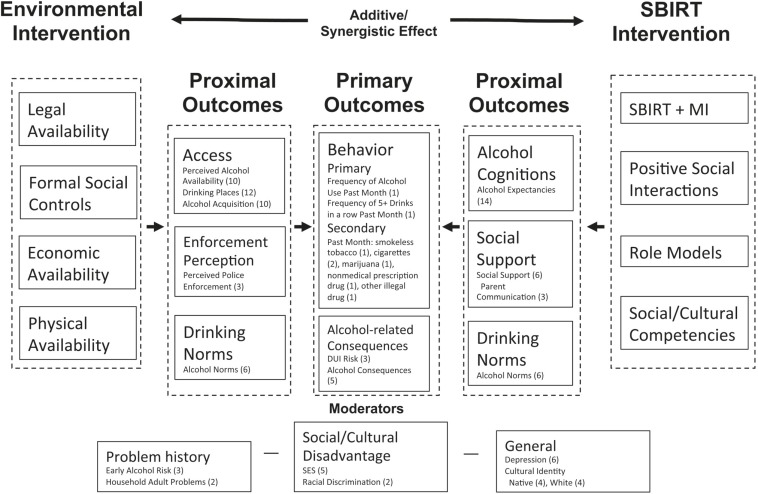
Method: To assess reliability and validity, we used three baseline surveys of high school students participating in a preventive intervention trial within the jurisdictional service area of the Cherokee Nation in northeastern Oklahoma. The 15-minute alcohol risk survey included 16 multi-item scales and one composite score measuring key proximal, primary, and moderating variables. Forty-four percent of the students indicated that they were AI (of whom 82% were Cherokee), including 23% who reported being AI only (n = 435) and 18% both AI and White (n = 352). Forty-seven percent reported being White only (n = 901).
Results: Scales were adequately reliable for the full sample and across race/ethnicity defined by AI, AI/White, and White subgroups. Among the full sample, all scales had acceptable internal consistency, with minor variation across race/ethnicity. All scales had extensive to exemplary test-retest reliability and showed minimal variation across race/ethnicity. The eight proximal and two primary outcome scales were each significantly associated with the frequency of alcohol use during the past month in both the cross-sectional and the longitudinal models, providing support for both criterion validity and predictive validity. For most scales, interpretation of the strength of association and statistical significance did not differ between the racial/ethnic subgroups.
Conclusions: The results support the reliability and validity of scales of a brief questionnaire measuring risk and protective factors for alcohol use among AI adolescents, primarily members of the Cherokee Nation.
Figures
References
-
- Boyce W, Torsheim T, Currie C, Zambon A. The Family Affluence Scale as a measure of national wealth: Validation of an adolescent self-report measure. Social Indicators Research. 2006;78:473–487.
-
- Center on Alcoholism, Substance Abuse, and Addictions Research Division. Family History Questionnaire. 1995. Retrieved from http://casaa.unm.edu/inst/Family%20History%20Questionnaire.pdf.
-
- Centers for Disease Control and Prevention. Methodology of the Youth Risk Behavior Surveillance System. Morbidity and Mortality Weekly Report. 2004;53:1–13. - PubMed
-
- Centers for Disease Control and Prevention, Division of Adolescent and School Health. Youth Risk Behavior Surveillance System (YRBSS): YRBS Questionnaire Content - 1991–2015. 2014. Retrieved from http://www.cdc.gov/healthyyouth/yrbs/pdf/questionnaire/cross-walk_1991-2....
-
- Christiansen BA, Goldman MS, Inn A. Development of alcohol-related expectancies in adolescents: Separating pharmacological from social-learning influences. Journal of Consulting and Clinical Psychology. 1982;50:336–344. - PubMed
Publication types
MeSH terms
Grants and funding
LinkOut - more resources
Full Text Sources
Medical
Miscellaneous