Review
. 2015 Apr;1851(4):456-68.
doi: 10.1016/j.bbalip.2014.11.012. Epub 2014 Dec 5.

Targeted lipidomic strategies for oxygenated metabolites of polyunsaturated fatty acids

Affiliations
Review

Targeted lipidomic strategies for oxygenated metabolites of polyunsaturated fatty acids

Giuseppe Astarita et al. Biochim Biophys Acta. 2015 Apr.

Abstract

Oxidation of polyunsaturated fatty acids (PUFA) through enzymatic or non-enzymatic free radical-mediated reactions can yield an array of lipid metabolites including eicosanoids, octadecanoids, docosanoids and related species. In mammals, these oxygenated PUFA mediators play prominent roles in the physiological and pathological regulation of many key biological processes in the cardiovascular, renal, reproductive and other systems including their pivotal contribution to inflammation. Mass spectrometry-based technology platforms have revolutionized our ability to analyze the complex mixture of lipid mediators found in biological samples, with increased numbers of metabolites that can be simultaneously quantified from a single sample in few analytical steps. The recent development of high-sensitivity and high-throughput analytical tools for lipid mediators affords a broader view of these oxygenated PUFA species, and facilitates research into their role in health and disease. In this review, we illustrate current analytical approaches for a high-throughput lipidomic analysis of eicosanoids and related mediators in biological samples. This article is part of a Special Issue entitled "Oxygenated metabolism of PUFA: analysis and biological relevance."

Keywords: Eicosanoid; Lipid mediator; Lipidomics; Mass spectrometry; PUFA, polyunsaturated fatty acid; Prostaglandin.


Figures

Figure 1
Figure 1
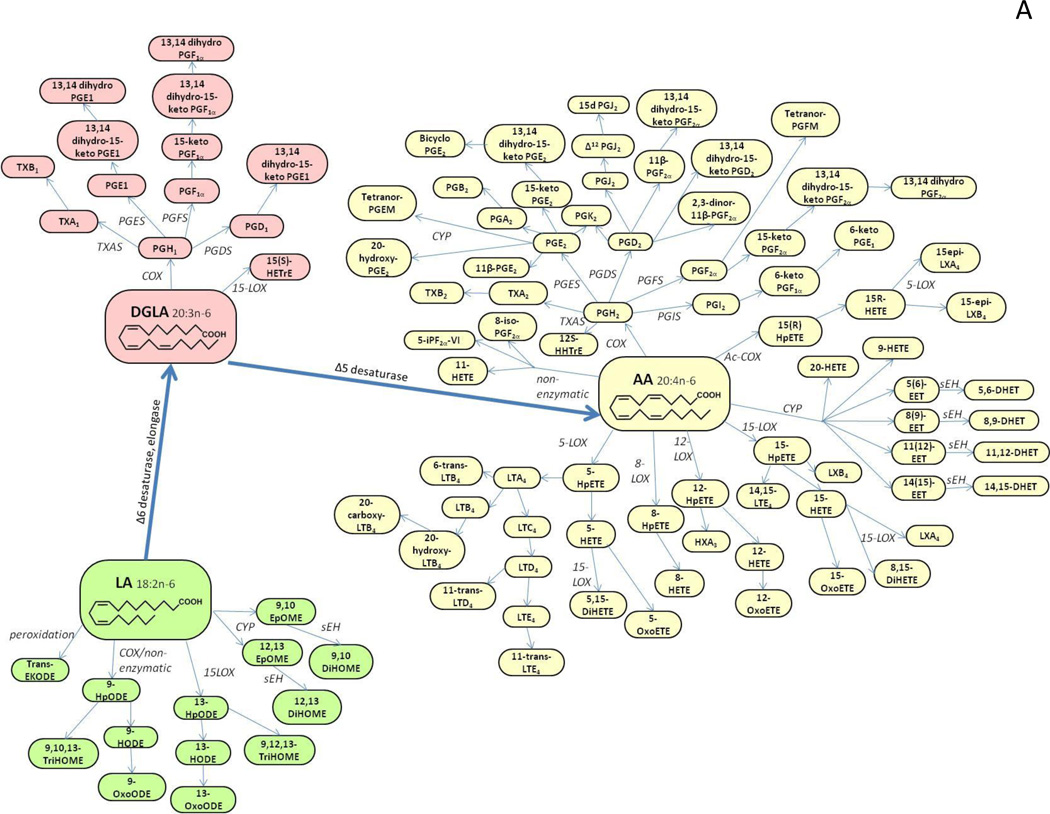
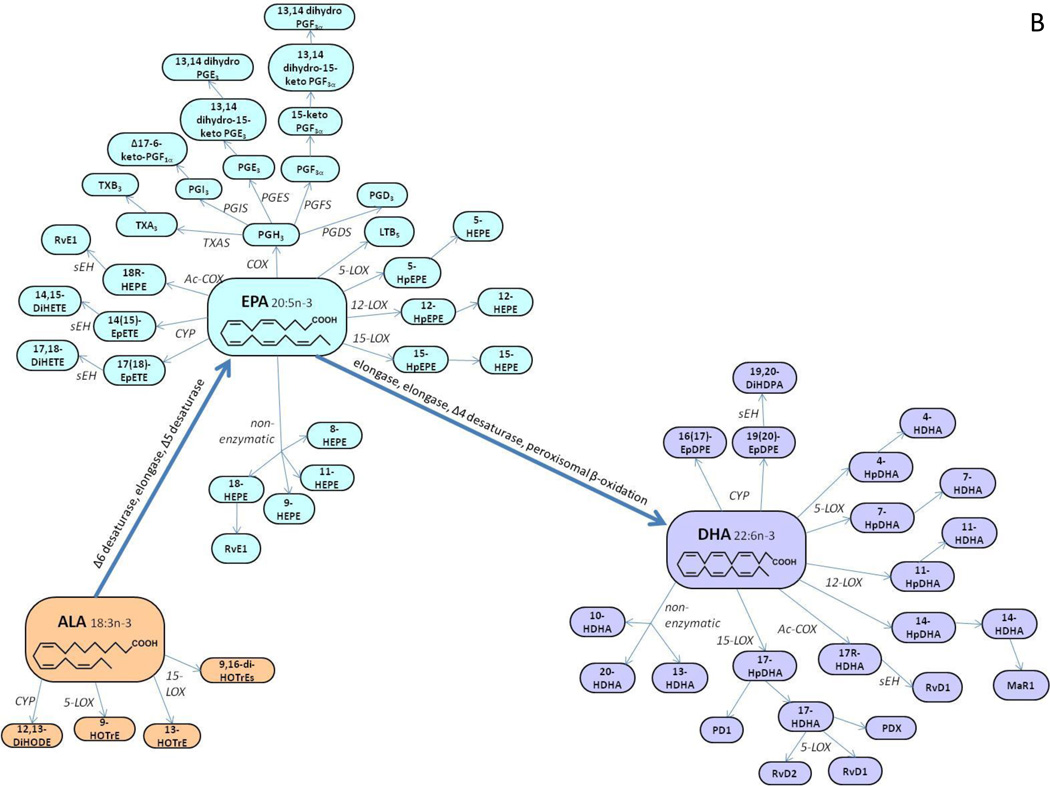
A. Schematic outline of oxygenated species derivatives of the omega-6 fatty acids linoleic acid C18:2 (LA), dihomo-γ-linolenic acid C20:3 (DGLA) and arachidonic acid C20:4 (AA), via the cyclooxygenase (COX), lipoxygenase (LOX), CYP-450 (CYP) or free radical catalyzed pathways. B. Schematic outline of oxygenated species derivatives of the omega-3 fatty acids α-linolenic acid C18:3 (ALA), eicosapentaenoic acid C20:5 (EPA) and docosahexaenoic acid C22:6 (DHA), via the COX, LOX, CYP or free radical catalyzed pathways. Abbreviations: dihydroxy-eicosatrienoic acid (DHET), dihydroxy-eicosatetraenoic acid (DiHETE), dihydroxy-octadecadienoic acid (DiHODE), dihydroxy-octadecenoic acid (DiHOME), epoxy-keto-octadecenoic acid (EKODE), epoxy-eicosatrienoic acid (EET), epoxy-docosapentaenoic acid (EpDPE), epoxy-eicosatetraenoic acid (EpETE), epoxy-octadecenoic acid (EpOME), hydroxy-docosahexaenoic acid (HDHA), hydroxy-eicosapentaenoic acid (HEPE), hydroxy-eicosatrienoic acid (HETrE), hydroxy-eicosatetraenoic acid (HETE), hydroxy-heptadecatrienoic acid (HHTrE), hydroxy-octadecadienoic acid (HODE), hydroxy-octadecatrienoic acid (HOTrE), hydroperoxy-docosahexaenoic acid (HpDHA), hydroperoxy-eicosapentaenoic acid (HpEPE), hydroperoxy-eicosatetraenoic acid (HpETE), hydroperoxy-octadecadienoic acid (HpODE), hepoxilin (HX), leukotriene (LT), lipoxin (LX), oxo-eicosatetraenoic acid (OxoETE), oxo-octadecadienoic acid (OxoODE), prostaglandin (PG), prostaglandin E metabolite (PGEM), prostaglandin F metabolite (PGFM), resolvin (Rv), soluble epoxide hydrolase (sEH), trihydroxy-octadecenoic acid (TriHOME), thromboxane (TX).
Figure 1
Figure 1
A. Schematic outline of oxygenated species derivatives of the omega-6 fatty acids linoleic acid C18:2 (LA), dihomo-γ-linolenic acid C20:3 (DGLA) and arachidonic acid C20:4 (AA), via the cyclooxygenase (COX), lipoxygenase (LOX), CYP-450 (CYP) or free radical catalyzed pathways. B. Schematic outline of oxygenated species derivatives of the omega-3 fatty acids α-linolenic acid C18:3 (ALA), eicosapentaenoic acid C20:5 (EPA) and docosahexaenoic acid C22:6 (DHA), via the COX, LOX, CYP or free radical catalyzed pathways. Abbreviations: dihydroxy-eicosatrienoic acid (DHET), dihydroxy-eicosatetraenoic acid (DiHETE), dihydroxy-octadecadienoic acid (DiHODE), dihydroxy-octadecenoic acid (DiHOME), epoxy-keto-octadecenoic acid (EKODE), epoxy-eicosatrienoic acid (EET), epoxy-docosapentaenoic acid (EpDPE), epoxy-eicosatetraenoic acid (EpETE), epoxy-octadecenoic acid (EpOME), hydroxy-docosahexaenoic acid (HDHA), hydroxy-eicosapentaenoic acid (HEPE), hydroxy-eicosatrienoic acid (HETrE), hydroxy-eicosatetraenoic acid (HETE), hydroxy-heptadecatrienoic acid (HHTrE), hydroxy-octadecadienoic acid (HODE), hydroxy-octadecatrienoic acid (HOTrE), hydroperoxy-docosahexaenoic acid (HpDHA), hydroperoxy-eicosapentaenoic acid (HpEPE), hydroperoxy-eicosatetraenoic acid (HpETE), hydroperoxy-octadecadienoic acid (HpODE), hepoxilin (HX), leukotriene (LT), lipoxin (LX), oxo-eicosatetraenoic acid (OxoETE), oxo-octadecadienoic acid (OxoODE), prostaglandin (PG), prostaglandin E metabolite (PGEM), prostaglandin F metabolite (PGFM), resolvin (Rv), soluble epoxide hydrolase (sEH), trihydroxy-octadecenoic acid (TriHOME), thromboxane (TX).
Figure 2
Figure 2
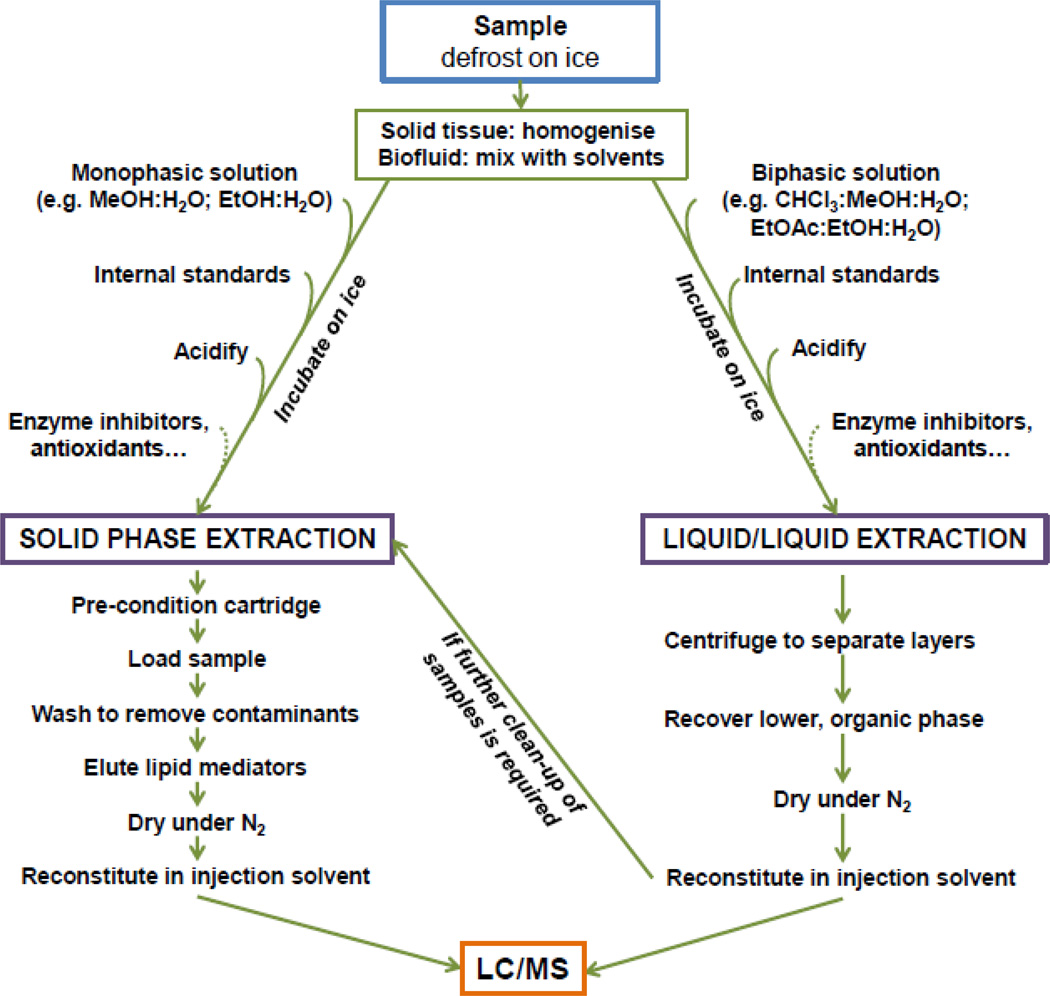
Workflow for the sample preparation options for the analysis of oxygenated PUFA species found in various biological tissue samples. Samples (liquid and/or solid tissues) can be prepared using solid phase extraction (SPE) or liquid/liquid extraction, or a combination of the two, before analysis by liquid chromatography/mass spectrometry (LC/MS). Acid is used to protonate the analytes prior to reversed phase SPE or liquid-liquid extractions; enzyme inhibitors can include protease or cyclooxygenase inhibitors, depending on the experimental design.
Figure 3
Figure 3
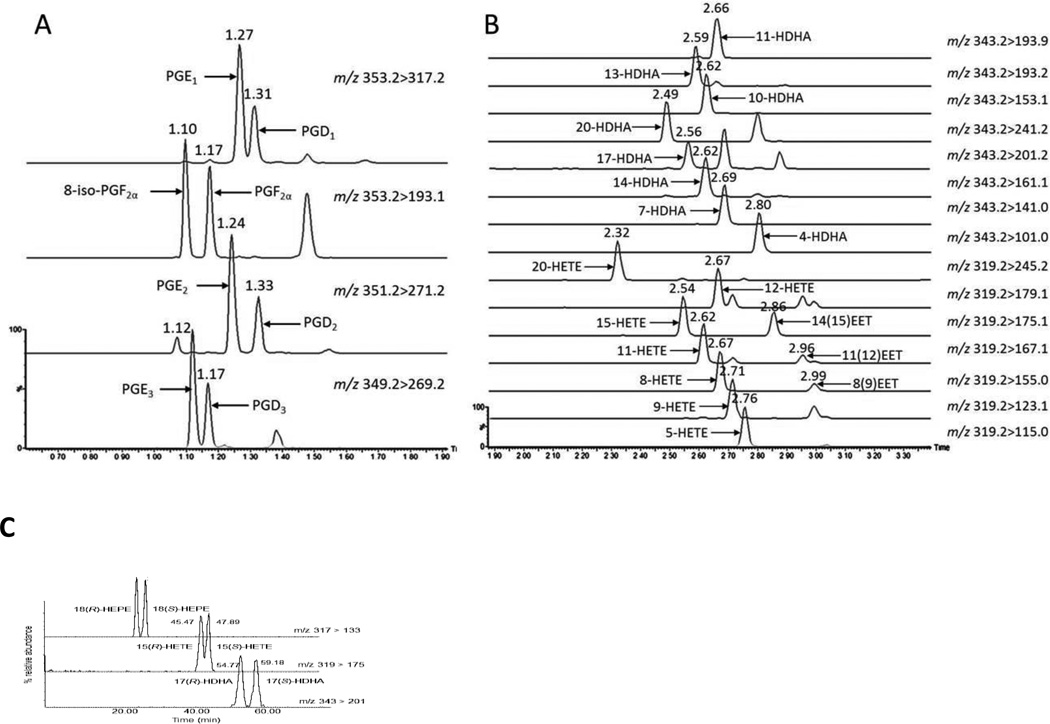
Representative UHPLC-MS/MS chromatograms showing separation of pairs of isobaric species with identical fragmentation patterns by chromatography (A), and of co-eluting metabolites by compound-specific precursor and fragment ions (B). Using a combination of UHPLC with a C18, reversed-phase column, a mixture of commercially available oxygenated PUFA species elutes according to their polarity, number of double bonds and acyl-chain length, allowing the separation of most isomeric and isobaric species (e.g., PGE2 and PGD2) in less than 10 minutes according to retention time and identifying fragmentation patterns (Table 1). A representative UHPLC-MS chromatogram for the chiral separation of enantiomers is shown in panel (C) (adapted from [57]).

References

    1. Buczynski MW, Dumlao DS, Dennis EA. Thematic Review Series: Proteomics. An integrated omics analysis of eicosanoid biology. J Lipid Res. 2009;50:1015–1038. - PMC - PubMed
    1. Nicolaou A, Mauro C, Urquhart P, Marelli-Berg F. Polyunsaturated Fatty Acid-derived lipid mediators and T cell function. Front Immunol. 2014;5:75. - PMC - PubMed
    1. Nicolaou A. Eicosanoids in skin inflammation. Prostaglandins Leukot Essent Fatty Acids. 2013;88:131–138. - PubMed
    1. Hwang SH, Wecksler AT, Wagner K, Hammock BD. Rationally designed multitarget agents against inflammation and pain. Curr Med Chem. 2013;20:1783–1799. - PMC - PubMed
    1. Wishart DS, Jewison T, Guo AC, Wilson M, Knox C, Liu Y, Djoumbou Y, Mandal R, Aziat F, Dong E, Bouatra S, Sinelnikov I, Arndt D, Xia J, Liu P, Yallou F, Bjorndahl T, Perez-Pineiro R, Eisner R, Allen F, Neveu V, Greiner R, Scalbert A. HMDB 3.0--The Human Metabolome Database in 2013. Nucleic Acids Res. 2013;41:D801–D807. - PMC - PubMed

Publication types