Review
. 2015 Jan 19;370(1660):20130383.
doi: 10.1098/rstb.2013.0383.

Ancient and modern environmental DNA

Affiliations
Review

Ancient and modern environmental DNA

Mikkel Winther Pedersen et al. Philos Trans R Soc Lond B Biol Sci. .

Abstract

DNA obtained from environmental samples such as sediments, ice or water (environmental DNA, eDNA), represents an important source of information on past and present biodiversity. It has revealed an ancient forest in Greenland, extended by several thousand years the survival dates for mainland woolly mammoth in Alaska, and pushed back the dates for spruce survival in Scandinavian ice-free refugia during the last glaciation. More recently, eDNA was used to uncover the past 50 000 years of vegetation history in the Arctic, revealing massive vegetation turnover at the Pleistocene/Holocene transition, with implications for the extinction of megafauna. Furthermore, eDNA can reflect the biodiversity of extant flora and fauna, both qualitatively and quantitatively, allowing detection of rare species. As such, trace studies of plant and vertebrate DNA in the environment have revolutionized our knowledge of biogeography. However, the approach remains marred by biases related to DNA behaviour in environmental settings, incomplete reference databases and false positive results due to contamination. We provide a review of the field.

Keywords: ancient; ancient DNA; environment; environmental DNA; review.


Figures

Figure 1.
Figure 1.
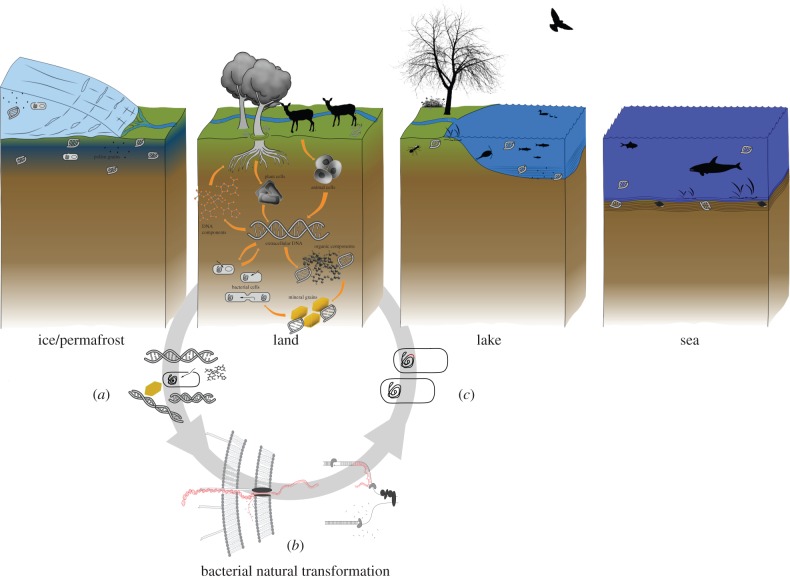
Environments where eDNA of plants and/or animals have been reported: basal glacier ice, terrestrial sediments, lake, rivers and lake sediments, and ocean water. The eDNA comes mainly from plant fine rootlets, faeces, urine and skin cells. The eDNA can remain in the cells, or be released from the cells in which case it may bind to inorganic particles that protect the DNA from microbial and spontaneous chemical degradation. Extracellular DNA may also be incorporated into the genomes of bacteria (bacterial natural transformation of short and degraded DNA). (a) The last may happen when extracellular DNA meets a bacterium's surface and crosses the outer cell wall via protruding structures named pili. At the inner membrane, one strand of DNA is transported into the cell while the opposite DNA strand is degraded. (b) Once inside the cell, the DNA fragment may encounter the bacterial genome and binding at a single-stranded region during genome replication. (c) When the two new genomes segregate, one of the daughter-cells carries the inserted environmental DNA sequence.
Figure 2.
Figure 2.
Geographical distribution of sites where studies have investigated eDNA (adapted from [19]). For references corresponding to numbers, see the electronic supplementary material.

Comment in

References

    1. Willerslev E. 2003. Diverse plant and animal genetic records from Holocene and Pleistocene sediments. Science 300, 791–795. (10.1126/science.1084114) - DOI - PubMed
    1. Hofreiter M, Mead JI, Martin P, Poinar HN. 2003. Molecular caving. Curr. Biol. 13, R693–R695. (10.1016/j.cub.2003.08.039) - DOI - PubMed
    1. Willerslev E, et al. 2007. Ancient biomolecules from deep ice cores reveal a forested southern Greenland. Science 317, 111–114. (10.1126/science.1141758) - DOI - PMC - PubMed
    1. Willerslev E, Hansen A, Christensen B, Steffensen JP, Arctander P. 1999. Diversity of Holocene life forms in fossil glacier ice. Proc. Natl Acad. Sci. USA 96, 8017–8021. (10.1073/pnas.96.14.8017) - DOI - PMC - PubMed
    1. Gould BA, Leon B, Buffen AM, Thompson LG. 2010. Evidence of a high-Andean, mid-Holocene plant community: an ancient DNA analysis of glacially preserved remains. Am. J. Bot. 97, 1579–1584. (10.3732/ajb.1000058) - DOI - PubMed