. 2015 Jan 19;370(1660):20130624.
doi: 10.1098/rstb.2013.0624.

Partial uracil-DNA-glycosylase treatment for screening of ancient DNA

Affiliations

Partial uracil-DNA-glycosylase treatment for screening of ancient DNA

Nadin Rohland et al. Philos Trans R Soc Lond B Biol Sci. .

Abstract

The challenge of sequencing ancient DNA has led to the development of specialized laboratory protocols that have focused on reducing contamination and maximizing the number of molecules that are extracted from ancient remains. Despite the fact that success in ancient DNA studies is typically obtained by screening many samples to identify a promising subset, ancient DNA protocols have not, in general, focused on reducing the time required to screen samples. We present an adaptation of a popular ancient library preparation method that makes screening more efficient. First, the DNA extract is treated using a protocol that causes characteristic ancient DNA damage to be restricted to the terminal nucleotides, while nearly eliminating it in the interior of the DNA molecules, allowing a single library to be used both to test for ancient DNA authenticity and to carry out population genetic analysis. Second, the DNA molecules are ligated to a unique pair of barcodes, which eliminates undetected cross-contamination from this step onwards. Third, the barcoded library molecules include incomplete adapters of short length that can increase the specificity of hybridization-based genomic target enrichment. The adapters are completed just before sequencing, so the same DNA library can be used in multiple experiments, and the sequences distinguished. We demonstrate this protocol on 60 ancient human samples.

Keywords: ancient DNA; authenticity; barcodes; flexibility; library preparation; target capture.


Figures

Figure 1.
Figure 1.
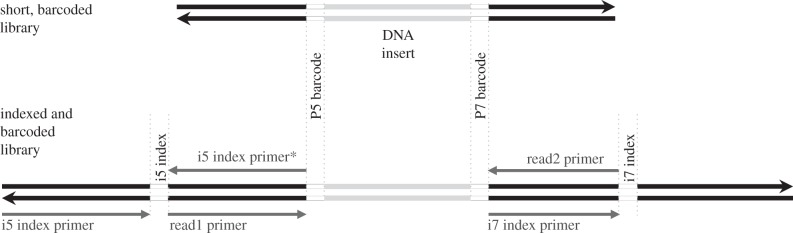
Schematic overview of our library architecture. After library preparation is finished with a PCR using the PreHyb primer pair, short, barcoded libraries can be used for, e.g. target enrichment via hybridization. Adapter sites of such short libraries need to be completed via indexing PCR before sequencing. If different experiments from the same libraries, such as mitochondrial target enrichment and shotgun sequencing, are pooled for sequencing, sequences from those experiments can be differentiated by the index sequences. The four regular Illumina sequencing primer sites for MiSeq, HiSeq and NextSeq instruments are shown, only the i5 index primer* is different for the NextSeq500.
Figure 2.
Figure 2.
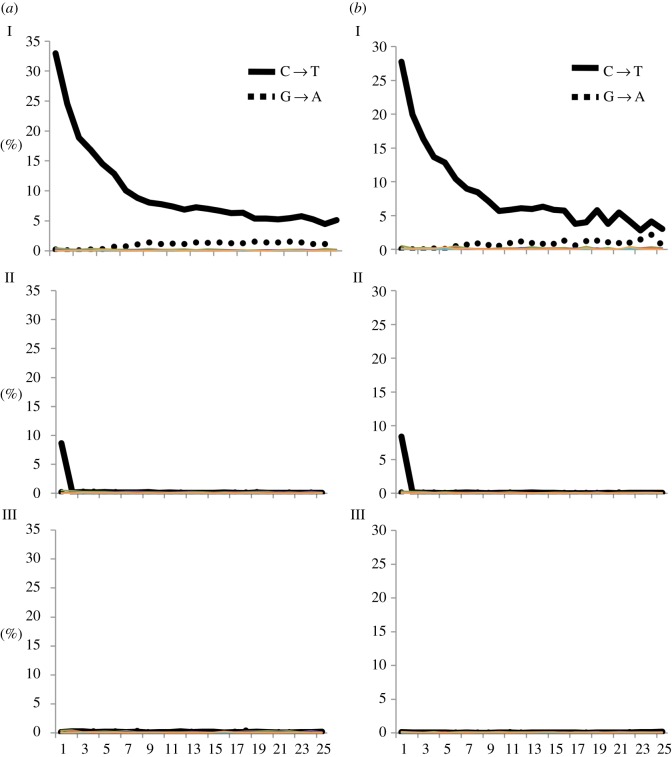
Damage profile of the terminal 25 nucleotides of two samples ((a) I–III) and ((b) I–III) treated in three different ways during library preparation: I, no UDG treatment; II, partial UDG treatment; III, full UDG treatment. The frequencies of all possible substitutions are plotted as a function of the distance from the 5′ end (average of the 5′ end and reverse complement of the 3′ end; between 1 and 25 bp on the x-axis) for all unique endogenous reads. Predominant substitution patterns (C → T and G → A) are highlighted. (Online version in colour.)
Figure 3.
Figure 3.
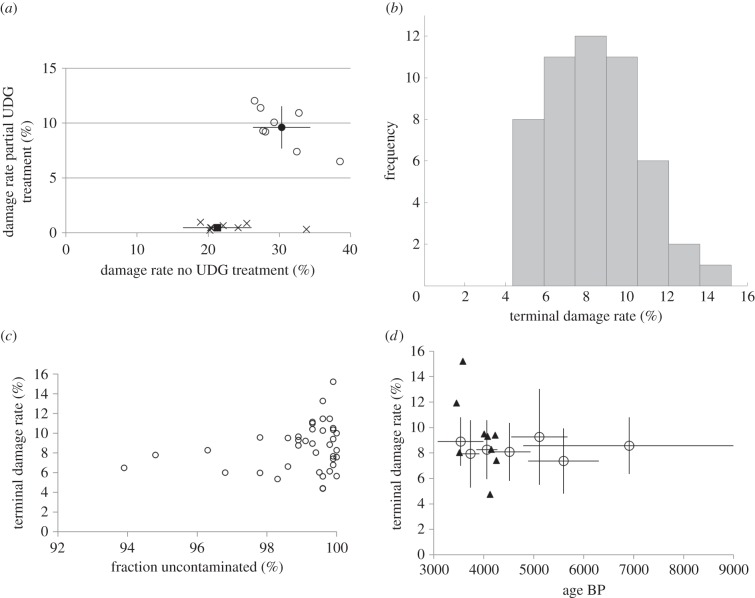
Partial UDG treatment (a) damage pattern in terminal bases (circles) and penultimate bases (crosses) for eight samples when libraries from the same extract were prepared without UDG-treatment (x-axis) and with partial UDG treatment (y-axis); average is shown in filled markers with 1 s.e. bars. The median reduction is three times for terminal bases and 26× for penultimate bases. (b) Histogram of terminal damage rate of 51 libraries prepared with the partial UDG treatment with average mitochondrial coverage >2.0×. (c) Terminal damage rate as a function of contamination estimate using reads aligning to the mitochondrial reference for all libraries prepared with the partial UDG-treatment protocol with coverage of >10× on the mitochondrial genome. (d) Terminal damage rates as a function of sample age for all partially UDG-treated libraries. Samples of similar age were grouped together and bars show 1 s.e.; triangles show results for individual samples with direct 14C dates.

References

    1. Paabo S. 1989. Ancient DNA: extraction, characterization, molecular cloning, and enzymatic amplification. Proc. Natl Acad. Sci. USA 86, 1939–1943. ( 10.1073/pnas.86.6.1939) - DOI - PMC - PubMed
    1. Shapiro B, Hofreiter M. 2014. A paleogenomic perspective on evolution and gene function: new insights from ancient DNA. Science 343, 1236573 ( 10.1126/science.1236573) - DOI - PubMed
    1. Briggs AW, Good JM, Green RE, Krause J, Maricic T, Stenzel U, Pääbo S. 2009. Primer extension capture: targeted sequence retrieval from heavily degraded DNA sources. J. Vis. Exp. 31, e1573 ( 10.3791/1573) - DOI - PMC - PubMed
    1. Enk J, Rouillard JM, Poinar H. 2013. Quantitative PCR as a predictor of aligned ancient DNA read counts following targeted enrichment. Biotechniques 55, 300–309. - PubMed
    1. Horn S. 2012. Case study: enrichment of ancient mitochondrial DNA by hybridization capture. Methods Mol. Biol. 840, 189–195. ( 10.1007/978-1-61779-516-9_22) - DOI - PubMed

Publication types