Selective testing strategies for diagnosing group A streptococcal infection in children with pharyngitis: a systematic review and prospective multicentre external validation study
- PMID: 25487666
- PMCID: PMC4284164
- DOI: 10.1503/cmaj.140772
Selective testing strategies for diagnosing group A streptococcal infection in children with pharyngitis: a systematic review and prospective multicentre external validation study
Abstract
Background: Several clinical prediction rules for diagnosing group A streptococcal infection in children with pharyngitis are available. We aimed to compare the diagnostic accuracy of rules-based selective testing strategies in a prospective cohort of children with pharyngitis.
Methods: We identified clinical prediction rules through a systematic search of MEDLINE and Embase (1975-2014), which we then validated in a prospective cohort involving French children who presented with pharyngitis during a 1-year period (2010-2011). We diagnosed infection with group A streptococcus using two throat swabs: one obtained for a rapid antigen detection test (StreptAtest, Dectrapharm) and one obtained for culture (reference standard). We validated rules-based selective testing strategies as follows: low risk of group A streptococcal infection, no further testing or antibiotic therapy needed; intermediate risk of infection, rapid antigen detection for all patients and antibiotic therapy for those with a positive test result; and high risk of infection, empiric antibiotic treatment.
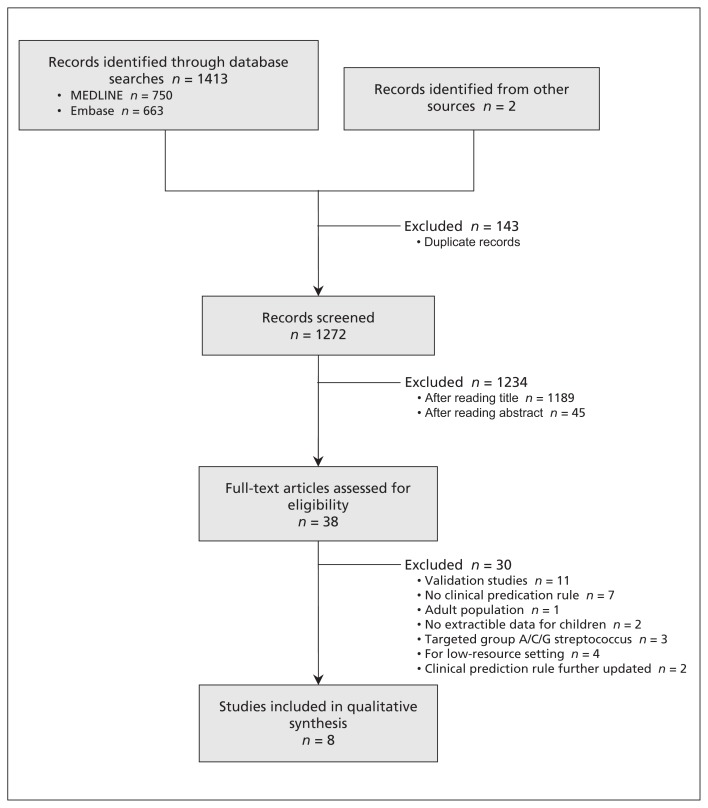
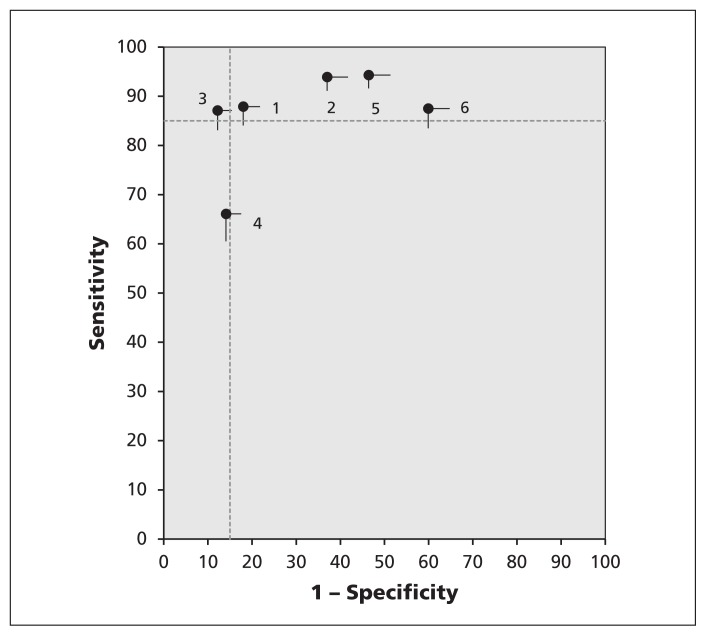
Results: We identified 8 clinical prediction rules, 6 of which could be prospectively validated. Sensitivity and specificity of rules-based selective testing strategies ranged from 66% (95% confidence interval [CI] 61-72) to 94% (95% CI 92-97) and from 40% (95% CI 35-45) to 88% (95% CI 85-91), respectively. Use of rapid antigen detection testing following the clinical prediction rule ranged from 24% (95% CI 21-27) to 86% (95% CI 84-89). None of the rules-based selective testing strategies achieved our diagnostic accuracy target (sensitivity and specificity>85%).
Interpretation: Rules-based selective testing strategies did not show sufficient diagnostic accuracy in this study population. The relevance of clinical prediction rules for determining which children with pharyngitis should undergo a rapid antigen detection test remains questionable.
© 2015 Canadian Medical Association or its licensors.
Figures
Comment in
-
Identifying and treating group A streptococcal pharyngitis in children.CMAJ. 2015 Jan 6;187(1):13. doi: 10.1503/cmaj.141532. Epub 2014 Dec 15. CMAJ. 2015. PMID: 25512654 Free PMC article. No abstract available.
References
-
- Nash DR, Harman J, Wald ER, et al. Antibiotic prescribing by primary care physicians for children with upper respiratory tract infections. Arch Pediatr Adolesc Med 2002;156:1114–9. - PubMed
-
- Shaikh N, Leonard E, Martin JM. Prevalence of streptococcal pharyngitis and streptococcal carriage in children: a meta-analysis. Pediatrics 2010;126:e557–64. - PubMed
-
- Carapetis JR, McDonald M, Wilson NJ. Acute rheumatic fever. Lancet 2005;366:155–68. - PubMed
Publication types
MeSH terms
LinkOut - more resources
Full Text Sources
Other Literature Sources
Medical