


Added benefit of raxibacumab to antibiotic treatment of inhalational anthrax
- PMID: 25487792
- PMCID: PMC4335881
- DOI: 10.1128/AAC.04606-14
Added benefit of raxibacumab to antibiotic treatment of inhalational anthrax
Abstract
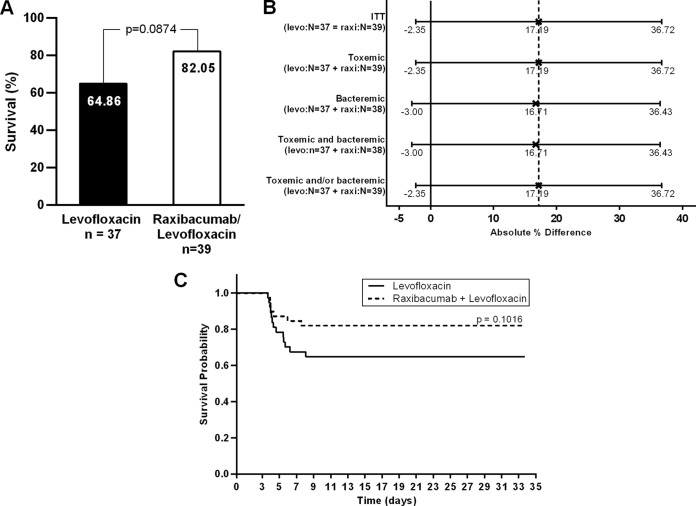
Although antibiotics treat bacteremia in inhalational anthrax, pathogenesis is mainly driven by bacterial exotoxins. Raxibacumab, an IgG1 monoclonal antibody, binds the protective antigen (PA) of Bacillus anthracis, thus blocking toxin effects and leading to improved survival in the rabbit and monkey models of inhalational anthrax. To assess raxibacumab's added benefit over levofloxacin (LVX) alone, rabbits surviving to 84 h after a challenge with 200 times the median (50%) lethal dose of B. anthracis spores were randomized to receive 3 daily intragastric LVX doses of 50 mg/kg of body weight, with the first LVX dose administered just prior to administration of a single intravenous dose of placebo or 40 mg/kg raxibacumab. The percentages of animals alive at 28 days following the last LVX dose were compared between the 2 treatment groups using a two-sided likelihood-ratio chi-square test. The 82% survival rate for the LVX-raxibacumab combination was higher than the 65% survival rate for LVX alone (P=0.0874). There were nearly 2-fold fewer deaths for the combination (7 deaths; n=39) than for LVX alone (13 deaths; n=37), and the survival time was prolonged for the combination (P=0.1016). Toxin-neutralizing-activity titers were similar for both treatment groups, suggesting that survivors in both groups were able to mount a toxin-neutralizing immune response. Microscopic findings considered consistent with anthrax were present in animals that died or became moribund on study in both treatment groups, and there were no anthrax-related findings in animals that survived. Overall, raxibacumab provided a meaningful benefit over antibiotic alone when administered late in the disease course.
Copyright © 2015, American Society for Microbiology. All Rights Reserved.
Figures
References
-
- Inglesby TV, O'Toole T, Henderson DA, Bartlett JG, Ascher MS, Eitzen E, Friedlander AM, Gerberding J, Hauer J, Hughes J, McDade J, Osterholmn MT, Parker G, Perl TM, Russell PK, Tonat K. 2002. Anthrax as a biological weapon, 2002: updated recommendations for management. JAMA 287:2236–2252. doi: 10.1001/jama.287.17.2236. - DOI - PubMed
-
- Jernigan DB, Raghunathan PL, Bell BP, Brechner R, Bresnitz EA, Butler JC, Cetron M, Cohen M, Doyle T, Fischer M, Greene C, Griffith KS, Guarner J, Hadler JL, Hayslett JA, Meyer R, Petersen LR, Phillips M, Pinner R, Popovic T, Quinn CP, Reefhuis J, Reissman D, Rosenstein N, Schuchat A, Shieh W-J, Siegal L, Swerdlow DL, Tenover FC, Traeger M, Ward JW, Weisfuse I, Wiersma S, Yewskey K, Zaki S, Ashford DA, Perkins BA, Ostroff S, Hughes J, Fleming D, Koplan JP, Gerberding JL, , National Anthrax Epidemiologic Investigation Team . 2002. Investigation of bioterrorism-related anthrax, United States, 2001: epidemiologic findings. Emerg Infect Dis 8:1019–1028. doi: 10.3201/eid0810.020353. - DOI - PMC - PubMed
-
- Jernigan JA, Stephens DS, Ashford DA, Omenaca C, Topiel MS, Galbraith M, Tapper M, Fisk TL, Zaki S, Popovic T, Meyer RF, Quinn CP, Harper SA, Fridkin SK, Sejvar JJ, Shepard CW, McConnell M, Guarner J, Shieh W-J, Malecki JM, Gerberding JL, Hughes JM, Perkins BA, Members of the Anthrax Bioterrorism Investigation Team . 2001. Bioterrorism-related inhalational anthrax: the first 10 cases reported in the United States. Emerg Infect Dis 7:933–944. doi: 10.3201/eid0706.010604. - DOI - PMC - PubMed
Publication types
MeSH terms
Substances
Supplementary concepts
LinkOut - more resources
Full Text Sources
Other Literature Sources
Medical
Molecular Biology Databases
