


Facial landmark localization by curvature maps and profile analysis
- PMID: 25488063
- PMCID: PMC4364336
- DOI: 10.1186/1746-160X-10-54
Facial landmark localization by curvature maps and profile analysis
Abstract
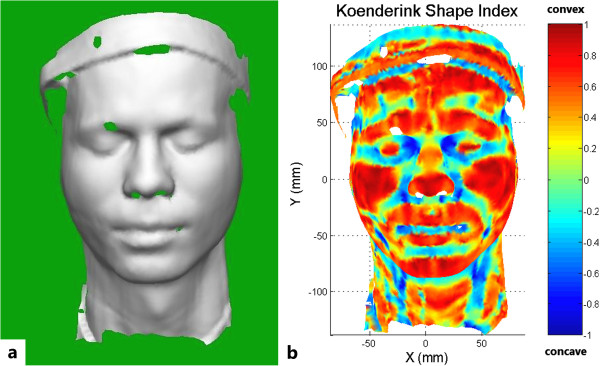
Introduction: Three-dimensional landmarks of the face are important for orthodontic examination, harmony assessment and treatment planning. Currently, facial landmarks are often measured by orthodontists via direct observation and manual soft tissue image analysis. This study wants to evaluate and present an objective method for measuring selected facial landmarks based on an analysis of curvature maps and of sagittal profile obtained by a laser-scanning method.
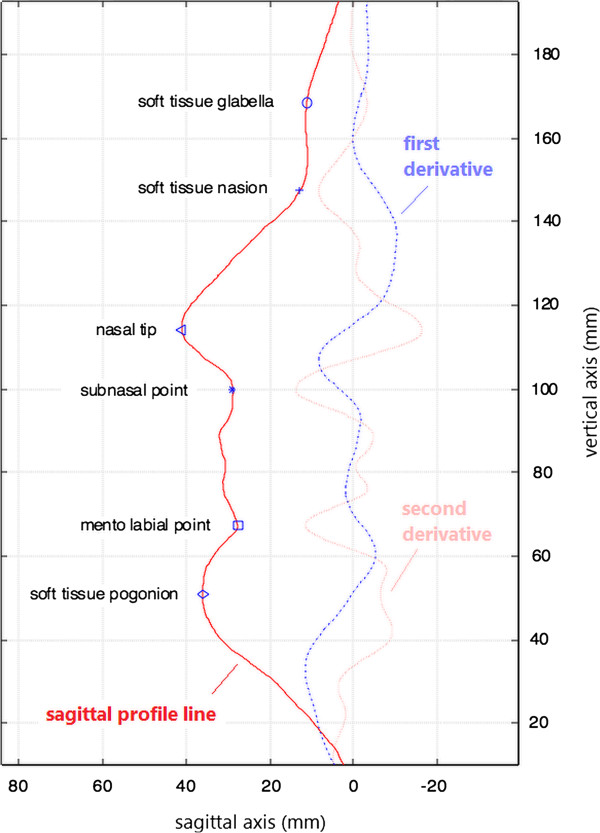
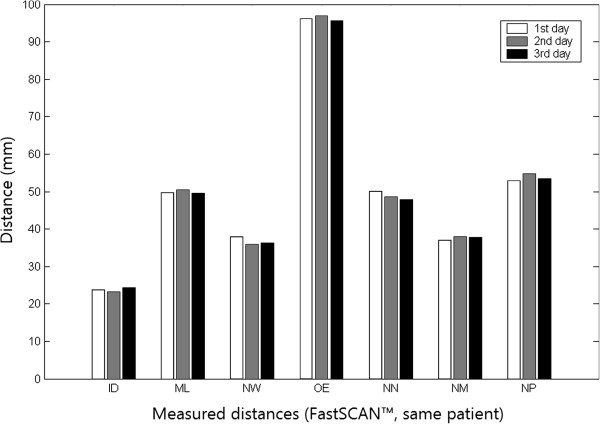
Methods: The faces of 15 people were scanned in 3D by means of the laser scanner FastSCAN™. It allowed the recording of a curvature map of the face in under a minute, which depicted the distribution of Gaussian and mean curvatures. The median-sagittal profile line of the face was localized in this map, and a mathematical analysis comprising its first and second derivatives was performed. Anatomical landmarks were identified and facial measurements performed. To assess validity the obtained data were compared with manual measurements by orthodontists by means of Lin's concordance correlation CCC coefficient and reliability was determined by consecutive measurements.
Results: Facial landmarks, such as the soft tissue glabella and nasal tip, could be easily and accurately identified and located. Lin's CCC showed substantial agreement between digital and manual measurements for 4 of the 7 distances evaluated. Larger discrepancies were due to inadequate image quality and scanning errors. Reliability of consecutive measurements by the same operator was excellent.
Conclusions: In our pilot study the three-dimensional laser-scanning method FastSCAN™ allowed a reliable and accurate identification of anatomical landmarks of the face. The obtained distances between certain landmarks, such as the intercanthal distance, were largely consistent with those from manual measurements. Due to its easy and rapid implementation, the method facilitates facial analysis and could be a clinically valid alternative to manual measurements, when remaining problems in scanning accuracy can be resolved.
Figures
References
-
- Arnett GW, McLaughlin RP. Dental and Facial Planning for Orthodontists and Oral Surgeons. London: Mosby; 2003. - PubMed
-
- Polhemus - Innovation in Motion™: FastSCAN™ - Official Homepage.http://polhemus.com/scanning-digitizing/fastscan-cobra-ci/
-
- Koenderink JJ, van Doorn AJ. Surface shape and curvature scales. Image Vision Comput. 1992;10:557–564. doi: 10.1016/0262-8856(92)90076-F. - DOI
MeSH terms
LinkOut - more resources
Full Text Sources
Other Literature Sources
Medical
