


Why public health people are more worried than excited over e-cigarettes
- PMID: 25488431
- PMCID: PMC4260246
- DOI: 10.1186/s12916-014-0226-y
Why public health people are more worried than excited over e-cigarettes
Abstract
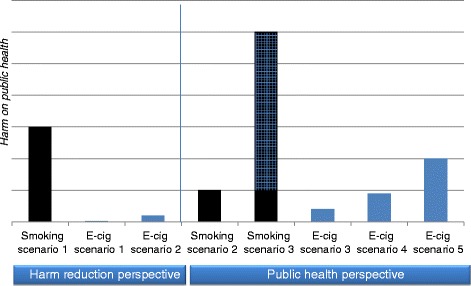
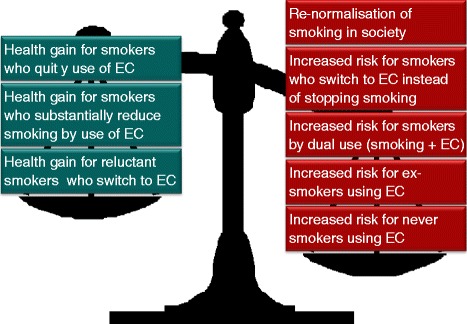
The research field on e-cigarettes is characterized by severe methodological problems, severe conflicts of interest, relatively few and often small studies, inconsistencies and contradictions in results, and a lack of long-term follow-up. Therefore, no firm conclusions can be drawn on the harm of e-cigarettes, but they can hardly be called safe. Experimental studies indicate negative health effects and, amongst others, the major ingredient propylene glycol warrants concern. Growing evidence raises doubt about the efficacy of e-cigarettes as a smoking cessation aid. Unfortunately, it seems that many smokers use e-cigarettes with the intention to quit but switch to long-term use of e-cigarettes or dual use. Use is spreading rapidly to minors, ex-smokers, and never-smokers. It is questionable whether the potential health benefits obtained by some smokers outweigh the potential harm by use of non-smokers, of undermining of complete cessation, smokers' dual use, and of eventual re-normalization of smoking. Even if e-cigarettes are significantly less harmful than conventional cigarettes, the product may have a very negative impact on public health if its use is spread to a large part of the population.
Figures
References
-
- Conference of the Parties to the WHO Framework Convention on Tobacco Control . Report by WHO. Moscow, Russian Federation; 2014 July. Report No.: FCTC/COP/6/10 21 July 2014. Provisional agenda item 4.4.2. 2014. Electronic Nicotine Delivery Systems.
-
- Changing concepts of sudden infant death syndrome: implications for infant sleeping environment and sleep position. American Academy of Pediatrics. Task Force on Infant Sleep Position and Sudden Infant Death Syndrome.Pediatrics 2000, 105:650–656. - PubMed
-
- The Electric Cigarette. [http://www.usacig.com/faq.aspx]; 2014.
-
- Smoke NV. [http://www.smokenv.com/faq.html]; 2014.
Publication types
MeSH terms
LinkOut - more resources
Full Text Sources
Other Literature Sources
Medical
