


Levels of polycyclic aromatic hydrocarbons in maternal serum and risk of neural tube defects in offspring
- PMID: 25488567
- PMCID: PMC4291766
- DOI: 10.1021/es503990v
Levels of polycyclic aromatic hydrocarbons in maternal serum and risk of neural tube defects in offspring
Erratum in
-
Correction to Levels of Polycyclic Aromatic Hydrocarbons in Maternal Serum and Risk of Neural Tube Defects in Offspring.Environ Sci Technol. 2015 Sep 1;49(17):10754-5. doi: 10.1021/acs.est.5b03471. Epub 2015 Aug 14. Environ Sci Technol. 2015. PMID: 26274604 Free PMC article. No abstract available.
Abstract
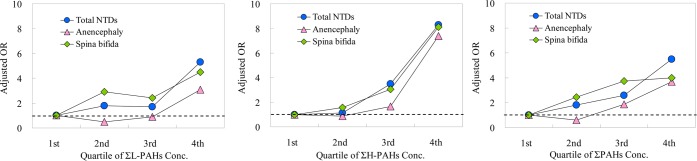
Polycyclic aromatic hydrocarbons (PAHs) are ubiquitous environmental pollutants, and have been reported to be a risk factor for human neural tube defects (NTDs). We investigated the relationship between PAH concentrations in maternal serum and NTD risk in offspring using a case-control study design, and explored the link between PAH concentrations to household energy usage characteristics and life styles. One hundred and seventeen women who had NTD-affected pregnancies (cases) and 121 women who delivered healthy infants (controls) were recruited in Northern China. Maternal blood samples were collected at pregnancy termination or at delivery. Twenty-seven PAHs were measured by gas chromatography-mass spectrometry. The concentrations of 13 individual PAHs detected were significantly higher in the cases than in the controls. Clear dose-response relationships between concentrations of most individual PAHs and the risk of total NTDs or subtypes were observed, even when potential covariates were adjusted for. High-molecular-weight PAHs (H-PAHs) showed higher risk than low-molecular-weight PAHs (L-PAHs). No associations between PAH concentrations and indoor life styles and energy usage characteristics were observed. It was concluded that maternal exposure to PAHs was associated with an increased risk of NTDs, and H-PAHs overall posed a higher risk for NTDs than L-PAHs.
Figures
References
-
- March of Dimes Foundation. Global report on birth Defects: The hidden toll of dying and disabled children; March of Dimes Birth Defects Foundation: New York, 2006.
-
- Langlois P. H.; Hoyt A. T.; Lupo P. J.; Lawson C. C.; Waters M. A.; Desrosiers T. A.; Shaw G. M.; Romitti P. A.; Lammer E. J. National Birth Defects Prevention Study. Maternal occupational exposure to polycyclic aromatic hydrocarbons and risk of neural tube defect-affected pregnancies. Birth Defects Res., Part A 2012, 949693–700. - PMC - PubMed
-
- Naufal Z.; Zhiwen L.; Zhu L.; Zhou G. D.; McDonald T.; He L. Y.; Mitchell L.; Ren A.; Zhu H.; Finnell R.; Donnelly K. C. Biomarkers of exposure to combustion by-products in a human population in Shanxi, China. J. Exposure Sci. Environ. Epidemiol. 2010, 204310–319. - PubMed
Publication types
MeSH terms
Substances
Grants and funding
LinkOut - more resources
Full Text Sources
Other Literature Sources
Medical
