


Pathogenic and commensal Escherichia coli from irrigation water show potential in transmission of extended spectrum and AmpC β-lactamases determinants to isolates from lettuce
- PMID: 25488608
- PMCID: PMC4408178
- DOI: 10.1111/1751-7915.12234
Pathogenic and commensal Escherichia coli from irrigation water show potential in transmission of extended spectrum and AmpC β-lactamases determinants to isolates from lettuce
Abstract
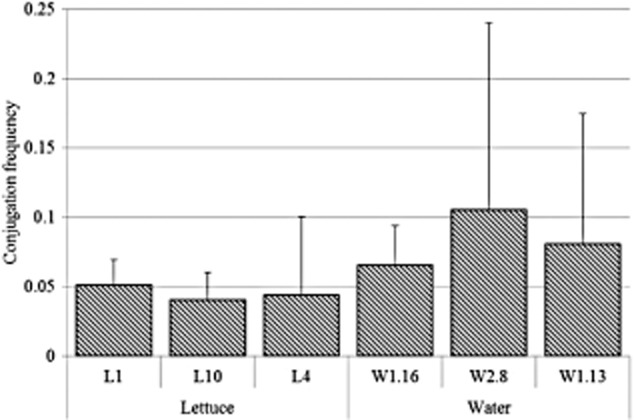
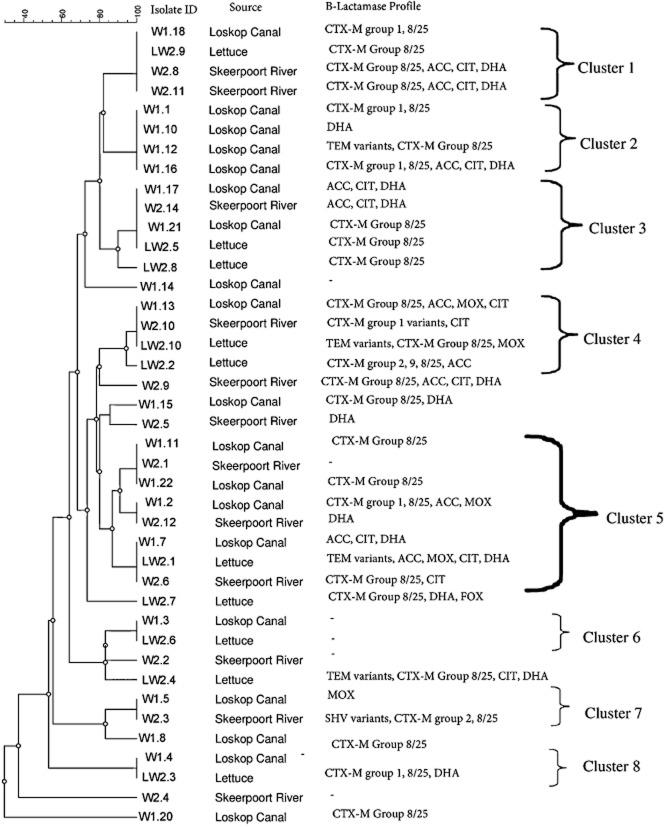
There are few studies on the presence of extended-spectrum β-lactamases and AmpC β-lactamases (ESBL/AmpC) in bacteria that contaminate vegetables. The role of the production environment in ESBL/AmpC gene transmission is poorly understood. The occurrence of ESBL/AmpC in Escherichia coli (n = 46) from lettuce and irrigation water and the role of irrigation water in the transmission of resistant E. coli were studied. The presence of ESBL/AmpC, genetic similarity and phylogeny were typed using genotypic and phenotypic techniques. The frequency of β-lactamase gene transfer was studied in vitro. ESBLs/AmpC were detected in 35 isolates (76%). Fourteen isolates (30%) produced both ESBLs/AmpC. Prevalence was highest in E. coli from lettuce (90%). Twenty-two isolates (48%) were multi-resistant with between two and five ESBL/AmpC genes. The major ESBL determinant was the CTX-M type (34 isolates). DHA (33% of isolates) were the dominant AmpC β lactamases. There was a high conjugation efficiency among the isolates, ranging from 3.5 × 10(-2) to 1 × 10(-2) ± 1.4 × 10(-1) transconjugants per recipient. Water isolates showed a significantly higher conjugation frequency than those from lettuce. A high degree of genetic relatedness between E. coli from irrigation water and lettuce indicated possible common ancestry and pathway of transmission.
© 2014 The Authors. Microbial Biotechnology published by John Wiley & Sons Ltd and Society for Applied Microbiology.
Figures

References
-
- Bezanson GS, MacInnis R, Potter G. Hughes T. Presence and potential for horizontal transfer of antibiotic resistance in oxidase-positive bacteria populating raw salad vegetables. Int J Food Microbiol. 2008;127:37–42. - PubMed
-
- Bhutani N, Talreja D, Walia S, Muraleedharan C, Kumar A, Rana SW, et al. 2012. Molecular analysis of Extended-Spectrum Beta-Lactamases (ESBLs) gene sequences of bacteria on retail lettuce and relatedness to clinical isolates. 52nd Interscience Conference on Antimicrobial Agents and Chemotherapy, San Francisco [WWW document]. URL http://www.abstractsonline.com/Plan/ViewAbstract.aspx?sKey=4ca432d4-62da... ] - PMC - PubMed
-
- Boehme S, Werner G, Klare I, Reissbrodt R. Witte W. Occurrence of antibiotic resistant enterobacteria in agricultural foodstuffs. Mol Nutr Food Res. 2004;48:522–531. - PubMed
-
- Börjesson S, Egervärn M, Finn M, Tillander I, Wiberg C. Englund S. High prevalence of ESBL-producing Escherichia coli in chicken meat imported into Sweden. Clin Microbiol Infect. 2011;17(Suppl. 4):O353.
Publication types
MeSH terms
Substances
LinkOut - more resources
Full Text Sources
Other Literature Sources
