


Prevalence and correlates of intimate partner violence towards female students of the University of Ibadan, Nigeria
- PMID: 25488683
- PMCID: PMC4295485
- DOI: 10.1186/1472-6874-14-131
Prevalence and correlates of intimate partner violence towards female students of the University of Ibadan, Nigeria
Abstract
Background: In Nigeria, there is paucity of information on the IPV burden and experience among young women in courtship and dating relationships. This study assesses the prevalence and correlates of IPV in female undergraduate and postgraduate students in a tertiary institution.
Methods: The study was a cross-sectional survey. A four-stage sampling technique was used to select 1,100 undergraduate and 255 postgraduate female students from the University of Ibadan, Nigeria. Data was collected using a 43-item self-administered structured questionnaire. Descriptive statistics and multivariate analyses were carried out at 0.05 level of significance.
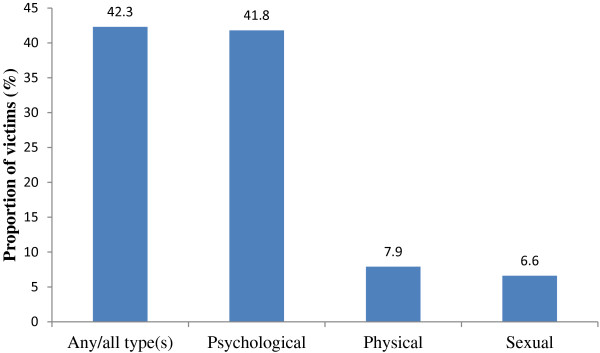
Results: The life-time prevalence of IPV was 42.3% (postgraduate: 34.5%, undergraduate: 44.1%; P < 0.05). Lifetime experience of psychological, physical and sexual IPV were 41.8%, 7.9% and 6.6% respectively. Recent experience (within the previous 12 months) of violence was also more frequently reported by respondents who had a previous history of physical (62.5%) (OR = 2.65; 95% CI: 2.02-3.49) and sexual (53.2%) (OR = 1.63; 95% CI:1.12-2.35) violence than respondents who had no such history. Postgraduate (OR = 0.64; 95% CI: 0.46-0.87) and married (OR = 0.53; 95% CI: 0.35-0.78) students were less likely to have experienced IPV than undergraduate and single students respectively. Students who smoked (OR = 2.46; 95% CI: 1.58-3.83); consumed alcohol (OR = 2.36; 95% CI: 1.82- 3.06); and with history of interparental violence (OR = 2.40; 95% CI: 1.88- 3.07) had a higher likelihood of experiencing violence than students who were not exposed to these behaviors. Adverse effects (such as the inability to concentrate) of IPV on academic performance were reported by 10.3% of victims.
Conclusion: The prevalence of IPV was high. There is the urgent need for interventions that will reduce vulnerability by addressing modifiable risk factors like smoking and alcohol consumption. Interventions should also encourage seeking health care following violence to reduce its consequences.
Figures
References
-
- World Health Organization: Prevalence Of Physical Violence Against Women. http://www.who.int/violence_injury_prevention/
-
- Garcia-Moreno C, Jansen H, Watts C, Ellsberg M, World Health Organization . Who Multi-Country Study On Women’s Health And Domestic Violence Against Women. Geneva: WHO Press; 2005. p. 204.
-
- World Health Organization/London School of Hygiene and Tropical Medicine . Preventing Intimate Partner And Sexual Violence Against Women: Taking Action And Generating Evidence. Geneva: World Health Organization; 2010. - PubMed
Pre-publication history
-
- The pre-publication history for this paper can be accessed here:http://www.biomedcentral.com/1472-6874/14/131/prepub
Publication types
MeSH terms
LinkOut - more resources
Full Text Sources
Other Literature Sources
Medical
Molecular Biology Databases
