


Microbiota organization is a distinct feature of proximal colorectal cancers
- PMID: 25489084
- PMCID: PMC4280621
- DOI: 10.1073/pnas.1406199111
Microbiota organization is a distinct feature of proximal colorectal cancers
Abstract
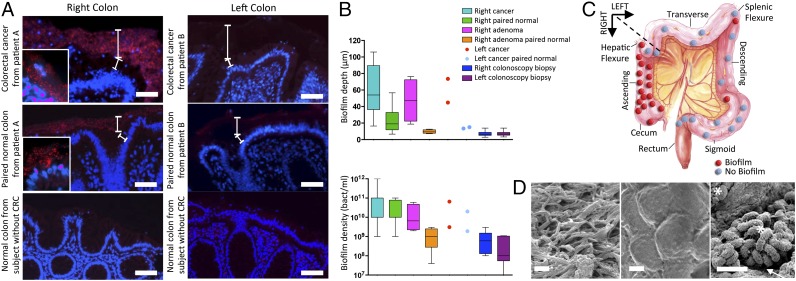
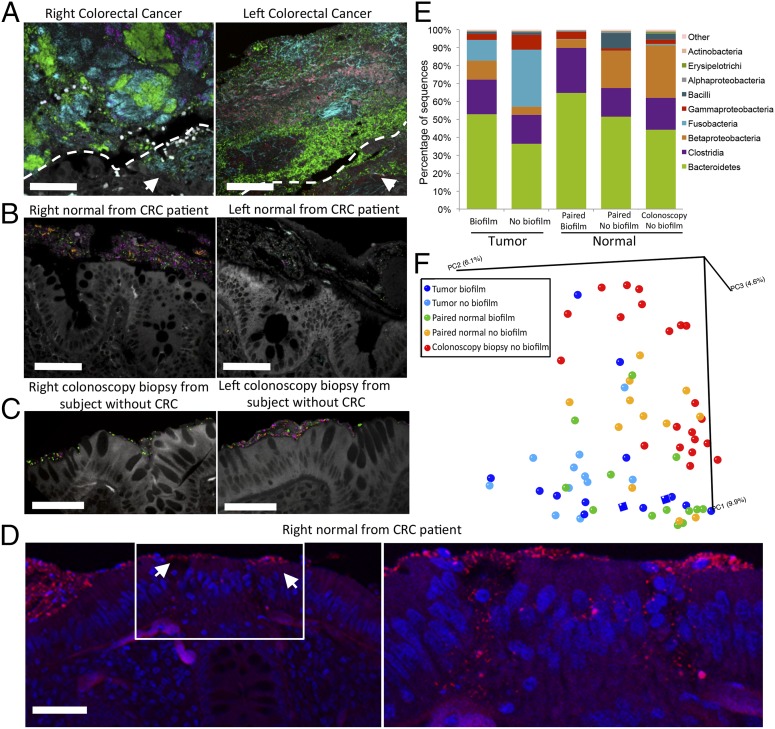
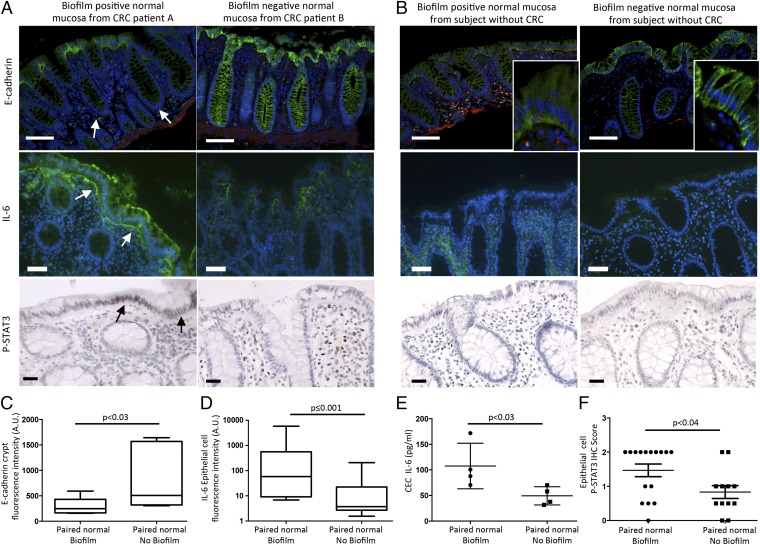
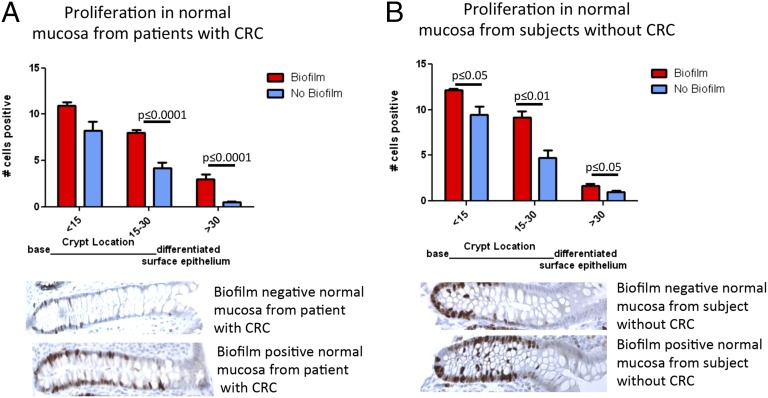
Environmental factors clearly affect colorectal cancer (CRC) incidence, but the mechanisms through which these factors function are unknown. One prime candidate is an altered colonic microbiota. Here we show that the mucosal microbiota organization is a critical factor associated with a subset of CRC. We identified invasive polymicrobial bacterial biofilms (bacterial aggregates), structures previously associated with nonmalignant intestinal pathology, nearly universally (89%) on right-sided tumors (13 of 15 CRCs, 4 of 4 adenomas) but on only 12% of left-sided tumors (2 of 15 CRCs, 0 of 2 adenomas). Surprisingly, patients with biofilm-positive tumors, whether cancers or adenomas, all had biofilms on their tumor-free mucosa far distant from their tumors. Bacterial biofilms were associated with diminished colonic epithelial cell E-cadherin and enhanced epithelial cell IL-6 and Stat3 activation, as well as increased crypt epithelial cell proliferation in normal colon mucosa. High-throughput sequencing revealed no consistent bacterial genus associated with tumors, regardless of biofilm status. However, principal coordinates analysis revealed that biofilm communities on paired normal mucosa, distant from the tumor itself, cluster with tumor microbiomes as opposed to biofilm-negative normal mucosa bacterial communities also from the tumor host. Colon mucosal biofilm detection may predict increased risk for development of sporadic CRC.
Keywords: adenoma; bacterial communities; biofilm; colorectal cancer; microbiome.
Conflict of interest statement
The authors declare no conflict of interest.
Figures
Comment in
-
Gut microbiota. Microbiota organization--a key to understanding CRC development.Nat Rev Gastroenterol Hepatol. 2015 Mar;12(3):128-9. doi: 10.1038/nrgastro.2015.25. Epub 2015 Feb 17. Nat Rev Gastroenterol Hepatol. 2015. PMID: 25688055
References
-
- Cho JH. The genetics and immunopathogenesis of inflammatory bowel disease. Nat Rev Immunol. 2008;8(6):458–466. - PubMed
-
- Podolsky DK. Inflammatory bowel disease. N Engl J Med. 2002;347(6):417–429. - PubMed
-
- Singh PK, et al. Quorum-sensing signals indicate that cystic fibrosis lungs are infected with bacterial biofilms. Nature. 2000;407(6805):762–764. - PubMed
Publication types
MeSH terms
Associated data
Grants and funding
- T32AI007417/AI/NIAID NIH HHS/United States
- 5T32CA126607-05/CA/NCI NIH HHS/United States
- P30 CA006973/CA/NCI NIH HHS/United States
- T32 AI007417/AI/NIAID NIH HHS/United States
- P30 DK089502/DK/NIDDK NIH HHS/United States
- R01 CA151393/CA/NCI NIH HHS/United States
- R21 CA170492/CA/NCI NIH HHS/United States
- U54 CA091409/CA/NCI NIH HHS/United States
- R01 DE022586/DE/NIDCR NIH HHS/United States
- T32 CA126607/CA/NCI NIH HHS/United States
- P30 CA021765/CA/NCI NIH HHS/United States
- Howard Hughes Medical Institute/United States
- K08 DK087856/DK/NIDDK NIH HHS/United States
LinkOut - more resources
Full Text Sources
Other Literature Sources
Medical
Miscellaneous
