Extended insulin boluses cannot control postprandial glycemia as well as a standard bolus in children and adults using insulin pump therapy
- PMID: 25489486
- PMCID: PMC4256306
- DOI: 10.1136/bmjdrc-2014-000050
Extended insulin boluses cannot control postprandial glycemia as well as a standard bolus in children and adults using insulin pump therapy
Abstract
Introduction: Insulin pumps are able to deliver bolus insulin as a standard, extended or combination bolus. There is minimal research to determine which bolus is preferable in different settings. Anecdotally, many patients utilizes only the standard bolus (SB) due to uncertainty regarding when and how to program the different bolus types. We compared postprandial glycemia when five different extended boluses (EBs) and an SB were used following a test meal. We sought to determine the impact of varying rates of insulin delivery from an EB on early postprandial glycemia.
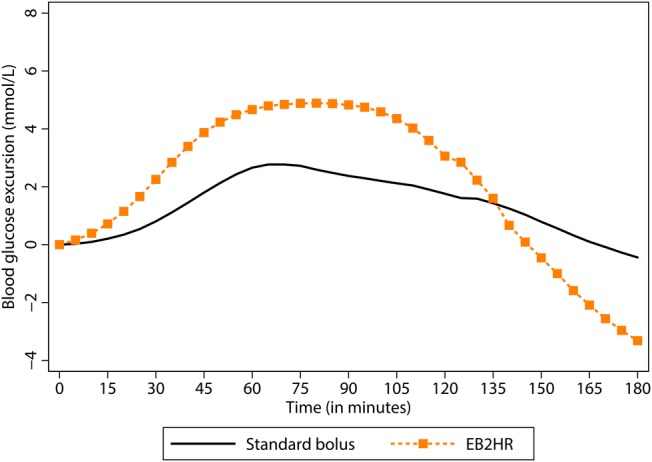
Methods: We conducted a randomized, repeated measures trial of 20 children and adults comparing postprandial glycemic excursions following EBs given at five different rates with SB as a control. All EBs were delivered over 2 h. Rates of EBs were chosen to reflect EBs used in clinical practice: EB1HR=100% of insulin:carbohydrate ratio (ICR) per hour (200% ICR total dose); EB2HR=50% of ICR per hour; EB3HR=33% of ICR per hour; EB4HR=25% of ICR per hour; EB6HR=16% ICR per hour. A standardized breakfast was given and activity was standardized. Continuous glucose monitoring was used to assess glycemia for 2 h after the meal.
Results: The mean postprandial glycemic excursions were lower at 30, 60, and 90 min (p<0.05) for SB compared with all EBs. The mean peak postprandial glycemic excursion and the area under the curve was lower for SB compared with all EBs (p<0.05).
Discussion: EBs resulted in higher postprandial glycemic excursions than SB for 2 h after the meal. For a moderate glycemic index meal EBs are unable to control glycemia for 2 h after a meal as well as SB. Further studies with different meal types are required to determine the impact of differential delivery of the EB on postprandial glycemia.
Trial registration number: ACTRN12612000609853.
Keywords: Insulin Delivery; Insulin Dose Management; Insulin Pump Therapy.
Figures

References
-
- Smart C, Aslander Van Vliet E, Waldron S. ISPAD clinical practice consensus guidelines 2009 compendium. Nutritional management in children and adolescents with diabetes. Pediatr Diabetes 2009;10(Suppl 12):18. - PubMed
-
- Wolpert H. Smart pumping for people with diabetes. Alexandria: American Diabetes Association, 2002.
-
- Darnell C. The extended bolus: the secret to mealtime insulin. Roche Diagnostics 2012[updated 19 August 2013; cited 2013 20 August 2013].
-
- Medtronic Diabetes, ed Dual/Square Wave quick reference guide for the Paradigm Revel Insulin Pump. 2013.
-
- Animas Vibe Insulin Pump and CGM System. 2013[updated 8 April 2013; cited 20 August 2013].
LinkOut - more resources
Full Text Sources
Other Literature Sources