


Relevance of platinum-sensitivity status in relapsed/refractory extensive-stage small-cell lung cancer in the modern era: a patient-level analysis of southwest oncology group trials
- PMID: 25490004
- PMCID: PMC4320001
- DOI: 10.1097/JTO.0000000000000385
Relevance of platinum-sensitivity status in relapsed/refractory extensive-stage small-cell lung cancer in the modern era: a patient-level analysis of southwest oncology group trials
Abstract
Background: Extensive-stage small-cell lung cancer (SCLC) patients who progress after platinum-based chemotherapy are traditionally categorized as platinum sensitive (progression ≥ 90 days from last platinum dose) or refractory (progression < 90 days), a practice arising from seminal observations of worse survival in refractory patients. Subsequent trials accounted for platinum sensitivity, resulting in higher sample sizes and increased resource use.
Methods: To assess whether platinum-sensitivity status remains associated with outcomes, patient-level data from recent Southwest Oncology Group trials in second- and/or third-line extensive-stage SCLC were pooled. Hazard ratios (HRs) for progression-free survival (PFS) and overall survival (OS) accounting for platinum sensitivity were calculated using unadjusted and adjusted Cox Proportional Hazard models. Recursive partitioning was performed to define prognostic risk groups.
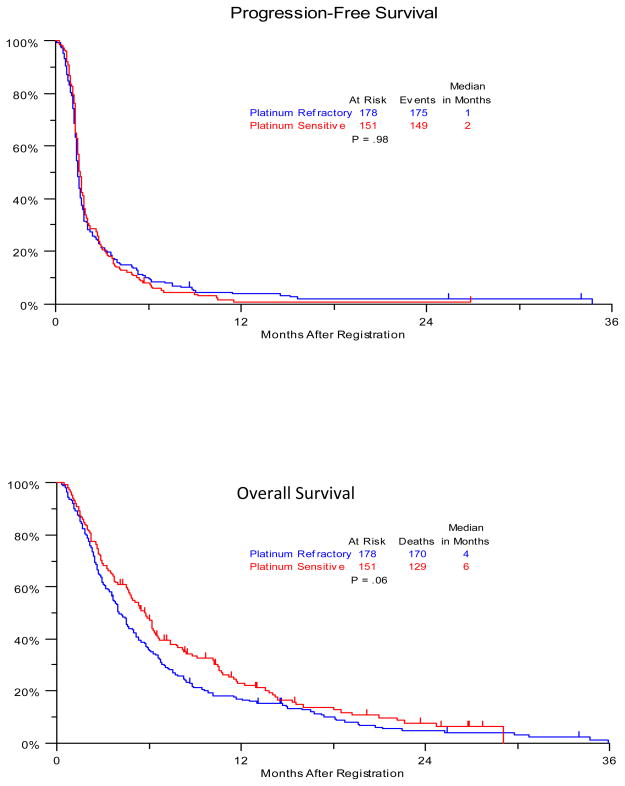
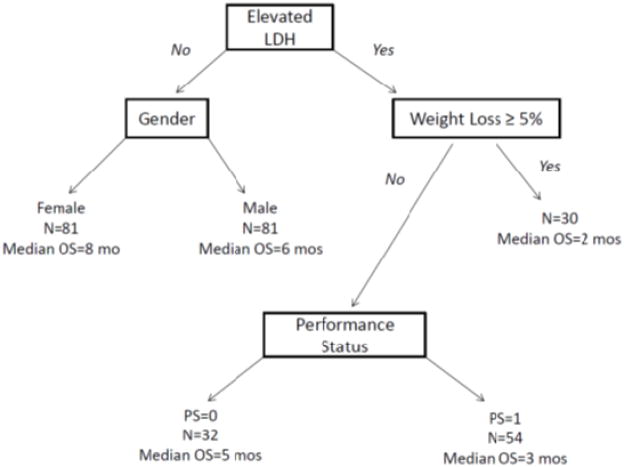
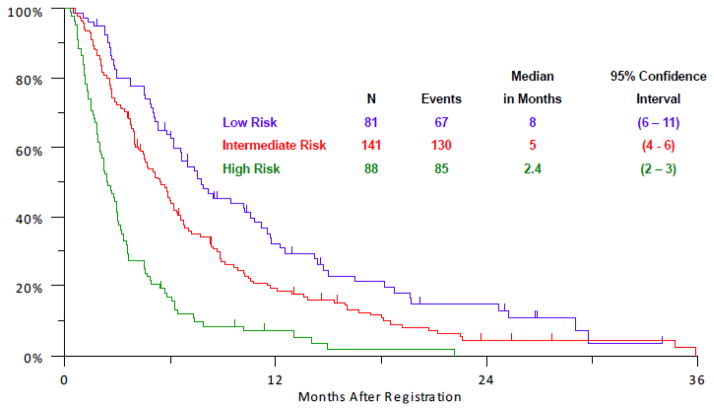
Results: Of 329 patients, 151 were platinum sensitive and 178 refractory. HRs from unadjusted Cox PFS and OS models for refractory versus sensitive disease were 1.0 (95% confidence interval, 0.81-1.25; p = 0.98) and 1.24 (0.99-1.57; p = 0.06), respectively. Adjusted Cox models showed that only elevated serum lactate dehydrogenase (HR, 2.04; p < 0.001), males (HR, 1.36; p = 0.04), performance status of 1 (HR, 1.25; p = 0.02), and weight loss greater than or equal to 5% (1.53, p = 0.01) were independently associated with OS. Platinum-sensitivity status was not associated with PFS (HR, 1.11; p = 0.49) or OS (HR, 1.25; p = 0.14), except in a model that excluded 36 patients who received more than one prior chemotherapy regimen (HR, 1.34; p = 0.049). Prognostic groups with differential OS outcomes (high, intermediate, and poor risk) were identified.
Conclusions: Platinum-sensitivity status may no longer be strongly associated with PFS or OS in at least one multivariate model. Validation of prognostic risk groups identified here is warranted. These data have critical implications in the design of future SCLC trials.
Trial registration: ClinicalTrials.gov NCT00068289 NCT00182689 NCT00828139.
Figures
Comment in
-
Relevance of platinum sensitivity in patients with relapsed or refractory small-cell lung cancer.J Thorac Oncol. 2015 May;10(5):e35. doi: 10.1097/JTO.0000000000000513. J Thorac Oncol. 2015. PMID: 25898966 No abstract available.
-
Second-line Treatment of Small Cell Lung Cancer: Is Platinum Sensitivity a Relevant Prognostic Factor?J Thorac Oncol. 2015 May;10(5):e35-e36. doi: 10.1097/JTO.0000000000000514. J Thorac Oncol. 2015. PMID: 25898967 No abstract available.
-
Reply to "diminishing role of platinum-sensitivity status in patients with small cell lung cancer".J Thorac Oncol. 2015 May;10(5):e36. doi: 10.1097/JTO.0000000000000515. J Thorac Oncol. 2015. PMID: 25898968 No abstract available.
References
-
- Schneider BJ. Management of recurrent small cell lung cancer. Journal of the National Comprehensive Cancer Network: JNCCN. 2008;6:323–31. - PubMed
-
- Giaccone G, Donadio M, Bonardi G, et al. Teniposide in the treatment of small-cell lung cancer: the influence of prior chemotherapy. Journal of clinical oncology: official journal of the American Society of Clinical Oncology. 1988;6:1264–70. - PubMed
-
- Jotte RM, Conkling P, Reynolds C, et al. Second-line amrubicin (AMR) vs topotecan in extensive-disease small cell lung cancer (ED-SCLC) sensitive to first-line platinum based chemotherapy: updated results of a randomized phase 2 trial. Journal of Thoracic Oncology. 2009;4:S399-S.
-
- Morgensztern D, Perry MC, Govindan R. A phase II study of topotecan and docetaxel in patients with sensitive relapse small cell lung cancer. Acta oncologica. 2008;47:152–3. - PubMed
-
- Lara PN, Jr, Chansky K, Davies AM, et al. Bortezomib (PS-341) in relapsed or refractory extensive stage small cell lung cancer: a Southwest Oncology Group phase II trial (S0327) Journal of thoracic oncology: official publication of the International Association for the Study of Lung Cancer. 2006;1:996–1001. - PubMed
Publication types
MeSH terms
Substances
Associated data
Grants and funding
- P30 CA093373/CA/NCI NIH HHS/United States
- N01 CA032102/CA/NCI NIH HHS/United States
- U10 CA180846/CA/NCI NIH HHS/United States
- N01 CA046441/CA/NCI NIH HHS/United States
- CA58882/CA/NCI NIH HHS/United States
- U10 CA032102/CA/NCI NIH HHS/United States
- K12 CA138464/CA/NCI NIH HHS/United States
- N01 CA038926/CA/NCI NIH HHS/United States
- U10 CA046441/CA/NCI NIH HHS/United States
- U10 CA180888/CA/NCI NIH HHS/United States
- U10 CA180819/CA/NCI NIH HHS/United States
- UG1 CA233340/CA/NCI NIH HHS/United States
- U10 CA058882/CA/NCI NIH HHS/United States
- U10 CA038926/CA/NCI NIH HHS/United States
LinkOut - more resources
Full Text Sources
Other Literature Sources
Medical
