


Challenges in managing HIV in people who use drugs
- PMID: 25490106
- PMCID: PMC4409950
- DOI: 10.1097/QCO.0000000000000125
Challenges in managing HIV in people who use drugs
Abstract
Purpose of review: HIV management in people who use drugs (PWUD) is typically complex and challenging due to the presence of multiple medical and psychiatric comorbidities as well as social, physical, economic and legal factors that often disrupt the HIV continuum of care. In this review, we describe the individual, health systems and societal barriers to HIV treatment access and care retention for PWUD. In addition, the clinical management of HIV-infected PWUD is often complicated by the presence of multiple infectious and noninfectious comorbidities.
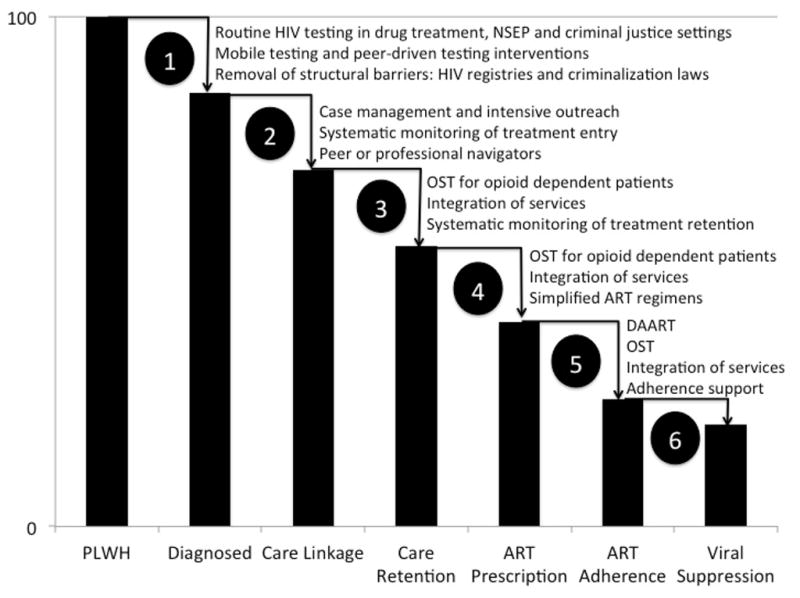
Recent findings: Improved HIV treatment outcomes can be enhanced through improved testing and linkage strategies along with better treatment retention and antiretroviral (ART) adherence. Improved ART adherence can be achieved through the provision of opioid substitution therapy (OST), directly administered ART (DAART) and integration of ART with OST services. Recent advances with direct-acting antivirals (DAAs) for hepatitis C virus (HCV) have shown superior outcomes than interferon-based regimes in HIV-HCV coinfected patients. Newer diagnostic technologies for tuberculosis (TB) hold promise for earlier diagnosis for PWUD coinfected with TB, and TB treatment outcomes are improved through combination with OST.
Summary: HIV-infected PWUDs are a key population who frequently experience suboptimal outcomes along the HIV continuum of care. A comprehensive strategy that encompasses evidence-based prevention and treatment interventions that target the individual, family, healthcare system, legal and societal structure is required to ensure greater participation and success in HIV treatment and care.
Conflict of interest statement
There are no conflicts of interest
Figures
References
-
- Joint United Nations Programme on HIV/AIDS (UNAIDS) The Gap Report. Geneva, Switzerland: 2014. [Accessed on 24 August 2014]. at: http://www.unaids.org/en/media/unaids/contentassets/documents/unaidspubl....
-
- Global State of Harm Reduction. [Accessed August 17, 2014];2012: Towards and integrated response. 2012 at http://www.ihra.net/files/2012/07/24/GlobalState2012_Web.pdf.
-
- Weber R, Huber M, Battegay M, et al. Influence of noninjecting and injecting drug use on mortality, retention in the cohort, and antiretroviral therapy, in participants in the Swiss HIV Cohort Study. HIV Med. 2014 - PubMed
-
- Baum MK, Rafie C, Lai S, Sales S, Page B, Campa A. Crack-cocaine use accelerates HIV disease progression in a cohort of HIV-positive drug users. J Acquir Immune Defic Syndr. 2009;50:93–9. - PubMed
Publication types
MeSH terms
Substances
Grants and funding
LinkOut - more resources
Full Text Sources
Medical
Research Materials
